
What Is Schema Design? A Guide for Data Architects

TL;DR:
- Schema design structures data organization, relationships, and constraints within databases to ensure performance. It involves three abstraction levels: conceptual, logical, and physical, each serving different audiences and purposes. Proper schema governance and adherence to best practices prevent technical debt, especially in distributed systems and microservices.
Schema design is the structural blueprint that defines how data is organized, related, and constrained within a database system to enable consistent and efficient data management. A database schema serves as the foundational blueprint defining tables, relationships, constraints, and data types across operational and analytical systems. Every reliable database starts with deliberate schema design. Without it, data integrity breaks down, queries slow to a crawl, and migrations become expensive guesswork. Schema design operates across three abstraction levels: conceptual, logical, and physical. Understanding all three is the starting point for any serious data architecture work.
What is schema design across the three schema levels?
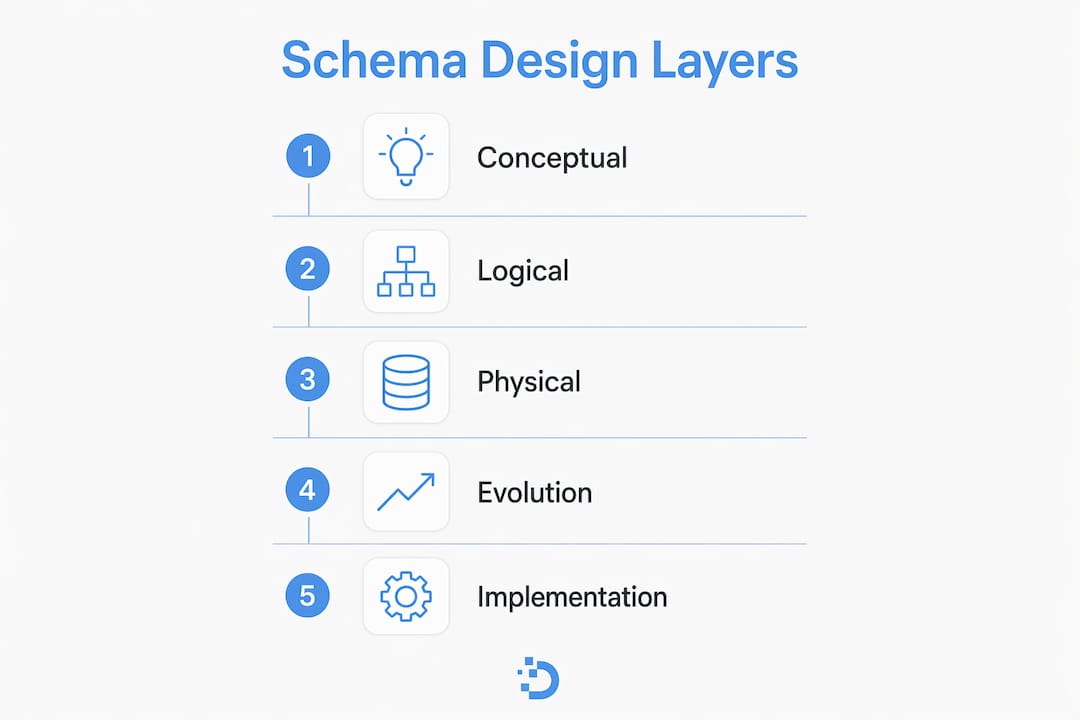
Schema design progresses from business intent to physical implementation through three distinct layers. Each layer serves a different audience and solves a different problem.

The conceptual schema is the highest-level view. It maps entities and their relationships without any reference to technology. Think of it as the business model translated into a data diagram. A conceptual schema for an e-commerce platform might define entities like Customer, Order, and Product, along with the relationships between them. This layer is built for stakeholders and product owners, not database engines.
The logical schema adds structure without committing to a specific platform. It defines tables, columns, data types, primary keys, foreign keys, and constraints. A logical schema answers the question: what does the data look like, and how does it relate? It is technology-agnostic, which makes it portable across PostgreSQL, MySQL, or any other relational system.
The physical schema is the implementation layer. It specifies indexes, partitions, storage engines, and platform-specific performance tuning. This is where a data architect makes decisions that directly affect query speed and write throughput.
| Schema level | Primary audience | Key elements |
|---|---|---|
| Conceptual | Business stakeholders | Entities, relationships, business rules |
| Logical | Data architects, developers | Tables, columns, keys, constraints, data types |
| Physical | DBAs, infrastructure teams | Indexes, partitions, storage, platform config |
These three layers support database evolution over time. Teams can update the logical schema without touching the conceptual model, or tune the physical layer without restructuring the logical design. That separation of concerns is what makes schema design for scalability achievable in practice.
What are the best practices for schema design?
Effective schema design in 2026 relies on 12 core principles, starting with an entity-relationship diagram, enforcing referential integrity, consistent naming conventions, and strategic indexing. These are not optional refinements. They are the difference between a schema that ages well and one that accumulates technical debt.
-
Start with an ERD. Draw your entity-relationship diagram before writing a single CREATE TABLE statement. An ERD surfaces missing relationships and redundant entities before they become structural problems.
-
Enforce referential integrity. Use foreign keys and database-level constraints to guarantee that relationships between tables stay valid. Application-level checks alone are not sufficient.
-
Use consistent naming conventions. Lowercase snake_case naming avoids bugs caused by case sensitivity differences across platforms and simplifies maintenance. A column named
user_idbehaves predictably on PostgreSQL, MySQL, and SQLite. A column namedUserIDdoes not. -
Normalize to reduce redundancy. Third Normal Form (3NF) is the standard target for most transactional schemas. It eliminates duplicate data and keeps updates consistent across the database.
-
Denormalize where query patterns demand it. Normalization and denormalization must balance performance needs with data consistency. Analyze your actual query patterns before adding redundant columns. Denormalize based on evidence, not assumption.
-
Index judiciously. Excessive indexing slows write operations and increases maintenance overhead. Add indexes to columns that appear in WHERE clauses, JOIN conditions, and ORDER BY expressions. Remove indexes that queries never use.
-
Document the schema inside the database. Use column comments and table descriptions. Documentation embedded in the schema travels with the database and survives team turnover.
Pro Tip: Run EXPLAIN ANALYZE on your most frequent queries before adding any index. The query plan will show you exactly where the database is doing full table scans, which is the only reliable signal that an index will help.
Why does schema design matter in distributed systems and microservices?
Schema design carries extra weight in distributed architectures. A schema is not just a database artifact. It is a contract between services requiring versioning and governance to prevent breakage in microservices. When a producer changes a field name or drops a column, every downstream consumer breaks unless that change is managed deliberately.
Schema governance in microservices depends on three practices:
- Schema registries that store and version schema definitions, so consumers can validate incoming data against a known structure before processing it.
- Version-controlled migrations that treat every schema change as application code, reviewed, tested, and deployed through the same pipeline as feature releases.
- Backward-compatible changes as the default. Adding a nullable column is safe. Dropping a column or changing a data type without a migration plan is not.
“Schema changes are not one-off tasks but continuous processes that require careful version control and testing to avoid operational issues. Automatic, version-controlled schema migrations prevent schema drift that causes environment mismatches and deployment failures.”
Modern schema design has shifted toward domain-driven approaches, aligning schemas with business boundaries and specific use cases to promote agility and maintainability. A payments service owns its schema. A user profile service owns its schema. Neither reaches directly into the other’s tables. That boundary discipline is what keeps distributed systems from becoming a tightly coupled mess.
Well-designed schemas provide organizational benefits including data integrity enforcement, improved query performance, security controls, and simplified maintenance. In distributed environments, those benefits multiply because consistency failures in one service propagate across the entire system.
How to apply schema design principles in your data architecture projects
Theory is only useful when it translates into repeatable practice. The schema design process moves from initial modeling through implementation and ongoing maintenance. Each phase has a concrete set of actions.
Pro Tip: Treat your schema as a living document from day one. Assign an owner, track changes in version control, and schedule quarterly reviews to catch drift before it becomes a migration crisis.
The practical steps that separate well-maintained schemas from ones that accumulate debt:
- Use ERD tools before creating tables. Tools like dbdiagram.io or Lucidchart let you model relationships visually and catch structural issues before they reach production.
- Apply version-controlled migrations. Tools like Flyway or Liquibase manage schema changes as versioned SQL scripts. Every environment runs the same migration history, which eliminates the “works on my machine” problem.
- Analyze query patterns before denormalizing. Pull query logs, identify the top 10 slowest queries, and denormalize only the tables those queries touch. Blanket denormalization creates consistency problems without guaranteed performance gains.
- Automate schema documentation. Tools like SchemaSpy or pgAdmin generate documentation directly from the live schema. Automated docs stay current without manual effort.
- Review the schema against evolving business requirements. A schema built for 10,000 users per day behaves differently at 10 million. Schema consistency reviews catch misalignments between the data model and actual usage before they become performance crises.
Poor schema design decisions can cause technical debt that complicates migrations and query optimization for years. The investment in getting it right upfront is always smaller than the cost of fixing it under production load.
For teams building structured data for AI training, schema discipline matters even more. A JSON-LD schema generator can help teams implement structured data consistently across large datasets, reducing manual errors in schema-driven pipelines.
Key Takeaways
Schema design is the foundational discipline that determines whether a database stays maintainable, performant, and consistent as systems and teams grow.
| Point | Details |
|---|---|
| Three schema levels | Conceptual, logical, and physical layers each serve a distinct audience and purpose. |
| Naming conventions matter | Lowercase snake_case prevents cross-platform bugs and simplifies long-term maintenance. |
| Schema as a contract | In microservices, schemas require versioning and governance to prevent breaking downstream services. |
| Normalize, then denormalize | Start with 3NF for integrity, then denormalize based on actual query analysis, not theory. |
| Migrations as code | Version-controlled schema migrations prevent drift and keep all environments consistent. |
Schema design is the discipline most teams underinvest in
I have reviewed data architectures across dozens of projects, and the pattern is consistent. Teams spend weeks debating which database engine to use and hours designing the schema. That ratio is backwards. The engine choice rarely matters as much as the structural decisions made in the first ERD session.
The normalization-versus-denormalization debate is where I see the most damage done. Architects normalize to 3NF because the textbook says to, then denormalize aggressively because queries are slow, without ever analyzing which queries are actually slow or why. The result is a schema that is neither consistent nor fast. The correct sequence is: normalize first, measure second, denormalize only where the data proves it necessary.
Schema governance in microservices is the other area where teams consistently underestimate the work. A schema registry is not optional infrastructure. It is the mechanism that keeps 15 services from breaking when one team renames a field. I have seen production outages traced directly to an undocumented schema change that propagated through three downstream consumers before anyone noticed.
The teams that treat schema design as a living discipline, with version control, ownership, and regular reviews, build systems that stay maintainable for years. The teams that treat it as a one-time setup task spend those same years fighting fires.
— Oleg
How DOT Data Labs delivers schema-consistent AI training data
Structured, schema-consistent data is the foundation of every reliable AI training pipeline. DOT Data Labs builds datasets with that discipline built in from the start.

Every dataset DOT Data Labs delivers goes through schema validation before it reaches your training infrastructure. That means consistent field names, enforced data types, and no silent nulls or type mismatches that corrupt model training. Whether you need off-the-shelf datasets ready for immediate use or a fully custom data pipeline scoped to your exact schema requirements, DOT Data Labs handles the full data supply chain. From raw collection through cleaning, labeling, and final delivery in model-ready formats, the schema stays consistent at every stage. Explore DOT Data Labs’ services to see how structured data delivery works in practice.
FAQ
What is schema design in simple terms?
Schema design is the process of defining a database’s structure, including its tables, relationships, constraints, and data types, before data is stored. It acts as the blueprint that governs how data is organized and accessed.
What are the three levels of database schema?
The three levels are conceptual (business entities and relationships), logical (tables, columns, keys, and constraints), and physical (indexes, storage, and platform-specific tuning). Each level serves a different audience and purpose in the design process.
Why is schema design important for AI training data?
A well-designed schema enforces consistent field names, data types, and relationships across a dataset. Inconsistent schemas introduce silent errors that degrade model training quality and make data pipelines unreliable.
What is the difference between normalization and denormalization?
Normalization reduces data redundancy by organizing tables to Third Normal Form (3NF). Denormalization intentionally adds redundancy to improve read performance. The right balance depends on actual query patterns, not theoretical rules.
How do you prevent schema drift in distributed systems?
Version-controlled migrations, schema registries, and backward-compatible change policies prevent schema drift. Treating every schema change as application code, reviewed and tested before deployment, keeps all environments consistent.