
What Is Schema Consistency in AI Data Pipelines?

TL;DR:
- Schema consistency ensures that data structures and constraints remain aligned across all systems and pipeline stages, preventing silent errors and model failures. Maintaining strict enforcement through tools like schema registries, versioning, and validation processes is critical for reliable AI training data. Addressing shared responsibilities and implementing proactive governance avoids schema drift, improving data quality and operational efficiency.
Schema consistency is the practice of keeping data schemas aligned across every system and pipeline stage that produces, transforms, or consumes data. In machine learning contexts, a schema defines the expected fields, data types, relationships, and constraints that training data must conform to. When that structure drifts between sources, models, or pipeline stages, the downstream consequences range from silent data corruption to outright model failure. Understanding schema consistency is the first step toward building AI pipelines that hold up under real production pressure.

What is schema consistency in data science and ML?
Schema consistency means that every system touching your data enforces the same structural rules: column names, data types, nullability constraints, and relationships all match expectations at every boundary. Relational systems use schemas as blueprints defining tables, columns, and constraints that keep data predictable and manageable. That predictability is what makes downstream queries and model training reliable.
The definition extends beyond naming. Schema rules must be preserved across system boundaries to maintain data integrity. A column named user_age that stores integers in your ingestion layer but strings in your feature store is a schema inconsistency, even though the name matches.
For ML practitioners, the practical stakes are high:
- Query reliability: Inconsistent types cause SQL joins to silently drop rows or return wrong results.
- Model accuracy: A training dataset with mixed type representations for the same feature produces noisy gradients and degraded model performance.
- Pipeline maintainability: Teams spend disproportionate time debugging data issues that consistent schema enforcement would have prevented at the source.
- Data integrity: Normalization reduces redundancy and maintains integrity, which directly supports consistent schemas in relational databases.
Pro Tip: Map every schema boundary in your pipeline before writing a single line of transformation code. Boundaries are where inconsistencies enter, and catching them on paper costs far less than catching them in a failed training run.
Schema consistency vs. schema matching vs. schema evolution
These three concepts are related but distinct. Conflating them leads to gaps in your data governance strategy.
| Concept | Definition | Primary Challenge |
|---|---|---|
| Schema Consistency | Uniform enforcement of structural rules across all systems and stages | Maintaining alignment as systems scale and data sources multiply |
| Schema Matching | Mapping corresponding attributes between two different schemas for integration | Semantic differences limit automation and require human intervention |
| Schema Evolution | Managing schema changes over time while preserving compatibility | Preventing upstream changes from breaking downstream consumers |
Schema matching is a prerequisite for integration. When you pull data from a third-party API and a relational database into a unified training dataset, schema matching identifies that cust_id in one source corresponds to customer_identifier in another. Full automation is difficult because semantic mismatches across data sources often require policy-driven validation to resolve correctly.
Schema evolution addresses what happens when a schema changes. A new field gets added, a data type gets widened, or a column gets deprecated. Managed evolution keeps those changes backward compatible so existing consumers do not break.
Schema consistency sits above both. It is the ongoing state you are trying to maintain. Matching and evolution are processes that support it. Without explicit consistency enforcement, even well-matched and carefully evolved schemas drift apart over time as teams make independent changes.
Why schema consistency is critical for AI training data
Schema inconsistencies in AI pipelines cause three categories of damage: data corruption, model quality degradation, and operational disruption. Each is costly in its own way, and all three are largely preventable.
Data corruption happens when a schema change in an upstream producer breaks a downstream consumer’s parsing logic. In event-driven architectures, this can propagate silently across thousands of records before anyone notices. Early validation reduces operational disruption by catching incompatibilities before they reach production consumers.
Model quality degradation is subtler. A feature that switches from a float to an integer representation mid-pipeline does not cause an obvious error. It causes a training dataset where the same semantic concept has two different numeric distributions. The model learns noise instead of signal.
Operational disruption compounds both problems. When a schema break surfaces in production, the debugging cycle is expensive. Engineers must trace the change back through multiple systems, identify affected records, and decide whether to reprocess or discard them.
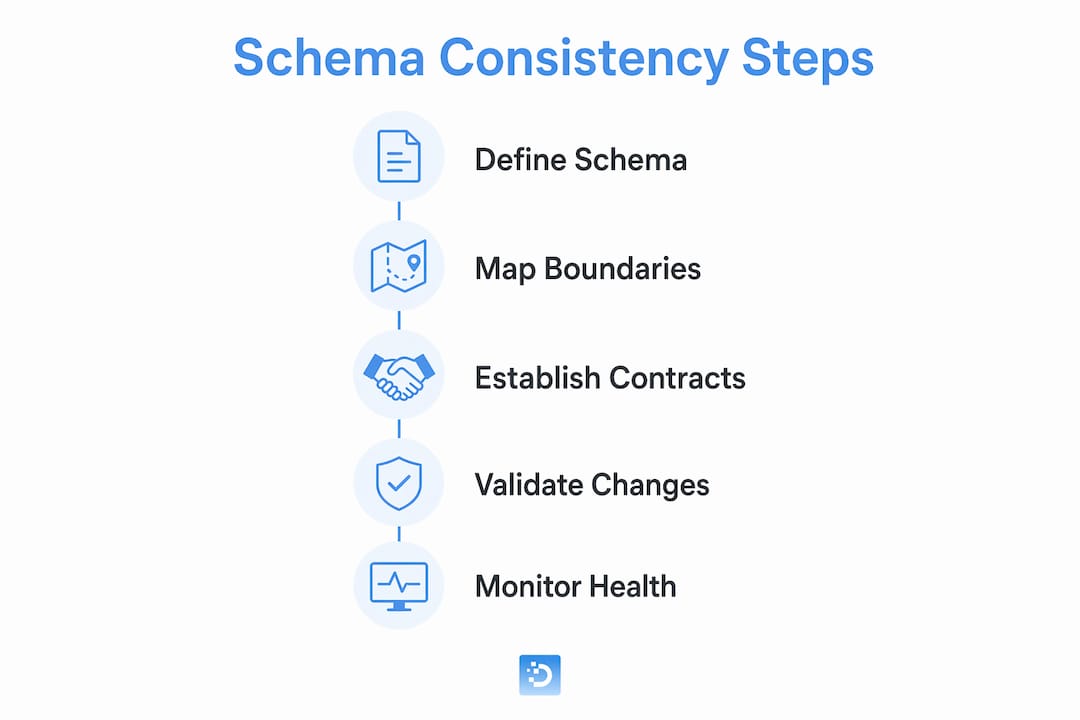
- Define schema contracts at every pipeline boundary before ingestion begins.
- Integrate schema validation into your CI/CD pipeline using tools like the Confluent Unified Schema Registry to catch breaking changes before deployment.
- Version every schema change and maintain a changelog accessible to all teams consuming the data.
- Run automated compatibility checks against downstream consumers whenever a schema update is proposed.
- Monitor schema health in production with alerting on unexpected type changes or missing fields.
“Schema consistency is not just about matching names. It is about enforcing data rules consistently across all data lifecycle boundaries.” — Aerospike
Pro Tip: Treat schema validation as a first-class citizen in your CI pipeline, not an afterthought. LinkedIn’s approach with their Universal Schema Registry validates schemas end-to-end across multiple formats before any change reaches production. That shift-left discipline is what separates teams that debug data from teams that train models.
Best practices and tools for maintaining schema consistency
Maintaining consistent schemas across complex, multi-source AI environments requires a combination of tooling, process, and governance. No single tool solves the problem alone.
Schema Registries
A schema registry is a centralized store for schema definitions and their version history. The Confluent Unified Schema Registry supports multiple serialization formats including Apache Avro, JSON Schema, and Protocol Buffers (Protobuf). Each format enforces structural constraints differently. Avro requires explicit field definitions and supports nullable types through union schemas. Protobuf uses field numbers rather than names, which makes certain evolutions safer. JSON Schema offers flexibility but requires stricter governance to prevent drift.
Versioning and Governance
Strong schema contracts define what changes are allowed and what require a major version bump. A governance policy might specify that adding a nullable field is backward compatible, while removing a field or changing a type is a breaking change requiring a new schema version and a migration plan. Without written policy, individual teams make incompatible decisions that accumulate into a consistency debt.
Validation in CI/CD
Integrating schema validation into your CI/CD pipeline catches breaking changes before they reach any environment. This is the shift-left approach. A pull request that modifies a schema triggers an automated compatibility check against all registered consumers. If the check fails, the merge is blocked.
Ongoing Monitoring
Schema health does not end at deployment. Production data drifts. Third-party sources change their APIs. New data collection runs introduce fields that were not in the original spec. Continuous monitoring with alerting on schema violations keeps your AI data pipeline healthy between releases.
For teams building scalable data schemas, the combination of a schema registry, CI-integrated validation, and a documented governance policy covers the majority of consistency risks in production AI environments.
Key takeaways
Schema consistency is the structural foundation that determines whether your AI pipeline produces reliable training data or introduces silent errors that degrade model quality.
| Point | Details |
|---|---|
| Core definition | Schema consistency enforces uniform field types, constraints, and relationships across every pipeline boundary. |
| Distinct from matching | Schema matching maps attributes between sources; consistency is the ongoing state you maintain after integration. |
| CI validation matters | Shift-left schema validation in CI/CD pipelines catches breaking changes before they corrupt training data. |
| Governance is required | Tooling alone is insufficient; written schema contracts and versioning policies prevent team-level drift. |
| Model quality depends on it | Type inconsistencies in training data introduce noise that degrades model performance without obvious error signals. |
The part most teams get wrong
Most teams I work with treat schema consistency as a data engineering problem. They assign it to whoever owns the pipeline and move on. That framing is the root cause of most schema failures I have seen in AI projects.
Schema consistency is a cross-functional contract. The team defining the data collection spec, the team building the transformation layer, and the team consuming features for model training all have to agree on the same structural rules. When those groups operate independently, schemas diverge. Not because anyone made a bad decision, but because no one was responsible for the shared definition.
The second mistake is conflating schema validity with schema consistency. A schema can be internally valid but inconsistent with the schema used three pipeline stages earlier. Validity checks confirm that a record conforms to its local schema. Consistency checks confirm that the local schema matches what every other system expects.
The fix is not more tooling. It is earlier alignment. Define your schema consistency workflow before you write ingestion code. Get sign-off from every team that will touch the data. Then automate enforcement so the agreement holds as the project scales. The teams that do this spend their time training models. The teams that skip it spend their time debugging pipelines.
— Oleg
How DOT data labs delivers schema-consistent training data
Schema inconsistencies in training data are one of the most common reasons AI projects stall before a model reaches production. DOT Data Labs builds datasets with schema alignment enforced from collection through delivery, so your team receives data that conforms to your exact structural specifications.

Every project starts with a schema contract scoped to your pipeline’s requirements. DOT Data Labs handles sourcing, cleaning, labeling, and validation against that contract before delivery. Whether you need off-the-shelf datasets ready for immediate use or a fully custom build with ongoing pipeline delivery, the output arrives in model-ready formats with documented schema versions. Explore DOT Data Labs’ full services to see how schema-aligned data delivery works in practice.
FAQ
What is the schema consistency definition?
Schema consistency is the practice of maintaining aligned structural rules, including field names, data types, and constraints, across all systems and stages that handle a dataset. It ensures data remains predictable and structurally reliable throughout its lifecycle.
How does schema consistency differ from schema validity?
Schema validity confirms that a single record conforms to its local schema definition. Schema consistency confirms that the local schema matches the structural expectations of every other system in the pipeline.
What tools enforce schema consistency in streaming pipelines?
The Confluent Unified Schema Registry is a widely used tool that validates schemas across multiple formats including Avro, JSON Schema, and Protobuf, and integrates compatibility checks directly into CI pipelines.
What affects schema consistency in AI projects?
The primary factors are independent schema changes by different teams, lack of versioning policies, absent CI-integrated validation, and semantic mismatches between data sources that automated matching cannot resolve without human review.
Why does schema consistency matter for model training?
Inconsistent schemas introduce type mismatches and structural noise into training data. That noise degrades model performance in ways that are difficult to diagnose because they do not produce obvious errors during training.