
Field Standardization Steps for AI Dataset Quality
TL;DR:
- Field standardization converts inconsistent dataset fields into structured, uniform formats to improve data quality and AI accuracy. It requires thorough auditing, stakeholder alignment, and maintaining a data dictionary, with continuous governance to sustain results over time. Teams that skip proper validation, stakeholder consensus, or regular audits risk data degradation and broken dependencies.
Field standardization steps are the procedures that convert inconsistent dataset fields into structured, uniform formats to improve data quality and AI model accuracy. Without them, models trained on messy inputs produce unreliable outputs, regardless of architecture quality. The industry term for this practice is data normalization and schema governance, and it covers everything from defining controlled field types to enforcing validation rules across your pipeline. Teams that treat field standardization as a one-time cleanup consistently see quality degrade within months.
What do you need before starting field standardization?
Preparation determines whether your standardization effort sticks or collapses under its own scope. Three things must be in place before you write a single validation rule.

Data samples and audit tools. Export a sample of 1,000 records per key object to calculate field completion and consistency rates. That sample size gives you a statistically meaningful baseline without requiring a full database scan. Pair it with a profiling tool, such as a Python pandas script or a SQL query, that counts null rates, value distributions, and duplicate entries per field.
Stakeholder alignment. Identify the business owner for each field you plan to standardize. A field labeled “industry” means something different to a sales team than to a data science team. Get written agreement on the canonical definition before touching the data.
A data dictionary. This document is the single source of truth for every field: its name, data type, allowed values, owner, and update frequency. Without it, standardization decisions live in someone’s head and disappear when they leave.
Pro Tip: Start your data dictionary in a shared spreadsheet before migrating it to a formal catalog tool. Speed of adoption matters more than tooling sophistication at the start.
| Prerequisite | What to prepare |
|---|---|
| Data sample | 1,000-record export per key object |
| Stakeholder map | Named owner per field with sign-off |
| Data dictionary | Field name, type, allowed values, owner |
| Validation tooling | Input controls, required-field enforcement |
What are the field standardization steps for AI training data?
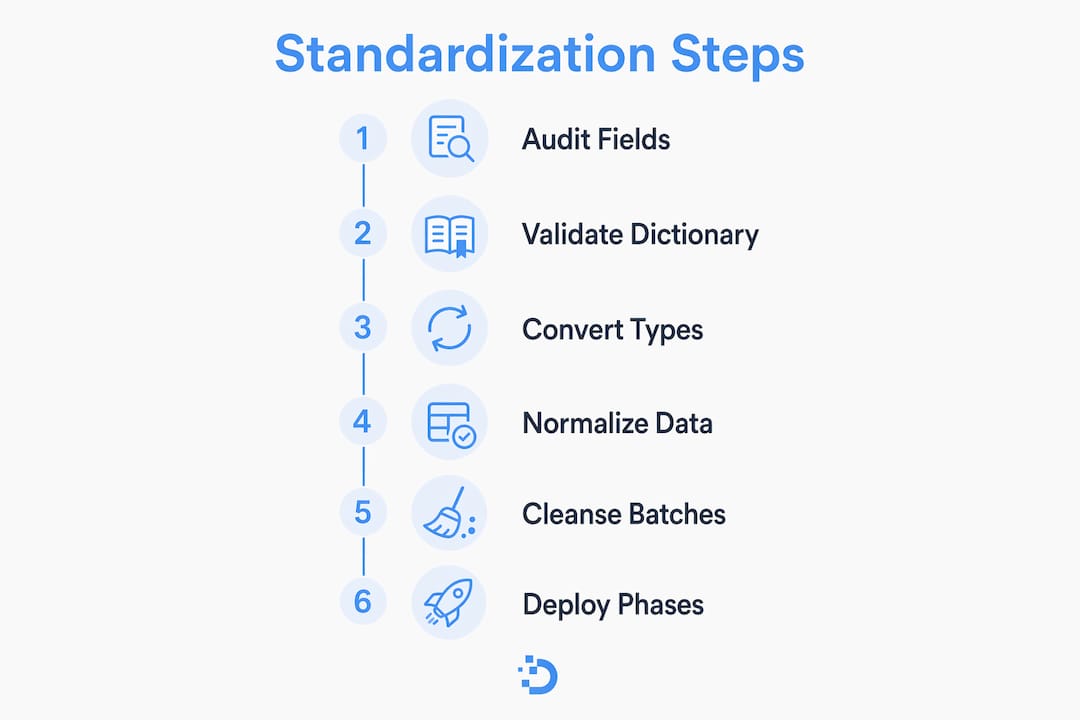
The standardization process runs in six sequential steps. Skipping any one of them creates gaps that compound downstream.
1. Audit your fields. Pull your 1,000-record sample and score each field on two metrics: completion rate (percentage of non-null values) and consistency rate (percentage of values matching an expected format). Focus only on 5–7 critical fields per object. Attempting to standardize every field simultaneously leads to inefficiency and data chaos.
2. Build and validate your data dictionary. For each critical field, document the canonical name, data type, allowed values, and the business rule that governs it. Circulate the draft to stakeholders and get explicit sign-off. This document becomes the legal contract between your data team and every downstream consumer, including your model training pipeline.
3. Convert free-text fields to controlled types. Free-text fields block reliable aggregation and make AI feature engineering nearly impossible. Replace them with picklists, enums, or boolean flags wherever the field captures a categorical concept. Picklists should contain between 4 and 8 mutually exclusive values to maintain usability without creating ambiguity.
4. Apply normalization before validation. Normalization must precede validation because raw inconsistent data will fail schema checks even when the underlying intent is correct. Normalize casing, strip whitespace, resolve abbreviations, and align date formats first. Then apply your validation schema. Teams that reverse this order waste cycles debugging false validation failures. For a deeper look at this sequence, the DOT Data Labs guide on programmatic data normalization covers the technical implementation in detail.
5. Execute data cleansing in batches. Run your cleansing scripts on one object at a time, not the full dataset. Batch processing limits blast radius if a transformation rule has an error. Log every change with a before/after record so you can audit the transformation history. This log also serves as the “evidence of intent” that SOPs require for compliance and audit readiness.
6. Deploy in phases and set KPIs. A successful rollout for a mid-sized team completes within one week, starting with core fields and ending with company-wide deployment and monitoring. Define your KPIs before go-live: field completion rate, consistency rate, and model feature coverage. Track them weekly for the first month.
Pro Tip: Use a staging environment to run your full cleansing pipeline before touching production data. A single bad transformation rule on a live dataset can corrupt months of labeled training examples.
The table below shows how controlled field types compare to free-text inputs across the metrics that matter most for AI training data.
| Metric | Free-text fields | Controlled picklists |
|---|---|---|
| Aggregation reliability | Low | High |
| Feature engineering effort | High | Low |
| Null rate detection | Difficult | Straightforward |
| Model input consistency | Inconsistent | Consistent |
What mistakes break field standardization efforts?
The most common failure mode is scope creep. Teams that try to standardize every field at once produce partial results across many fields instead of complete results on a few. Limit your standardization scope to 5–7 critical fields per sprint and expand only after those fields are stable.
The second most common mistake is deleting deprecated fields. Archiving deprecated fields instead of deleting them prevents broken dependencies and preserves data history for model auditing and retraining. Deletion feels clean but routinely breaks downstream pipelines in ways that take days to diagnose.
A third pitfall is treating standardization as a project with an end date. Field hygiene requires recurring audits to prevent quality degradation over time. Teams that close the ticket after the initial rollout find their data back in disarray within two quarters.
- Limit scope to 5–7 fields per sprint
- Archive deprecated fields; never delete them without a full dependency audit
- Write validation error messages in plain language so data entry teams understand the rule
- Keep picklists to 4–8 values; longer lists generate inconsistent selections
- Schedule a review within 30 days of go-live to catch edge cases your initial audit missed
Pro Tip: Validation rules without clear error messages create silent failures. Write messages that tell the user exactly what format is expected, not just that the input is wrong.
How do you sustain field standardization quality over time?
Governance is what separates a one-time cleanup from a durable data quality program. Without it, schema sprawl returns within months.
Assign one field owner per object who controls schema changes. That person approves new fields, manages deprecations, and signs off on any changes to allowed values. A single decision-maker eliminates the ambiguity that causes competing definitions to proliferate. For teams building out their schema governance from scratch, the DOT Data Labs schema design guide covers role structures and approval workflows in detail.
Set quarterly audits with two core metrics: field population rate and value consistency rate. Run these audits against the same 1,000-record sample methodology you used at baseline so results are comparable over time. Dashboards that surface these metrics weekly keep the team honest between formal audits.
- Assign one named field owner per object with schema change authority
- Run quarterly audits measuring population rate and consistency rate
- Maintain a formal field request process: any new field requires a business case and data dictionary entry before creation
- Communicate schema changes to all downstream consumers, including model training teams, before deployment
- Treat your data dictionary as a living document with a version history
SOPs serve as the documented evidence of intent that auditors and compliance teams require. Write them for every recurring governance task, not just the initial rollout. Blueprint AI’s guide on database schema design offers a useful structural reference for teams formalizing their field governance documentation.
Key Takeaways
Effective field standardization requires limiting scope, normalizing before validating, and treating governance as an ongoing program rather than a one-time project.
| Point | Details |
|---|---|
| Start with 5–7 fields | Limit initial scope to critical fields to produce measurable results without creating chaos. |
| Normalize before validating | Stabilize raw data formats first so validation rules produce accurate results. |
| Archive, never delete | Deprecated fields should be archived to protect downstream pipelines and model audit trails. |
| Assign one field owner | A single decision-maker per object prevents schema sprawl and conflicting definitions. |
| Audit quarterly | Schedule recurring reviews with population and consistency metrics to sustain data quality. |
The part most teams skip until it’s too late
The technical steps in field standardization are not the hard part. The hard part is getting stakeholders to agree on what a field means before you lock it down.
I have seen teams spend weeks building picklists and validation rules, only to discover that two business units use the same field to capture completely different concepts. The data dictionary review gets rushed or skipped because it feels like admin work. It is not. It is the only step that prevents you from standardizing the wrong thing at scale.
The other thing I would push back on is the instinct to automate everything immediately. Programmatic normalization is powerful, but running it on fields you do not fully understand yet produces clean-looking data with wrong values. Start with a manual review of your 1,000-record sample. Understand the mess before you write the script that fixes it.
Free-text fields are the single biggest source of AI training data problems I encounter. Teams know they are bad. They keep them anyway because converting them requires a stakeholder conversation nobody wants to have. That conversation is worth having. A model trained on a field with 400 unique free-text values for what should be a 6-value picklist will learn noise, not signal.
Treat your data governance program the way you treat your model monitoring program: never finished, always improving.
— Oleg
DOT Data Labs and your standardization pipeline
Field standardization is only as durable as the data flowing into your pipeline. If your source data arrives inconsistent, no amount of governance will keep your training sets clean.

DOT Data Labs delivers AI training datasets that are sourced, cleaned, and structured to your exact field specifications before they reach your team. Whether you need a one-off custom dataset built to a defined schema or an ongoing data pipeline that continuously feeds standardized, labeled data into your training infrastructure, DOT Data Labs handles the full supply chain. Recent projects include a 32 million science Q&A dataset delivered in under 30 days and 50,000 hours of talking-head video with aligned subtitles. Your team defines the fields. DOT Data Labs delivers the data that fits them.
FAQ
What are field standardization steps in AI datasets?
Field standardization steps are the sequential procedures used to convert inconsistent dataset fields into uniform, structured formats. The core steps are: audit fields, define a data dictionary, convert free-text to controlled types, normalize, validate, cleanse in batches, and deploy with monitoring.
How many fields should I standardize at once?
Limit each standardization sprint to 5–7 critical fields. Attempting to standardize more simultaneously produces incomplete results and increases the risk of errors across your dataset.
Should I delete deprecated fields during cleanup?
No. Archive deprecated fields rather than deleting them. Deletion breaks downstream dependencies and removes data history needed for model auditing and retraining.
How often should I audit standardized fields?
Run formal audits quarterly, measuring field population rate and value consistency rate against your original baseline sample. Weekly dashboard monitoring keeps quality visible between audits.
What is the difference between normalization and validation in field standardization?
Normalization stabilizes raw inconsistent data first, such as fixing casing and date formats. Validation then checks the normalized data against your schema rules. Running validation before normalization produces false failures on data that is structurally correct but inconsistently formatted.
Recommended
- Machine-Ready Dataset Guide: Build Optimized AI Training Sets | DOT Data Labs Blog
- How to Format Training-Ready Data for AI Fine-Tuning | DOT Data Labs Blog
- Why Field Standardization Matters for AI Data Quality | DOT Data Labs Blog
- Custom dataset production checklist to boost AI accuracy | DOT Data Labs Blog