
Validation Data for ML Teams: A 2026 Practitioner’s Guide

TL;DR:
- Validation data provides an independent, representative subset to tune hyperparameters and prevent overfitting. It should constitute 15-20% of data and be strictly separated from training and test sets. Proper practices include stratified sampling, fitting preprocessing on training data only, and refreshing validation splits regularly to maintain unbiased evaluation.
Validation data is defined as an independent subset of your dataset used during model development to tune hyperparameters, detect overfitting, and guide model selection without touching the final test set. It sits between your training data and your test data in the standard three-way split, and its independence from both is what makes it useful. Industry-standard splits follow either a 60/20/20 or 70/15/15 ratio for training, validation, and test sets. That means your validation set typically represents 15–20% of your total data. DOT Data Labs structures every custom dataset delivery around these splits to protect the integrity of the final evaluation from the start.
Why validation data is critical for tuning and avoiding overfitting
Validation data acts as a real-time feedback signal during training. When your model’s training accuracy keeps climbing while validation accuracy plateaus or drops, that divergence is the clearest signal of overfitting you have. Without a separate validation set, you would not catch this until you hit the test set, at which point it is too late to adjust.
The practical uses of a validation set during model development include:
- Hyperparameter tuning. Learning rate, regularization strength, and model depth are all selected based on validation performance, not training performance.
- Early stopping. Training halts when validation loss stops improving, preventing the model from memorizing noise in the training data.
- Model selection. When comparing architectures or feature sets, the validation set provides the comparison metric.
- Checkpoint selection. The model weights saved at the best validation epoch are used for final evaluation, not the weights from the last epoch.
The risk most teams underestimate is what happens when you reuse the same validation set across dozens of tuning iterations. Each iteration leaks information that gradually biases your validation results. The set loses its objectivity. Your reported validation metrics start to look better than your actual generalization performance.
Pro Tip: Track how many hyperparameter decisions you have made against a single validation set. Once that number exceeds 20–30 iterations on a small dataset, consider rotating in a fresh validation split or switching to k-fold cross-validation.

The role of datasets in model success extends well beyond raw size. A validation set that is too small, stale, or contaminated by preprocessing leakage will give you false confidence at exactly the wrong moment.
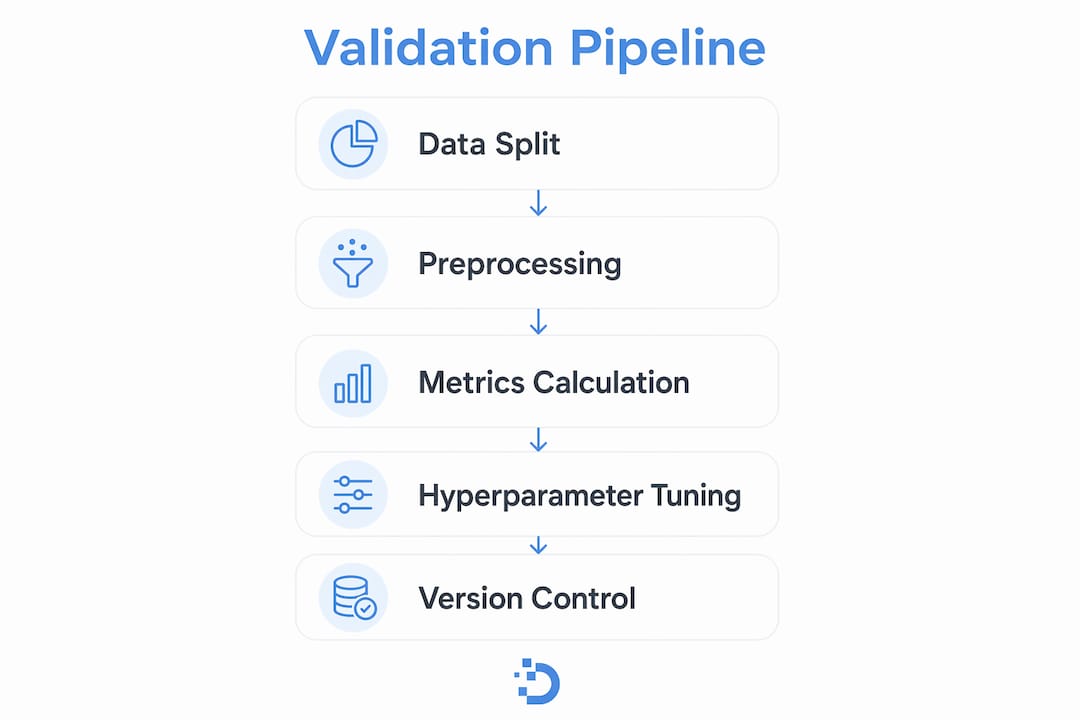
How to create and maintain high-quality validation datasets
Getting the split right is the foundation of honest model evaluation. The steps below reflect current best practices for building validation sets that stay reliable across the full development cycle.
-
Apply stratified sampling for imbalanced classes. A random split on an imbalanced dataset can produce a validation set where rare classes are underrepresented or absent entirely. Stratified splits preserve the original class distribution, so your validation metrics reflect real-world performance rather than sampling luck.
-
Fit preprocessing on training data only. Scalers, encoders, and imputers must be fit exclusively on training data statistics. Apply those fitted transforms to the validation and test sets independently. Fitting on the full dataset before splitting is one of the most common sources of data leakage in production pipelines. The DOT Data Labs blog on data preprocessing covers this in detail.
-
Use temporal splits for time-series data. Random splits on sequential data allow future information to leak into the past. Always split chronologically, with the validation window sitting after the training window and before the test window.
-
Rotate or refresh validation sets in iterative projects. When a project runs for weeks or months with continuous tuning, the original validation set becomes progressively less objective. Collecting or designating a new validation split at defined intervals preserves its value as an unbiased estimator.
-
Keep validation and test sets strictly separate. Using test data for tuning corrupts the final evaluation. The test set must remain unseen until the model is fully finalized. Validation handles all interim decisions.
-
Use k-fold cross-validation when data is limited. K-fold cross-validation reduces variance in error estimates and makes better use of small datasets. A separate held-out test set is still required even when using k-fold.
What metrics and frameworks do modern validation pipelines use?
Modern validation goes well beyond a single accuracy number. The most informative validation frameworks operate at the sample level, comparing predicted outputs against ground truth row by row. Automated frameworks use unique identifiers per sample to make these comparisons traceable and reproducible across runs.
The table below summarizes the core metrics used in structured validation tasks:
| Metric | What it measures | Best used for |
|---|---|---|
| Accuracy | Correct predictions as a share of total | Balanced class distributions |
| Precision | True positives out of all positive predictions | Minimizing false positives |
| Recall | True positives out of all actual positives | Minimizing false negatives |
| F1 score | Harmonic mean of precision and recall | Imbalanced classes, general use |
| F2 score | Recall-weighted F score | High recall priority tasks |
| Specificity | True negatives out of all actual negatives | Medical or safety-critical tasks |
Confidence intervals via bootstrap resampling quantify uncertainty in these metrics reliably. A model that scores 0.87 F1 with a narrow confidence interval is a fundamentally different result from one that scores 0.87 with a wide interval. The interval tells you how much to trust the number.
For LLM validation and medical imaging datasets, partial labeling support matters. Not every sample in a validation set will have complete ground truth. Modern frameworks handle missing or partial labels without discarding those samples entirely, which preserves statistical power on expensive labeled datasets. In regulated industries, HIPAA-compliant AI deployment adds an additional layer of requirements around how validation outputs are stored and audited.
Pro Tip: Always log the exact validation set version, preprocessing pipeline version, and model checkpoint together. Reproducing a validation result six months later is impossible without all three.
Common pitfalls that undermine validation data integrity
Most validation failures are not caused by bad models. They are caused by subtle process errors that corrupt the feedback signal before training even finishes.
- Implicit validation set peeking. Manually inspecting validation errors and then adjusting the model or features based on what you see is a form of leakage. The model has not seen the data, but you have, and your decisions are shaped by it.
- Preprocessing leakage. Fitting normalization or encoding on the full dataset before splitting is the single most common source of inflated validation scores in production ML work.
- Overly small validation sets. A validation set with fewer than a few hundred samples produces noisy metric estimates. Small shifts in a handful of predictions swing accuracy by several percentage points, making model comparisons unreliable.
- Distribution shift between splits. Validation and test data must come from the same underlying distribution as training data. A validation set drawn from a different time period, geography, or collection method will give you misleading performance estimates.
- Treating validation metrics as final results. Validation performance is a development tool, not a publication number. The test set produces the result you report.
The fix for most of these issues is process discipline, not better algorithms. Locking down your data pipeline before training starts, using iterative model tuning practices that respect split boundaries, and documenting every preprocessing decision eliminates the majority of validation integrity problems.
Key Takeaways
Validation data is the primary feedback mechanism in model development, and its integrity determines whether your tuning decisions reflect real generalization or measurement error.
| Point | Details |
|---|---|
| Standard split ratios | Use 60/20/20 or 70/15/15 splits; validation sets should represent 15–20% of total data. |
| Stratified sampling | Always stratify splits on imbalanced datasets to maintain representative class distributions. |
| Preprocessing discipline | Fit all scalers and encoders on training data only, then apply to validation and test sets. |
| Rotation prevents bias | Refresh validation sets after many tuning iterations to preserve their objectivity. |
| Metrics need context | Pair every metric with a confidence interval to understand how much to trust the result. |
Why I think most teams treat validation data as an afterthought
I have seen ML teams spend months on architecture search and feature engineering while treating their validation split as a one-time decision made in the first week of a project. That is backwards. The validation set is the instrument you use to measure everything else. If the instrument is compromised, every reading it gives you is wrong.
The most reliable teams I have worked with treat their validation set as a living benchmark. They version it, they track how many tuning decisions have been made against it, and they rotate it on a schedule rather than waiting for results to look suspicious. They also keep a hard wall between validation and test. Not a soft guideline. A hard wall, enforced in the pipeline.
The other thing worth saying directly: quality validation data requires quality labels. A validation set with noisy or inconsistent ground truth will give you misleading metrics even if your split methodology is perfect. Investing in accurate annotation for your validation set pays back more than the same investment in additional training samples, because it sharpens the instrument you use to make every other decision.
Treat validation data strategy as a first-class engineering concern, not a preprocessing step you configure once and forget.
— Oleg
How DOT Data Labs supports high-quality validation dataset creation
Building a reliable validation set requires more than a random split. It requires clean source data, accurate labels, and a pipeline that respects split boundaries from the start.

DOT Data Labs delivers custom labeled datasets built to your exact specifications, including validation-ready splits with stratified sampling and documented preprocessing pipelines. The team handles the full data supply chain, from sourcing and collection through annotation and quality checks, so your validation set arrives with the ground truth accuracy your metrics depend on. For teams running continuous model development, ongoing data pipelines keep validation sets fresh without manual intervention. Visit dotdatalabs.ai to discuss your dataset requirements directly with the team.
FAQ
What is validation data in machine learning?
Validation data is an independent dataset subset used during model development to tune hyperparameters and detect overfitting. It sits between the training set and the test set in the standard three-way split.
What is the standard validation set size?
Industry practice sets validation sets at 15–20% of total data, following either a 60/20/20 or 70/15/15 split for training, validation, and test sets.
How does validation data differ from test data?
Validation data guides development decisions like hyperparameter tuning and early stopping. Test data is reserved for a single final evaluation after all development decisions are complete.
What causes data leakage in validation sets?
The most common cause is fitting preprocessing transforms on the full dataset before splitting. Scalers and encoders must be fit on training data only, then applied to validation and test sets separately.
When should you use k-fold cross-validation instead of a fixed split?
K-fold cross-validation works best when your total dataset is small and a fixed 20% validation split would produce noisy metric estimates. A separate held-out test set is still required alongside k-fold.