
Dataset Validation: Best Practices for ML Engineers
TL;DR:
- Dataset validation verifies data integrity and suitability before training machine learning models. It includes schema, semantic, relational, and provenance checks to prevent costly errors. Automating validation with contracts and audits helps maintain pipeline stability and improves model performance.
Dataset validation is the systematic process of verifying data integrity, structure, and suitability before using it to train machine learning models. Without it, errors in your training data propagate silently into model behavior, producing failures that are expensive to diagnose and even more expensive to fix. Industry frameworks like the VIDS-standard enforce 21 machine-verifiable rules covering annotation provenance, structure, and ML readiness. That level of rigor exists because schema checks alone are not enough. Effective dataset validation layers schema verification, semantic checks, relational consistency, and provenance audits into a single quality gate.
What are the key types of dataset validation for ML pipelines?
Validation is more than syntax. It includes semantic and relational checks that verify internal consistency and real-world applicability. ML teams that skip these layers train on data that looks clean but behaves badly.
The four core validation types are:
- Schema and format validation. Checks data types, column presence, null rates, and value ranges. A feature column typed as string when it should be float will silently break downstream transformations.
- Semantic validation. Confirms that values are plausible for the domain, not just syntactically correct. A patient age of 312 passes a type check but fails a domain sanity check. Semantic validation is critical but routinely neglected.
- Relational consistency validation. Cross-checks related fields for logical coherence. Delivery dates preceding order dates are a classic example of errors that isolated field checks miss entirely.
- Provenance and metadata validation. Confirms data lineage, annotator credentials, and quality control records. The VIDS-standard requires annotator identity and QC metadata as mandatory fields, not optional ones.
Pro Tip: Cross-field consistency checks are the most overlooked validation step. Always verify that related columns make logical sense together, not just individually.
How to implement automated dataset validation

Automation turns one-time audits into continuous quality assurance. Great Expectations automates checks like no nulls in critical columns, regex pattern matching, range enforcement, and uniqueness, all integrated directly into data pipelines. The framework uses “expectation suites,” which are versioned contracts that define what valid data looks like for a specific dataset.
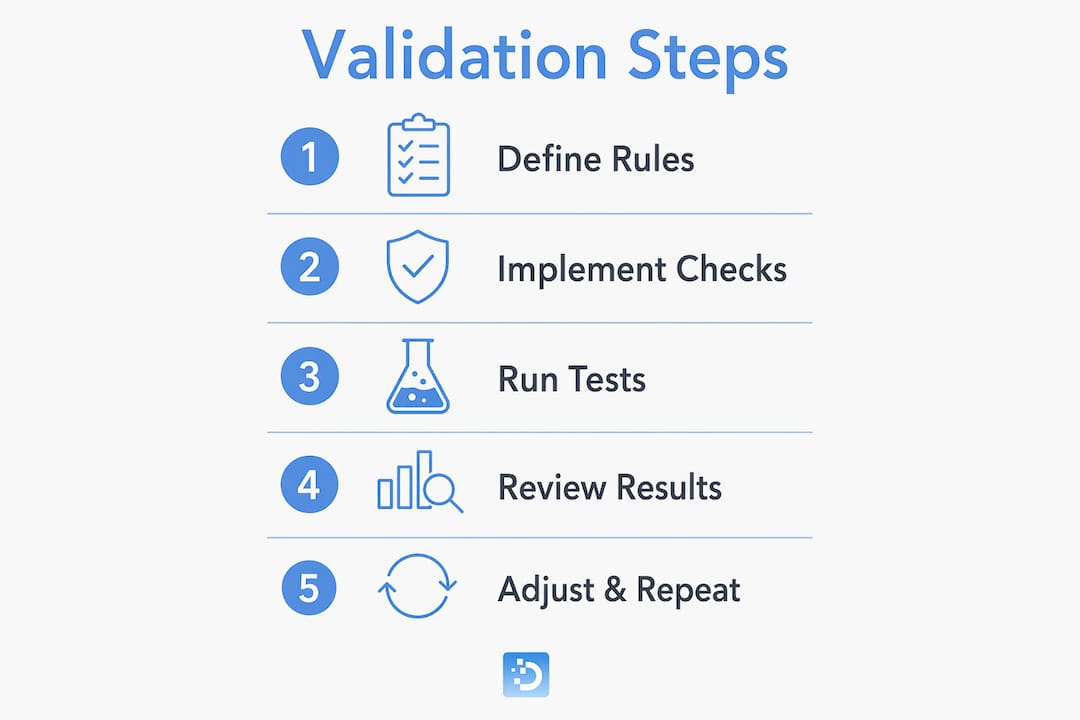
A practical implementation follows this sequence:
- Define a validation contract. Specify column types, null rules, accepted value ranges, and uniqueness constraints before writing any pipeline code.
- Write expectation suites. Translate the contract into executable rules using a framework like Great Expectations or vids-validator.
- Run validation on ingestion. Trigger checks every time new data enters the pipeline, not just during initial setup.
- Integrate into CI/CD. Add validation as a pipeline stage so that a failed check blocks downstream training jobs automatically.
- Schedule nightly audits. Run full suite checks on accumulated data to catch drift that point-in-time checks miss.
Pro Tip: Start with five to ten non-negotiable rules rather than trying to validate everything at once. A focused contract that runs reliably beats an exhaustive one that teams disable because it generates too many false positives.
The table below maps common validation rules to their implementation method and the error class they catch.
| Validation rule | Implementation method | Error class caught |
|---|---|---|
| No nulls in primary keys | Great Expectations expect_column_values_to_not_be_null | Missing identity fields |
| Regex on email columns | Pattern match expectation | Malformed input data |
| Date range enforcement | Min/max value constraint | Out-of-distribution timestamps |
| Uniqueness on record IDs | expect_column_values_to_be_unique | Duplicate records |
| Referential integrity | Cross-table join check | Orphaned foreign keys |
Effective validation requires layering database constraints with programmatic validation to catch diverse error types at different pipeline stages. No single tool covers every failure mode.
Which dataset validation checks should you run first?
A 10-point audit checklist addressing nulls in primary keys, date ranges, duplicates, and referential integrity is the minimum before trusting any dataset for ML training. These checks catch issues that traditional model metrics often overlook until training is already underway.
Run these audits in order of impact:
- Null check on primary keys. A null primary key means the record cannot be reliably joined or referenced. Fix this before anything else.
- Duplicate record detection. Duplicates inflate class frequencies and bias model learning. Check for exact and near-duplicate rows.
- Date range plausibility. Flag records with dates outside the expected collection window. A 2019 timestamp in a 2025 dataset warrants investigation.
- Categorical value consistency. Confirm that categorical columns contain only expected labels. “Male,” “male,” and “M” are three representations of the same value and will be treated as three separate classes.
- Referential integrity. Every foreign key should resolve to an existing primary key in the referenced table. Orphaned records introduce noise.
- Class distribution check. Severe imbalance in label distribution is a data quality problem, not just a modeling problem. Catch it here.
- Feature range validation. Flag values outside statistically plausible bounds for each numeric feature.
- Cross-field logical consistency. Check that related fields agree. Start date must precede end date. Purchase amount must be positive if payment status is “completed.”
- Label quality spot check. Sample labeled records manually or use automated label error detection combined with feature audits to catch mislabeled examples.
- Metadata completeness. Confirm that provenance fields, annotator IDs, and collection timestamps are present and populated.
You can use a structured audit checklist to run these checks systematically across new datasets before they enter your pipeline.
How does dataset validation protect model training and pipeline stability?
Poor validation creates two categories of damage: immediate training failures and slow-burn degradation. The immediate failures are easier to catch. The slow-burn problems, where a model trains successfully but on subtly wrong data, are far more costly.
Contract validation using versioned data contracts prevents breaking changes in upstream data sources from silently degrading pipeline stability. Defining column types, null rules, and value ranges formally gives the pipeline a mechanism to reject bad data before it reaches training. Without this, upstream schema changes cause model performance to erode over weeks before anyone notices.
Early detection of data drift and contract violations using formal data contracts is critical for maintaining pipeline and model performance over time. This is especially true in production environments where upstream data sources change without notice.
In regulated domains, the stakes are higher. Datasets in high-risk applications must include metadata on annotator credentials and QC processes as part of validation. Statistical checks alone are insufficient for regulatory acceptance. Healthcare, finance, and automotive AI teams face this requirement directly. DOT Data Labs builds provenance metadata and QC records into every delivered dataset to meet these standards.
Pro Tip: Do not treat validation rigor and operational efficiency as opposites. A well-scoped contract with 10 enforced rules runs faster and catches more real errors than a 100-rule suite that teams learn to override.
Key Takeaways
Dataset validation is the single most effective control point for preventing silent data errors from degrading model performance and pipeline reliability.
| Point | Details |
|---|---|
| Layer your validation types | Schema, semantic, relational, and provenance checks each catch different error classes. |
| Automate with contracts | Use Great Expectations or versioned data contracts to enforce rules on every pipeline run. |
| Run the 10-point audit first | Check nulls, duplicates, date ranges, and referential integrity before any model training begins. |
| Catch drift early | Formal data contracts detect upstream schema changes before they silently degrade model performance. |
| Provenance matters in regulated domains | Annotator credentials and QC metadata are required for validation in healthcare, finance, and automotive AI. |
Why most teams underinvest in validation until it’s too late
Teams consistently underestimate validation until a model ships with a defect that traces back to a data error caught by a check they skipped. I have seen this pattern repeatedly. A schema check passes, the pipeline runs, training completes, and the model underperforms in production. The root cause is almost always a semantic or relational error that no one thought to test.
The most common mistake is treating schema validation as the finish line. It is the starting point. A dataset can be perfectly typed and still be semantically wrong for the task. Age values in a medical dataset that cluster suspiciously around round numbers, or a sentiment label distribution that does not match the source domain, will not trigger a schema error. They require domain-specific sanity checks that most teams never write.
My practical advice: build validation into your team’s workflow the same way you build tests into software. Treat a missing validation contract as a bug, not an oversight. The teams that do this consistently spend less time debugging mysterious model failures and more time shipping reliable systems.
— Oleg
How DOT Data Labs handles validation for production-ready datasets
Validation is built into every dataset DOT Data Labs delivers, not added as an afterthought. The team applies schema, semantic, relational, and provenance checks across the full data supply chain, from raw collection through to final model-ready output.
DOT Data Labs has delivered projects including a 32 million science Q&A dataset in under 30 days and 50,000 hours of labeled video with aligned subtitles, each passing multi-layer quality checks before delivery. Whether you need off-the-shelf validated datasets or a fully custom build scoped to your specifications, the team handles sourcing, cleaning, labeling, and validation without requiring you to manage multiple vendors. Visit dotdatalabs.ai to discuss your dataset requirements with the team.
FAQ
What is dataset validation in machine learning?
Dataset validation is the process of verifying that training data meets defined quality standards for structure, completeness, consistency, and domain suitability before model training begins. It includes schema checks, semantic audits, and relational consistency verification.
What is the difference between schema validation and semantic validation?
Schema validation checks data types, null rates, and column structure. Semantic validation checks whether values are plausible and meaningful for the target domain, catching errors that pass format checks but would mislead a trained model.
How does Great Expectations support automated validation?
Great Expectations automates checks like null enforcement, regex matching, range constraints, and uniqueness rules, and integrates directly into CI/CD pipelines to block training jobs when data fails validation.
What are data contracts and why do they matter?
Data contracts are versioned agreements that formally define column types, null rules, and value ranges for a dataset. They prevent upstream schema changes from silently degrading pipeline stability and model performance over time.
Which validation checks should I run before trusting a new dataset?
Run null checks on primary keys, duplicate detection, date range plausibility, categorical consistency, referential integrity, and a label quality spot check as your first 10 audits before any training begins.