
What Is an AI Optimization Layer? A 2026 Guide
TL;DR:
- An AI optimization layer manages inference speed, costs, and system reliability without altering trained models. It employs techniques like quantization, batching, and caching to improve performance and reduce expenses at scale. Most teams overlook its importance, risking inefficiency and unpredictable costs in production.
An AI optimization layer is a dedicated architectural component that manages inference efficiency, operational costs, and system reliability in production AI, separate from model training. The term maps to what production engineers formally call the inference optimization and cost governance layer within modern AI stacks. Modern production AI architectures implement an 8-layer framework where this layer handles system performance and real-world reliability, distinct from anything that happens during training. Understanding this distinction is the foundation for building AI systems that actually hold up under production traffic.
What is an AI optimization layer and what does it do?
An AI optimization layer sits between your model and your users, managing how inference requests are processed, priced, and protected. It does not change model weights. It does not retrain anything. Its job is to make the model you already have run faster, cheaper, and more reliably at scale.
The layer covers four operational domains:
- Inference management: Controls request batching, latency targets, and throughput scheduling so the model handles concurrent requests without degrading.
- Cost governance: Tracks token usage, agent execution costs, and infrastructure spend in real time. Centralized cost control addresses inference costs, infrastructure, agent execution, and operational overhead as distinct budget categories.
- Reliability guards: Handles traffic spikes, enforces fallback logic, and maintains compliance with rate limits and data handling rules.
- Observability integration: Feeds performance signals into adjacent layers, including the governance and monitoring layers that complete the 8-layer production stack.
The optimization layer is not a feature you bolt on after launch. It is an architectural position with defined responsibilities.
Pro Tip: If your team is still treating inference optimization as a deployment checklist item rather than a persistent system layer, you will hit cost spikes and latency regressions the moment traffic scales.

Which AI optimization techniques improve inference performance?
Inference optimization techniques fall into two categories: model compression and runtime efficiency. Both reduce cost and latency without retraining the model from scratch.
The most widely adopted model compression techniques are:
- Quantization: Reduces the bit-width of model weights, cutting memory use and compute requirements. Moving from FP32 to INT8 typically halves memory footprint with minimal accuracy loss.
- Pruning: Removes redundant connections or neurons from the model graph, producing a smaller model that runs faster on the same hardware.
- Knowledge distillation: Trains a smaller “student” model to replicate the behavior of a larger “teacher” model, transferring performance to a fraction of the compute cost. These three techniques are the standard path from prototype to production or edge deployment.
Runtime efficiency techniques operate at the serving layer:
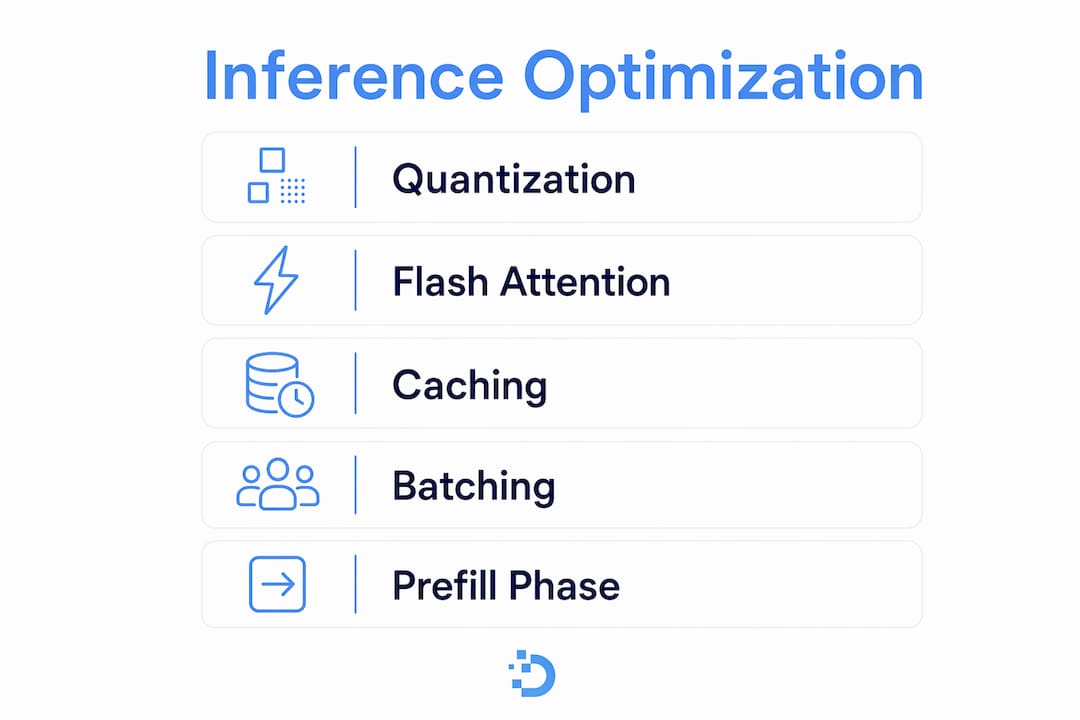
- Continuous batching groups incoming requests dynamically rather than waiting for a fixed batch size, maximizing GPU utilization.
- Flash attention rewrites the attention computation to reduce memory bandwidth, which directly cuts latency on long-context requests.
- Automatic prefix caching reuses computed key-value states for repeated prompt prefixes, eliminating redundant compute on common inputs.
- Speculative decoding uses a smaller draft model to predict tokens, then verifies them with the full model in parallel, cutting decode latency significantly.
Stacking these techniques compounds the gains. Combining quantization, flash attention, caching, and continuous batching produces cumulative cost reductions in the range of 5–8x compared to naive inference. That is not a marginal improvement. It is the difference between a model that is economically viable at scale and one that is not.
LLM inference also splits into two distinct phases with different resource profiles. The prefill phase is compute-bound; the decode phase is memory-bound. Treating these phases differently with phase-specific strategies, such as KV cache management for decode, is what separates efficient inference from wasteful inference.
How does training optimization differ from inference optimization?
Training optimization and inference optimization solve different problems. Conflating them is one of the most common mistakes ML teams make when moving from research to production.
Training optimization focuses on minimizing a loss function. Algorithms like SGD and Adam adjust model weights across thousands of iterations. The goal is learning efficiency, achieving better model performance with less data, compute, and energy during the training run. Once training ends, these optimizers have no further role.
Inference optimization starts where training ends. Its inputs are hardware constraints, traffic patterns, latency budgets, and cost targets. It does not touch model weights. It manages how the trained model executes requests in the real world.
Treating the model as the entire AI system is a critical architectural mistake. The optimization layer and the control plane around it are what maintain system reliability and cost control once the model is deployed. A well-trained model running on a poorly configured inference stack will underperform a mediocre model running on a well-tuned one.
Without an optimization layer in production, teams encounter predictable failure modes: latency spikes during traffic surges, runaway inference costs from unmonitored agent call chains, and silent degradation when hardware utilization exceeds safe thresholds.
Pro Tip: Set up cost governance before you hit production traffic. Retroactively adding budget limits to a live system is significantly harder than building them into the architecture from the start.
What are the practical benefits of an AI optimization layer in production?
The measurable impact of a well-implemented optimization layer is significant. Inference-level optimization techniques yield 3–5x throughput improvements and 60–80% cost reduction compared to unoptimized inference. Those numbers translate directly to infrastructure budget and product reliability.
The practical benefits break down across three dimensions:
- Throughput and latency: Continuous batching and flash attention allow the same GPU cluster to serve 3–5x more requests per second. This matters when your product scales from hundreds to millions of daily users.
- Cost predictability: Continuous cost governance layers enforce real-time budget limits and alert on unusual inference costs from agent workflows. Without this, a single runaway agent chain can generate thousands of dollars in unexpected API spend overnight.
- Operational reliability: Fault tolerance logic, traffic shaping, and compliance enforcement reduce the manual intervention required to keep a production system stable.
The optimization layer also amplifies the value of your training data. A model trained on high-quality, large-scale datasets reaches its performance ceiling faster. The optimization layer then ensures that ceiling is reached consistently at inference time, not just in benchmark conditions. Data quality and inference efficiency are not separate concerns. They compound each other.
Key Takeaways
An AI optimization layer is the production component that determines whether a well-trained model is also a cost-efficient, reliable, and scalable one.
| Point | Details |
|---|---|
| Separate from training | The optimization layer manages inference, cost, and reliability. It does not retrain or modify model weights. |
| Techniques stack for gains | Combining quantization, continuous batching, and caching produces 5–8x cost reductions over naive inference. |
| Two optimization types | Training optimization minimizes loss functions; inference optimization manages hardware efficiency and operational cost. |
| Cost governance is non-negotiable | Centralized visibility into token use and agent call chains prevents silent cost spikes invisible to individual teams. |
| Data quality multiplies results | High-quality training data and a well-configured optimization layer compound each other’s impact in production. |
Why most teams still get this wrong
The teams I see struggle most with production AI are not struggling because their models are bad. They are struggling because they built a great model and then treated deployment as a solved problem. The optimization layer gets added as an afterthought, if it gets added at all.
The uncomfortable reality is that inference optimization is not a one-time configuration. Effective cost optimization requires centralized visibility into token use and agent call chains on an ongoing basis. The moment you add a new agent workflow or increase context window size, your cost and latency profile changes. A static configuration does not catch that.
I have also seen teams invest heavily in model architecture and training data quality, then deploy on an inference stack that throws away most of those gains through inefficient batching and no caching. The complementary relationship between training optimization and inference optimization is not theoretical. It shows up directly in your infrastructure bill and your p99 latency.
The teams that get this right treat the optimization layer as a permanent engineering responsibility, not a launch task. They assign ownership, instrument it with observability, and revisit it every time the model or traffic pattern changes. That discipline is what separates AI products that scale from ones that become too expensive to run.
— Oleg
How DOT Data Labs supports your AI optimization pipeline
The effectiveness of any optimization layer depends on what you feed the model during training. A model trained on noisy, inconsistently labeled data will hit a lower performance ceiling regardless of how well you tune inference. DOT Data Labs builds production-ready training datasets at scale, covering everything from raw data sourcing and web collection through cleaning, annotation, and final delivery in model-ready formats. Recent projects include a 32 million science Q&A dataset delivered in under 30 days and 50,000 hours of labeled talking-head video. If your optimization layer is doing its job but your model still underperforms, the bottleneck is almost always the training data. DOT Data Labs AI data pipeline services keep that bottleneck from coming back.
FAQ
What is an AI optimization layer in simple terms?
An AI optimization layer is a system component that manages how a trained model handles real-world requests. It controls inference speed, cost, and reliability without modifying the model itself.
How does AI optimization work at inference time?
Inference optimization applies techniques like quantization, continuous batching, and prefix caching to reduce compute cost and latency. These techniques can deliver 3–5x throughput gains and 60–80% cost reduction compared to unoptimized serving.
What is the difference between training and inference optimization?
Training optimization adjusts model weights using algorithms like Adam or SGD to minimize loss. Inference optimization manages hardware efficiency, request batching, and cost governance after the model is deployed.
Why does the optimization layer matter for cost control?
Without centralized cost governance, agent workflows and token usage can generate unexpected spend that individual teams cannot detect. The optimization layer enforces budget limits and surfaces cost anomalies in real time.
What AI optimization techniques should practitioners prioritize first?
Quantization and continuous batching deliver the largest gains with the lowest implementation risk. Stacking these with prefix caching and flash attention compounds the cost and latency improvements further.