Data Engine for AI and ML Teams: 2026 Guide
What is a data engine, and why does it matter?
A data engine is a centralized platform designed to collect, process, transform, and route vast amounts of structured, semi-structured, and unstructured data across an enterprise. Unlike legacy ETL pipelines with rigid schemas, a modern data engine adapts to evolving data needs in real time, delivering processed data to analytics tools, AI models, and storage layers on demand.

For ML teams, the distinction matters immediately. You are not just moving data. You are managing freshness, lineage, and format consistency across every training run.
Key use cases include:
- Feeding cleaned, labeled data into model training pipelines
- Routing high-value data to high-performance storage while archiving lower-priority records cost-effectively
- Enabling real-time analytics without rebuilding pipelines for each new data source
- Supporting compliance workflows with policy-driven access controls and audit trails
Core features every data processing engine should have
A production-grade data processing engine delivers six capabilities that separate it from basic ETL tooling:
- Data ingestion from any source: Cloud platforms, on-premises systems, and edge devices, all managed through centralized fleet controls
- Real-time enrichment: Parsing, reducing, and transforming raw data before it reaches downstream consumers, cutting the load on analytics systems
- Configurable routing: Schema-on-need functionality applies formatting only when required, reducing complexity and processing overhead
- Tiered storage management: High-value data goes to high-performance systems; lower-priority data routes to cost-efficient storage automatically
- Unified query access: Teams query data in place, whether it sits in cloud storage, on-premises, or distributed environments, without restructuring it first
- Integration with enterprise tools: Native connectors to data lakes, messaging brokers like Apache Kafka, and ML frameworks keep the pipeline continuous
Business benefits of deploying a data engine
The shift from fragmented ETL pipelines to a unified data analytics platform eliminates silos and removes manual preparation steps. Business logic gets applied once, consistently, rather than duplicated across every downstream tool.
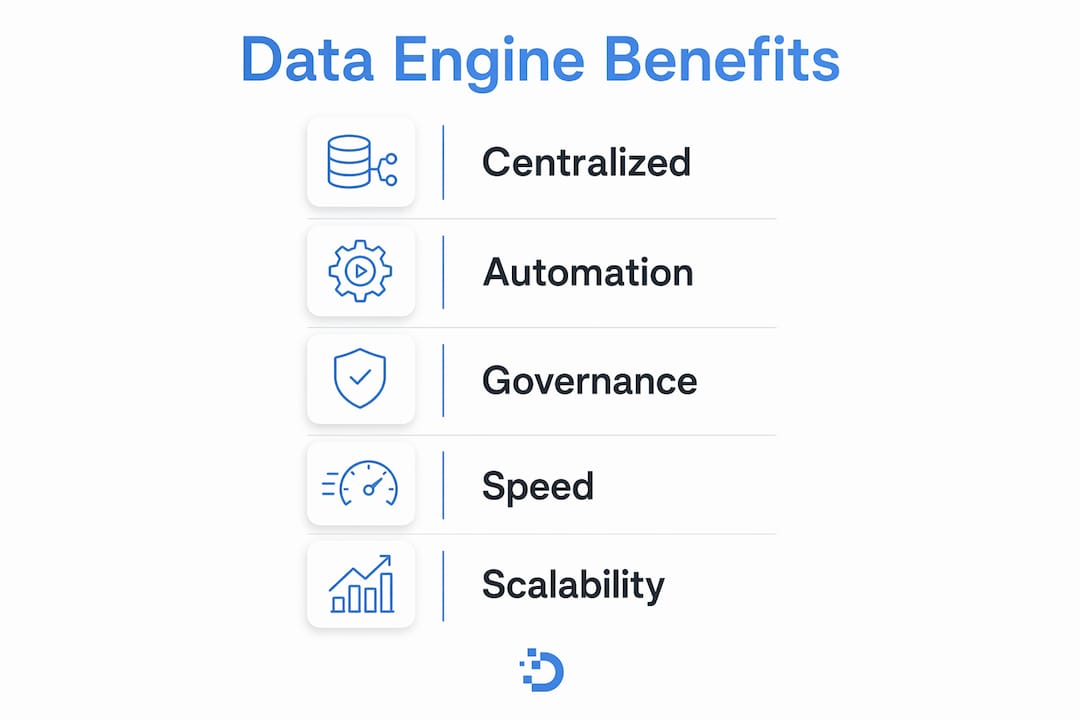
For AI teams specifically, the payoff is data quality. Consolidating transformation logic in one place reduces data drift, the silent killer of model accuracy where BI dashboards and ML features diverge because they were built from different versions of the same source data.
Practical benefits include:
- Scalability: Distributed processing handles growing data volumes by adding compute horizontally, maintaining performance from gigabytes to petabytes
- Cost control: Tiered storage routing cuts spend on high-performance storage by reserving it for data that actually needs it
- Reduced manual prep: Automated workflows continuously process incoming data and deliver analytics-ready datasets without engineer intervention
- Governance built in: Lineage tracking, policy enforcement, and quality validation run during transformation, not as an afterthought
How data engines power AI and ML pipelines
For AI and ML teams, a data engine facilitates the full training pipeline: data discovery, ingestion, curation, cleaning, labeling, and real-time vectorization, unifying batch and streaming workloads in a single system.
“What excites us most about NetApp AI Data Engine is having one end-to-end AI data solution that will streamline and secure the entire AI data pipeline. Instead of managing dozens of different tools and data silos, users will finally have unified and up-to-date AI data with built-in data discovery, curation, guardrails, automated data transformation, and secure retrieval endpoints for GenAI applications, all integrated into their storage.” — NetApp
Operationalizing data for AI requires more than speed. Governance policies, automated change data capture, and version control are what make models explainable and reproducible. Data freshness and lineage matter more than throughput alone. A data engine that acts as a system of record for training datasets lets you reproduce any model run, trace any prediction back to its source data, and satisfy auditors without scrambling.
For teams building AI data pipelines, the engine is the connective tissue between raw collection and model-ready output.

Which frameworks power modern big data engines?
The open-source ecosystem has largely converged on a small set of proven technologies. Understanding them helps you evaluate any vendor’s claims about performance and flexibility.
Batch and stream processing
- Apache Spark handles unified batch and streaming workloads across Python, SQL, Scala, Java, and R. It runs faster than most data warehouses for distributed ANSI SQL queries and scales machine learning training from a single laptop to fault-tolerant clusters of thousands of machines.
- Apache Kafka integrates with Spark to handle high-throughput, fault-tolerant streaming, ensuring no data is missed between ingestion and processing.
Distributed SQL query execution
- Presto delivers sub-second SQL query performance across data lakes, lakehouses, and NoSQL sources, handling interactive and batch workloads with a single query interface.
- Trino, a fork of Presto, extends the same distributed SQL model with additional connector support and active community development.
In-memory query performance
- Apache DataFusion is an extensible query engine written in Rust, using Apache Arrow as its in-memory columnar format. It offers a full query planner, multi-threaded vectorized execution, and built-in support for CSV, Parquet, JSON, and Avro. DataFusion Ballista extends it to distributed multi-node execution.
Practical insights from AI training data experts
Data engineering for AI teams requires treating the data engine as more than infrastructure. It is the governance layer for your models.
Key principles worth operationalizing:
- Consolidate business logic once. Applying transformations in a single engine prevents BI dashboards and ML features from diverging over time.
- Build for lineage, not just throughput. Every training dataset needs a traceable path from raw source to model input.
- Use a semantic layer. Semantic layer capabilities in data engines let both human analysts and AI agents access metrics with consistent definitions, reducing feature drift between teams.
- Prioritize data freshness. Stale training data produces stale models. Automated change data capture keeps datasets current without manual refresh cycles.
Pro Tip: “Data engine” covers at least three distinct architectures: query engines like Presto and DataFusion, data routing platforms, and AI-specific training pipelines. Buying the wrong type wastes budget and delays model delivery. Clarify which problem you are solving before evaluating vendors.
Security and compliance considerations
Security in a data engine is not a feature you add later. Access controls, encryption, and audit logging need to run during data processing, not after data lands in storage.
Policy-driven guardrails enforce which data reaches which systems, protecting sensitive records from being routed to environments without adequate controls. Automated versioning supports explainable AI requirements by preserving a traceable record of every dataset used in training. For regulated industries, this is the difference between a model you can deploy and one that fails a compliance review.
Performance optimization techniques
Columnar storage formats like Parquet, combined with Apache Arrow’s in-memory representation, cut query times by reading only the columns a query needs rather than full row scans. Partition pruning and row-group skipping reduce bytes read at the storage layer before any compute runs.
For streaming workloads, keeping Kafka and Spark tightly integrated reduces latency between event ingestion and processing. Intelligent workload partitioning distributes jobs across compute nodes so performance scales linearly as data volumes grow. Caching compiled query plans and snapshot-keyed results eliminates redundant execution for repeated reads over unchanged data, a practical win for BI and AI agent workloads that query the same metrics frequently.
Key Takeaways
A data engine is the single most important piece of infrastructure between your raw data sources and your production AI models.
| Point | Details |
|---|---|
| Definition and purpose | A data engine collects, processes, transforms, and routes structured, semi-structured, and unstructured data across an enterprise in real time. |
| AI pipeline role | Data engines unify batch and streaming workloads, supporting discovery, curation, cleaning, labeling, and vectorization for model training. |
| Core frameworks | Apache Spark, Presto, Trino, and Apache DataFusion are the dominant open-source technologies powering production data engines. |
| Governance is non-optional | Lineage tracking, version control, and policy-driven access controls are required for reproducible, compliant AI model training. |
| Architecture clarity | Query engines, data routing platforms, and AI training pipelines are distinct architectures. Matching the right type to your use case prevents costly mismatches. |
Need production-ready training data without building the pipeline yourself? DOT Data Labs delivers custom AI training datasets at scale, from raw collection through labeled, validated, model-ready output. Recent projects include a 32 million science Q&A dataset delivered in under 30 days and 50,000 hours of annotated talking-head video.