
Data Engineering for AI: What ML Teams Must Know
TL;DR:
- Data engineering for AI involves designing systems that ensure reliable, point-in-time data delivery to machine learning models in production. It emphasizes feature consistency, validation, and monitoring to prevent silent model degradation caused by data drift and leakage. Implementing centralized feature stores and quality as code practices is crucial for building robust, scalable AI pipelines.
Data engineering for AI is the practice of designing and operating systems that collect, transform, and deliver data to machine learning models consistently, at the right time, in the right format, and with production-grade reliability. It goes well beyond traditional analytics engineering. Where a standard data warehouse pipeline asks “what is the current state of the data?”, an AI pipeline asks “what was true at the exact moment this prediction was made?” That distinction drives every architectural decision in the field.
The tools that define this discipline include feature stores like Databricks Feature Store, validation frameworks like Great Expectations, and orchestration systems built on Apache Kafka and Apache Spark. Getting these systems right is the difference between a model that performs in production and one that silently degrades after deployment.

What is data engineering for AI and how does it differ from analytics?
Data engineering for AI designs and operates systems that deliver data to AI and ML models consistently, emphasizing production reliability over the reporting accuracy that traditional analytics pipelines prioritize. This is a meaningful distinction, not a subtle one. Analytics pipelines are built to answer historical questions. AI pipelines are built to feed live, stateful systems where a single bad input can corrupt a model’s behavior for thousands of downstream predictions.
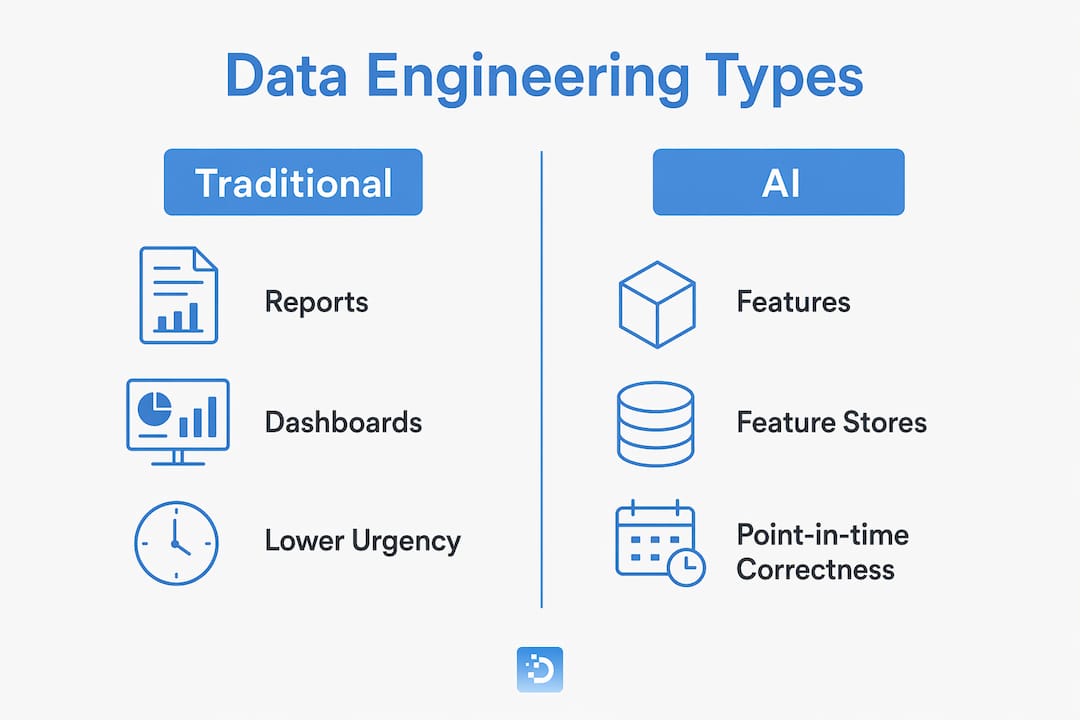
Traditional data engineering produces dashboards and reports. Data engineering for machine learning produces features: structured, versioned, numerically encoded representations of raw data that a model can consume directly. The output format, the correctness requirements, and the failure modes are all different.
The importance of data engineering in AI workflows is also organizational. ML teams that lack dedicated data engineering support spend the majority of their time on data preparation rather than model development. That ratio inverts the value proposition of hiring data scientists in the first place.
How data engineering supports AI model training and inference
The core workflow in AI data engineering follows five stages: ingestion, validation, transformation, feature storage, and monitoring. Each stage has specific production requirements that analytics pipelines simply do not enforce.
- Ingestion pulls raw data from sources including databases, event streams, APIs, and file systems into a unified processing layer.
- Validation applies quality gates before any transformation occurs, checking completeness, freshness, uniqueness, and statistical validity.
- Transformation converts raw records into model-ready features using tools like dbt for SQL-based transformations and Apache Spark for large-scale distributed processing.
- Feature storage registers computed features in a central store so the same logic runs identically during training and during live inference.
- Monitoring tracks ingestion lag, feature freshness, and distribution drift continuously after deployment.
Feature stores are the architectural component that most distinguishes AI data engineering from everything that came before it. Databricks Feature Store uses Unity Catalog for governance and provides millisecond-latency online feature serving, meaning the same feature definition that trained the model also serves it in real time. This eliminates the most common source of silent model degradation.
Point-in-time correctness is the other non-negotiable requirement. Temporal leakage, caused by including future data in feature computation, falsely inflates offline evaluation metrics and devastates production accuracy. Feast’s "get_historical_features()` API enforces point-in-time joins so that training data only reflects what was known at each prediction timestamp.
Pro Tip: Build your feature store integration before you build your first model. Retrofitting point-in-time correctness into an existing pipeline is significantly harder than designing it in from the start.
What are the biggest production challenges in AI data pipelines?
Production AI pipelines fail in ways that analytics pipelines do not. The failures are often silent, meaning no error is thrown, but model accuracy quietly erodes over weeks.
The four most common failure modes are:
- Training-serving skew: Inconsistent feature logic between batch training pipelines and real-time serving pipelines produces features that look identical in development but diverge in production. The fix is defining versioned feature logic executed once for both contexts.
- Temporal leakage: Future data leaks into training features, producing models that appear accurate offline but fail in production. Point-in-time joins are the only reliable prevention.
- Schema drift: Upstream data sources change column names, types, or semantics without notice. Structural drift is detectable automatically. Semantic drift, where a column retains its name but changes its meaning, requires human review.
- Distribution drift: The statistical distribution of incoming data shifts away from the training distribution. This matters more in AI than in analytics because models encode distributional assumptions that reports do not.
Production-grade AI pipelines require robustness against all four failure modes, demanding reliability engineering practices including synthetic failure simulations, runbooks, and postmortems. Monitoring metrics to track include ingestion lag thresholds (over 5 minutes for streaming, over 1 hour for batch), feature freshness breaches, validation pass rates, and serving latency.
“While analytics pipelines ask ‘What is the current truth?’, AI pipelines ask ‘What was true at the exact prediction time?’” This single question defines the entire engineering discipline.
How does AI data engineering compare to traditional data engineering?
The table below captures the critical differences across three engineering contexts.
| Dimension | Traditional data engineering | Data engineering for AI |
|---|---|---|
| Primary output | Reports, dashboards, aggregates | Features, training datasets, model inputs |
| Correctness standard | Current accuracy | Point-in-time accuracy |
| Failure mode | Wrong numbers in a report | Silent model degradation |
| Serving requirement | Batch refresh (daily/hourly) | Millisecond-latency online serving |
| Quality enforcement | Schema validation | Statistical validity, drift detection, freshness SLAs |
AI pipelines require stricter correctness and monitoring standards than analytics pipelines because model failures compound over time rather than appearing as obvious errors. A wrong number in a dashboard is visible. A feature that drifts 3% per week is invisible until a model audit surfaces it months later.
Many experienced software engineers find the transition to AI data engineering difficult precisely because the discipline requires statefulness and temporal reasoning that standard ETL work does not. Feature modeling, pipeline idempotency, and point-in-time join logic are domain-specific skills that take deliberate practice to develop.
Pro Tip: Treat your feature definitions as contracts, not code. Version them, document their semantics, and require sign-off from both the data engineering and ML teams before any change goes to production.
Best practices for building AI data pipelines in 2026
The modern AI data engineering stack is well-defined. The tools below represent the current production standard across teams at scale.
- Apache Kafka for real-time event streaming and ingestion from distributed sources.
- Great Expectations for data quality as code. ExpectationSuites and Checkpoints automate validation gates and trigger alerts on failure, making quality enforcement repeatable across every pipeline run.
- dbt and Apache Spark for transformation logic, with dbt handling SQL-layer transformations and Spark handling large-scale distributed feature computation.
- Feast for open-source feature store management, with point-in-time join support built in.
- Prometheus for pipeline monitoring, tracking ingestion lag, validation pass rates, and serving latency against defined SLAs.
The data quality as code principle is the most important shift in 2026 practice. Quality checks are no longer manual reviews or ad hoc scripts. They are versioned, automated, and embedded directly in the pipeline as first-class engineering artifacts. Teams that treat data quality as an afterthought consistently produce models that fail in production within 60 to 90 days of deployment.
CI/CD for data pipelines is equally non-negotiable. Every change to a feature definition, transformation logic, or validation threshold should pass through automated testing before reaching production. The data transformation process for AI requires the same engineering discipline as application code, including code review, automated tests, and staged rollouts.
Key takeaways
Data engineering for AI requires point-in-time correctness, centralized feature stores, and automated quality gates to prevent the silent model degradation that standard analytics pipelines cannot detect.
| Point | Details |
|---|---|
| AI pipelines differ fundamentally | AI data engineering enforces temporal correctness and feature consistency that analytics pipelines do not require. |
| Feature stores prevent skew | Tools like Databricks Feature Store and Feast unify feature logic across training and inference to eliminate training-serving skew. |
| Quality as code is the standard | Great Expectations automates validation gates, making data quality repeatable and auditable across every pipeline run. |
| Silent failures are the real risk | Schema drift, distribution drift, and temporal leakage degrade model accuracy without throwing errors, requiring continuous monitoring. |
| Production requires five stages | Every AI data pipeline needs ingestion, validation, transformation, feature storage, and monitoring to be production-ready. |
What I’ve learned building AI data pipelines that actually hold up
The part of AI data engineering that most teams underestimate is point-in-time correctness. I have seen teams spend months tuning model architectures while their training data silently contained future information. The offline metrics looked excellent. Production accuracy was 20% lower than expected. The root cause was a single join without a time boundary.
The second thing I would stress is treating data quality as code from day one. Teams that bolt on Great Expectations after a pipeline is already in production spend weeks retrofitting expectations that should have been written alongside the transformation logic. Embedding validation early is not extra work. It is the work.
The third lesson is about monitoring. Silent pipeline failures are the norm, not the exception. Ingestion lag, feature freshness, and drift detection need alerting thresholds defined before the first model goes live, not after the first incident. The teams I have seen succeed in production AI are the ones who treat their data pipeline with the same operational rigor as their serving infrastructure.
Finally, duplicated feature logic across batch and streaming pipelines is a debt that always comes due. Define feature computation once, version it, and execute it in both contexts. The short-term convenience of separate implementations is never worth the long-term debugging cost.
— Oleg
How DOT Data Labs supports your AI data engineering work
Building production-grade AI data pipelines requires more than good tooling. It requires high-quality, consistently structured training data that your pipeline can actually process reliably. DOT Data Labs provides custom AI training datasets and ongoing data pipelines built to the exact specifications your models require, from raw collection through validated, model-ready output.
DOT Data Labs has delivered a 32 million science Q&A dataset in under 30 days and processed 50,000 hours of talking-head video with aligned subtitles for AI training. For teams that need continuous data supply, ongoing AI data pipelines feed cleaned, labeled, and structured data into your training infrastructure on a scheduled or real-time basis, without requiring you to manage multiple vendors or build internal collection tooling.
FAQ
What is data engineering for AI?
Data engineering for AI is the discipline of building systems that collect, transform, and deliver data to machine learning models with production-grade reliability, point-in-time correctness, and consistent feature quality across training and inference.
How does a feature store prevent training-serving skew?
A feature store registers versioned feature definitions and executes the same computation logic for both offline training and online serving, eliminating the inconsistencies that arise when batch and streaming pipelines use separate code.
What tools are standard for AI data pipelines in 2026?
The current production stack includes Apache Kafka for ingestion, Great Expectations for validation, dbt and Apache Spark for transformation, Feast or Databricks Feature Store for feature serving, and Prometheus for monitoring.
Why is temporal leakage dangerous for AI models?
Temporal leakage includes future data in training features, which inflates offline evaluation metrics and produces models that fail in production because they were trained on information that would not have been available at prediction time.
How is data quality enforced in AI pipelines?
Data quality is enforced as code using frameworks like Great Expectations, which define ExpectationSuites and Checkpoints that run automated validation gates at each pipeline stage and trigger alerts when thresholds are breached.