
Training Data for ML Teams: Best Practices in 2026

TL;DR:
- High-quality training data is essential for accurate machine learning models and should be sourced carefully, cleaned thoroughly, and monitored continuously. Data ownership, systematic auditing, and embedding quality checks into pipelines prevent model failures caused by poor data. Proper data structuring and formatting, such as JSONL or Parquet, optimize training efficiency across different tasks.
Training data is defined as the labeled, curated collection of examples used to teach a machine learning model how to recognize patterns and make accurate predictions. The quality of this dataset determines model performance more than architecture choices or hyperparameter tuning. The data-centric AI paradigm makes this explicit: improving your data consistently outperforms improving your model. This article covers sourcing, cleaning, and enhancing machine learning datasets so your team builds models that generalize well and hold up in production.
What is training data and how do you source it well?
Training data sourcing is the process of identifying, collecting, and vetting raw examples before any cleaning or labeling begins. The source determines the ceiling on data quality, so this decision carries more weight than most teams give it.
The four primary sources for machine learning datasets are:
- Web crawls. Large-scale web scraping produces high-volume, diverse corpora. Follow your AI data acquisition workflow to vet domains for quality and licensing before ingestion.
- Human-labeled data. Annotators produce ground-truth labels for tasks where no existing signal exists, such as medical image classification or nuanced sentiment analysis.
- Synthetic data. Generated examples fill gaps in rare classes or sensitive domains. Use synthetic data to augment, not replace, real-world examples.
- Proprietary datasets. Internal logs, transaction records, and customer interactions often carry the highest signal for domain-specific models.
Legal and ethical constraints shape every sourcing decision. GDPR, the EU AI Act, and emerging AI opt-out standards like robots.txt extensions require teams to verify licensing and provenance before collection begins. Geographic, linguistic, and domain diversity also matter. A dataset built entirely from English-language web content will underperform on multilingual tasks and introduce demographic bias.
Pro Tip: Before scraping any web source, check the domain’s terms of service and robots.txt directives. Provenance records protect you during audits and make decontamination easier later.
How do you clean training data to maximize model accuracy?
Data cleaning is where most teams underinvest and where most model failures originate. The bottleneck in enterprise AI is almost always poor, noisy, or unrepresentative data, not the model architecture.
Follow these steps in order:
- Split before you clean. Separate your training, validation, and test sets before any preprocessing. Computing normalization statistics on combined train/test data causes data leakage, which invalidates your performance metrics entirely.
- Deduplicate aggressively. Web-crawled corpora lose 60–80% of raw tokens after deduplication removes boilerplate and near-duplicates. That figure reflects how much noise exists in raw web data. Use exact hash comparisons for identical documents and MinHash+LSH for fuzzy near-duplicate detection. The DOT Data Labs deduplication guide for ML engineers covers both methods in depth.
- Filter low-quality content. Remove spam, machine-generated filler, boilerplate navigation text, and content flagged by quality classifiers. A 5–10% duplicate rate in fine-tuning datasets measurably degrades generalization by encouraging memorization. Even a small contamination rate compounds across training steps.
- Decontaminate against eval benchmarks. Benchmark contamination invalidates evaluation metrics if unchecked. Remove any training documents with n-gram overlaps against your evaluation sets before training begins.
- Detect and redact PII. Named entity recognition models and regex patterns catch most personally identifiable information. Redaction protects regulatory compliance under GDPR and reduces liability.
- Hold out a clean test set. Industry standard practice holds out 5–10% of total data as a final test set, untouched during development. This set exists only to measure real-world generalization.
| Cleaning step | Primary risk it prevents |
|---|---|
| Split before preprocessing | Data leakage and inflated metrics |
| Exact and fuzzy deduplication | Memorization and poor generalization |
| Benchmark decontamination | Over-optimistic evaluation scores |
| PII redaction | Regulatory violations and privacy exposure |
Pro Tip: Run your decontamination check after deduplication, not before. Deduplication changes document boundaries and can create new partial overlaps with benchmark examples.

Advanced techniques to enhance datasets and maintain quality
Cleaning removes bad data. Enhancement improves the data you keep. The data-centric AI approach treats data improvement as an ongoing practice, not a one-time preprocessing step.
The most impactful enhancement technique is confident learning. When a trained model consistently disagrees with a label across multiple runs, that label is likely wrong. Fixing 50–200 mislabeled examples can improve slice-level F1 scores by 0.05–0.15. That improvement exceeds what most teams achieve through extensive hyperparameter tuning. Identify error slices, relabel the flagged examples with human annotators, and retrain.
Continuous quality gates are the second critical enhancement layer. Embedding hard-fail checks directly into your data pipeline means corrupted or stale data never reaches training infrastructure. Quality gates with hard fails drive trust and reduce AI hallucinations better than post-hoc fixes applied after training. Pair these gates with automated incident routing so data issues trigger immediate remediation workflows rather than silent failures.
Domain ownership matters as much as tooling. Assign explicit owners to each data slice or domain. Owners run root cause analysis when quality metrics drop and approve remediation before the next pipeline run. This structure, described in detail in the AI data quality checklist, creates durable improvements rather than one-off fixes.
The most effective way to reduce AI hallucinations is to use freshness-guaranteed, semantically clean, and quality-certified data products. Bigger models and prompt engineering do not compensate for dirty training data.
Pro Tip: Set up automated data quality dashboards that track duplicate rate, label agreement score, and PII detection rate across every pipeline run. Catching drift early costs far less than retraining after a quality failure.
How to structure and format datasets for efficient model training
Format and structure decisions affect training speed, reproducibility, and the validity of your evaluation results.
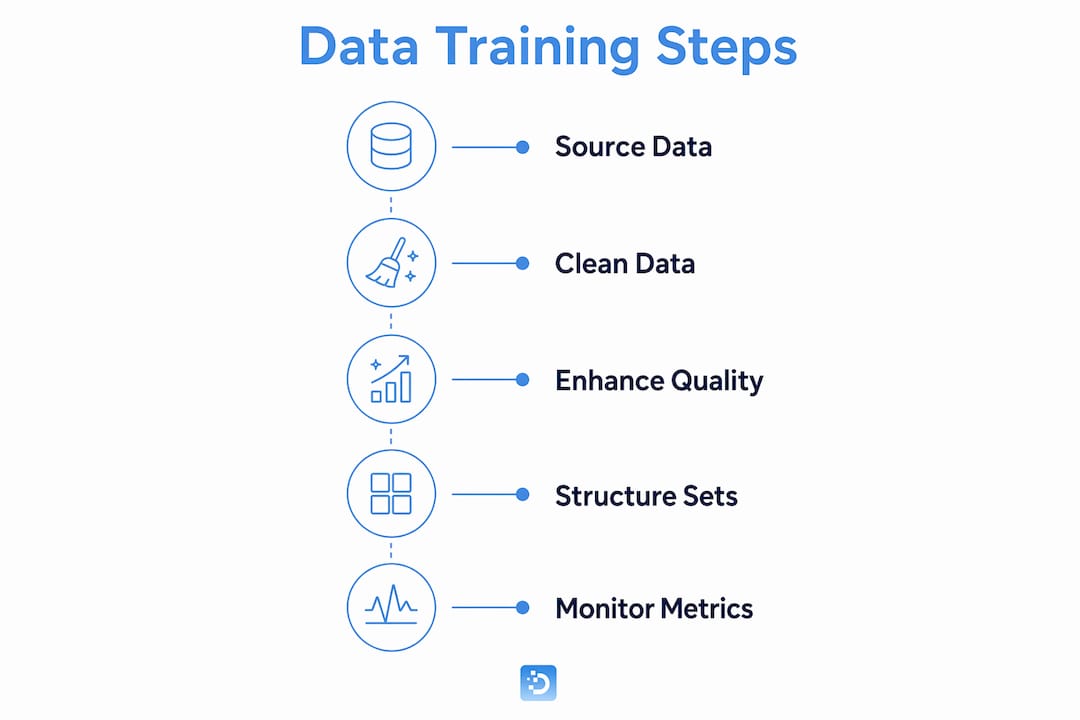
JSONL and Parquet are the two preferred formats for production training pipelines. JSONL handles streaming and incremental updates well. Parquet compresses columnar data efficiently and integrates cleanly with distributed compute frameworks like Apache Spark and Apache Arrow.
Dataset size requirements vary by task type. Fine-tuning a large language model on a narrow domain task typically requires 1,000–10,000 high-quality examples. Pretraining from scratch demands billions of tokens. Classification tasks with balanced classes can perform well with a few thousand labeled examples per class, provided the labels are clean.
| Task type | Minimum viable dataset size | Key format consideration |
|---|---|---|
| LLM fine-tuning | 1,000–10,000 examples | JSONL with token length limits |
| Text classification | 500–5,000 per class | Stratified train/val/test split |
| Image classification | 1,000+ per class | Balanced class representation |
| Pretraining | Billions of tokens | Parquet with deduplication applied |
Stratified splitting preserves class distribution across training, validation, and test sets. For imbalanced classification problems, stratification prevents the test set from accidentally containing only majority-class examples. Set token length limits and define truncation strategies before training begins. Truncating at inference time without matching training behavior causes distribution shift.
Key takeaways
High-quality training data, sourced carefully, cleaned thoroughly, and monitored continuously, is the primary lever for improving AI model performance and reducing hallucinations.
| Point | Details |
|---|---|
| Split before cleaning | Compute preprocessing statistics only on training data to prevent leakage. |
| Deduplicate aggressively | Even a 5–10% duplicate rate measurably degrades model generalization. |
| Use confident learning | Fixing 50–200 mislabeled examples outperforms extensive hyperparameter tuning. |
| Embed quality gates | Hard-fail pipeline checks catch corrupted data before it reaches training. |
| Match format to task | Use JSONL for LLM fine-tuning and Parquet for large-scale pretraining pipelines. |
The data quality problem most teams refuse to admit
After working with AI teams across multiple industries, the pattern I see most often is this: teams spend months tuning model architecture and almost no time auditing their labels. They treat data as a solved problem the moment the pipeline runs without errors. A pipeline that runs without errors and a pipeline that produces clean, representative, correctly labeled data are two very different things.
The teams that ship reliable models treat data quality as an engineering discipline with ownership, metrics, and incident response. They track clean data the same way they track uptime. The teams that struggle treat data quality as a preprocessing checkbox. Business-aligned quality governance, where data owners answer for model failures tied to their data slices, creates accountability that no automated tool can replicate. The future of trustworthy AI runs through data rigor, not model complexity.
— Oleg
How DOT Data Labs delivers production-ready training datasets
ML teams that need high-quality datasets without building an internal data supply chain use DOT Data Labs. The company handles sourcing, web scraping, deduplication, human annotation, and quality validation across the full pipeline.

DOT Data Labs delivers three models: off-the-shelf datasets for immediate use, one-off custom builds scoped to your exact specifications, and ongoing data pipelines for teams that need continuous, freshness-guaranteed data feeds. Recent projects include a 32 million science Q&A dataset delivered in under 30 days and 50,000 hours of talking-head video with aligned subtitles. Every dataset ships with compliance scoping against GDPR and applicable data protection regulations. Visit DOT Data Labs to scope your next dataset project.
FAQ
What is the training data definition in machine learning?
Training data is the labeled, curated collection of examples used to teach a machine learning model to recognize patterns. The model adjusts its parameters based on these examples during the training process.
What does a training data set typically include?
A training data set includes input examples paired with correct output labels, split into training, validation, and test subsets. The test subset, typically 5–10% of total data, remains untouched until final evaluation.
How does data cleaning affect AI model accuracy?
Removing duplicates, filtering low-quality content, and decontaminating against eval benchmarks directly improves generalization. A duplicate rate as low as 5–10% measurably degrades model performance by encouraging memorization over learning.
What is the best format for training data in LLM pipelines?
JSONL is the preferred format for LLM fine-tuning because it supports streaming and incremental updates. Parquet works better for large-scale pretraining due to its compression efficiency and compatibility with distributed compute frameworks.
How do you prevent data leakage in training datasets?
Split your dataset into training, validation, and test sets before any preprocessing begins. Compute normalization statistics exclusively on the training split to avoid contaminating evaluation metrics.