
AI Data Acquisition Workflow for ML Teams in 2026
TL;DR:
- Most ML projects struggle with sourcing quality data at scale, which critically impacts model performance. Building an early, governance-integrated acquisition workflow ensures proper source identification, validation, and ongoing pipeline management to prevent costly data issues. Teams that prioritize data curation, provenance tagging, and balanced automation maintain model accuracy and compliance effectively.
Getting quality training data at scale is where most ML projects hit their first serious wall. The ai data acquisition workflow you build in the early stages of a project determines whether your model trains on signal or noise. Poor sourcing decisions, skipped governance steps, and ad hoc collection methods compound quickly. By the time model performance disappoints, tracing the problem back to data is expensive and slow. This guide walks through each phase of a production-grade acquisition workflow, from source identification and governance through ingestion, validation, delivery, and ongoing pipeline management.
Key takeaways
| Point | Details |
|---|---|
| Governance starts before collection | Define legal, ethical, and quality criteria before touching a single data source. |
| Batch and streaming serve different needs | Choose ingestion method based on latency requirements, not default assumptions. |
| AI data cannibalism is a real risk | Training on synthetic outputs degrades model accuracy by 15-30% without proper curation. |
| Storage overhead is routinely underestimated | Plan for 2-3x the final dataset size to account for raw, processed, and versioned copies. |
| Human curation cannot be fully automated | Automation handles volume; human review catches edge cases that break models in production. |
Building a solid AI data acquisition workflow
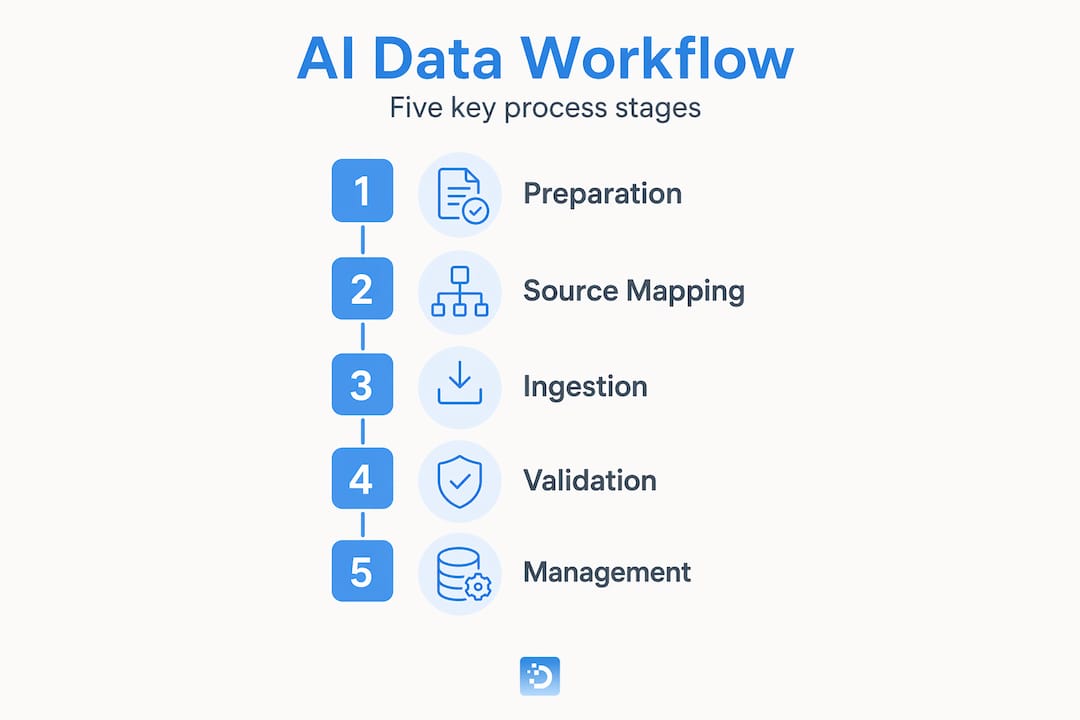
Before any scraping tool runs or API key gets configured, the preparation phase does the most work. This is where teams define what data they actually need, where it lives, and what rules govern its collection.
Know your source types. Data for AI training typically falls into three categories: proprietary (internal logs, user data, transactional records), public (web data, open datasets, government repositories), and synthetic or human-labeled data generated specifically for training. Each has different cost, freshness, and licensing profiles. Mixing them without tracking provenance creates problems downstream that are hard to unwind.
Break down your data silos early. Fragmented, siloed data systems block AI readiness. Teams that rely on traditional ETL pipelines and disconnected source systems end up with inconsistent schemas, duplicate records, and blind spots in coverage. Moving to open formats and a unified data catalog at the start prevents these issues from compounding.
Key preparation decisions to make before collection begins:
- Define freshness requirements: how old is too old for your model’s use case?
- Establish quality thresholds: acceptable null rates, schema consistency, class balance targets
- Identify licensing constraints for every external source
- Document data lineage expectations so audits are possible later
Pro Tip: Map your data sources against your model’s domain requirements before scoping collection volume. A mismatch in domain coverage causes more downstream rework than almost any other preparation failure.
95% of AI deployments rely on data pipelines with embedded governance to manage legal and ethical risks. Building that governance into the workflow from day one is not overhead. It is the difference between a dataset you can use in production and one that creates legal exposure.
Execution: ingesting and processing data at scale
Once preparation is done, the execution phase covers how data actually moves from sources into your training infrastructure. The choices you make here affect latency, cost, and maintainability.

Batch versus streaming. Batch ingestion works well for static or slow-moving datasets: historical records, labeled datasets purchased from vendors, crawled web content. Streaming ingestion is the right choice when your model needs continuous updates, such as fraud detection systems or recommendation engines that need fresh behavioral data. Streaming architectures with Change Data Capture enable sub-second latency and continuous synchronization without burdening source systems. Many teams use a hybrid approach, streaming high-priority signals while batch-processing bulk historical data on a schedule.
A practical ingestion pipeline for AI training data typically includes these steps:
- Source connection: APIs, web scrapers, database connectors, or file ingestion from cloud storage
- In-flight validation: schema checks, deduplication, and basic anomaly detection as data arrives
- Transformation: normalization, tokenization, format conversion, and field standardization
- Routing: separate raw data to cold storage and processed data to the training-ready layer
- Metadata tagging: source identifier, collection timestamp, processing version, and quality score
Pro Tip: Do not skip in-flight validation in favor of cleaning everything post-ingestion. Catching schema violations and duplicates at the point of entry reduces storage costs and keeps downstream pipelines clean.
Automated data validation tools now handle anomaly detection, schema drift, and quality flagging within the pipeline itself. Automation at this layer can save 30 to 60 minutes per manual review task and automate up to 90% of routine data processing operations. That time compounds across a large project. A well-built AI data pipeline handles this at scale without manual intervention on every run.
Verification: preventing AI data cannibalism
Verification is where many teams cut corners and pay for it later. The most specific risk to understand here is AI data cannibalism.
What AI data cannibalism actually means. When a model is trained on data that includes outputs from earlier versions of itself or similar models, the synthetic patterns crowd out the human-generated signal. Model accuracy degrades by 15-30% across just three iterations when this is not controlled. The degradation is gradual and easy to miss until model performance in production becomes noticeably worse.
The solution is a data curation pipeline that explicitly separates synthetic from human-labeled data. SHA-256 hashing and blockchain-anchored metadata can tag each record at the point of collection and maintain that tag through all downstream processing. Synthetic data treated as supplemental rather than foundational preserves model accuracy and reduces bias.
| Verification method | Best used for | Limitation |
|---|---|---|
| Hash-based deduplication | Removing exact duplicates across sources | Does not catch near-duplicates or paraphrased content |
| Schema validation | Catching structural drift in ingested records | Misses semantic quality issues |
| Differential privacy checks | Protecting sensitive source data during training | Adds computational overhead |
| Human spot review | Catching edge cases and labeling errors | Does not scale to full dataset coverage |
| Source provenance tagging | Isolating synthetic from human-labeled data | Requires consistent tagging from collection through delivery |
“Treating synthetic data as supplemental rather than foundational is the most practical way to protect model accuracy without abandoning synthetic data entirely.”
Ongoing data management and delivery
A well-executed acquisition and verification phase still fails if the ongoing management layer is disorganized. This is where many teams lose ground after a strong start.
Effective pipelines separate raw, processed, and validated datasets with metadata manifests that make every version reproducible. That separation matters for debugging, compliance audits, and retraining on historical data subsets.
Dataset delivery formats and their trade-offs:
| Format | Strengths | Weaknesses |
|---|---|---|
| Parquet | Columnar, compressed, fast for large-scale reads | Not human-readable; requires specific tooling |
| JSON | Flexible schema, widely supported | Verbose; slower to parse at scale |
| CSV | Simple, universal compatibility | No native type enforcement; poor for nested data |
For most large-scale ML projects, Parquet is the default choice for structured training data. JSON works well for semi-structured or nested records. CSV is a pragmatic fallback for smaller datasets or when the downstream system has limited format support.
Infrastructure considerations to plan for from the start:
- Storage overhead of 2-3x the final dataset size is standard once raw, processed, and versioned copies are accounted for
- Monitor ingestion rates and failure rates daily rather than weekly
- Set alerts on storage growth curves to avoid capacity surprises mid-project
- Version every processed dataset with a manifest that includes source hash, collection date, and processing run ID
My perspective on where teams go wrong
I have seen teams pour serious engineering effort into automation and then watch their models perform worse than expected six months later. The pattern is almost always the same. Automation got the volume right but nobody owned the quality criteria. The pipeline was running cleanly in terms of uptime and throughput while quietly ingesting inconsistent labels, domain-mismatched records, and an increasing proportion of synthetic content nobody tracked.
My honest read on this: over-automation without embedded governance is the most common failure mode in AI data acquisition today. The tools are good enough that teams can build a pipeline fast. What they cannot automate is judgment about what belongs in a training set and what does not.
The teams I have seen do this well treat data curation as a first-class engineering discipline, not a cleanup task. They assign ownership, define quality contracts, and review samples regularly even when the pipeline is healthy. They also plan for synthetic data explicitly, deciding upfront what ratio of synthetic to human-labeled content is acceptable for each model type.
The future of this space will include better tooling for provenance tracking and real-time quality scoring. But the underlying discipline of knowing your data before you train on it is not going away.
— Oleg
How Dotdatalabs can handle your data pipeline
Building and maintaining a production-grade data acquisition pipeline takes significant time and specialized expertise that most ML teams do not have sitting idle. Dotdatalabs handles the full data supply chain for AI teams: custom data sourcing and collection, cleaning, labeling, validation, and delivery in model-ready formats. For teams that need continuous feeds, ongoing managed pipelines keep training infrastructure supplied without requiring internal tooling builds. Recent projects include a 32 million science Q&A dataset delivered in under 30 days. If your data acquisition workflow needs to move faster or scale further, Dotdatalabs is built for exactly that.
FAQ
What is data acquisition in AI?
Data acquisition in AI refers to the process of identifying, collecting, cleaning, and preparing raw data for use in training machine learning models. It includes sourcing from APIs, web scraping, databases, and labeled datasets.
How do you prevent AI data cannibalism in a training pipeline?
Use provenance tagging and hash-based tracking to separate synthetic from human-labeled data at the point of collection. Treat synthetic data as supplemental, and maintain that separation through all downstream processing stages.
What is the best format for delivering AI training datasets?
Parquet is the standard for large structured datasets due to its compressed columnar format and fast read performance. JSON suits semi-structured or nested data, while CSV is reserved for smaller or simpler use cases.
How much storage should I plan for in an AI data pipeline?
Plan for 2-3x the size of your final dataset to account for raw, processed, and versioned storage copies across the pipeline lifecycle.
When should I use streaming ingestion versus batch ingestion?
Use streaming ingestion when your model requires low-latency or real-time data updates. Use batch ingestion for static or infrequently updated datasets where processing on a schedule is sufficient.