
Training data for LLMs: What it is and how to get it right

TL;DR:
- Most ML teams underestimate the extensive effort required for data preparation before training LLMs, dismissing myths that models are trained solely on internet text. Training involves multiple stages—pretraining, supervised fine-tuning, and reinforcement learning—each demanding unique data quality standards and filtering strategies. Focusing on deduplication, quality filtering, and rigorous auditing of datasets significantly enhances model performance, cost-efficiency, and trustworthiness.
Most ML teams underestimate how much work goes into the data before a single training run begins. The assumption that LLMs are simply trained on “the internet” is one of the most persistent and costly myths in the field. In reality, LLM training data is assembled in stages: broad pretraining on massive, mostly unannotated text, followed by post-training phases that rely on tightly structured, instruction- or preference-based examples. Each stage has different quality requirements, different failure modes, and different compliance considerations. If you’re responsible for data quality or model performance, here’s the full picture.
Key Takeaways
| Point | Details |
|---|---|
| Multi-stage pipeline | LLM training data is assembled in discrete pretraining, SFT, and RLHF stages, each needing specific curation. |
| Deduplication matters | Removing exact, near-duplicate, and repeated substrings is key to prevent model memorization and performance issues. |
| Quality filtering boosts results | High-quality filtering enables better LLM outcomes with fewer training tokens than relying on scale alone. |
| Audit for contamination | Test set leakage, benchmark overlap, and safety risks must be proactively tracked and mitigated during curation. |
| No magic dataset | Ongoing measurement and adaptation of training data strategy beats static, ‘one and done’ collections. |
The multi-stage anatomy of LLM training data
To set a foundational understanding, let’s examine how LLM training data is assembled step by step.
LLM training is not a single pass over one dataset. It’s a sequence of phases, each with its own data format and quality bar. Training data sources include public web crawls, licensed third-party text, proprietary datasets, and structured human-generated examples. Mixing these sources incorrectly, or failing to track which data feeds which phase, is one of the fastest ways to degrade model performance.
The three primary training phases are:
- Pretraining: The model learns general language patterns from billions of tokens of broad, mostly unstructured text. Volume matters here, but quality filtering still applies.
- Supervised fine-tuning (SFT): The model is shown high-quality examples of correct behavior. These examples are narrow, curated, and often human-authored or human-validated.
- Reinforcement learning from human feedback (RLHF): Human raters compare outputs and signal preferences. The data here is structured as comparisons or rankings, not raw text.
Each phase requires a completely different dataset schema. A document that is perfect for pretraining may be useless or actively harmful during SFT. Building quality datasets for AI training means planning those distinctions upfront, not retrofitting them during model evaluation.
| Training phase | Data type | Volume needs | Key quality bar |
|---|---|---|---|
| Pretraining | Broad web text, books, code | Billions of tokens | Dedup, language filter, safety |
| SFT | Instruction-response pairs | Thousands to millions | Accuracy, format consistency |
| RLHF | Ranked output comparisons | Tens of thousands | Inter-rater reliability, coverage |
Thinking about dataset structuring strategies at each phase is not optional. It’s the difference between a model that generalizes well and one that looks good internally but fails in production.
Data curation: Deduplication and quality filtering essentials
Understanding where high-quality data comes from leads to the next challenge: ensuring that data is actually unique and valuable.

Deduplication sounds simple. It isn’t. Deduplication methods include exact copy removal, near-duplicate detection using Jaccard similarity or MinHash, and substring-level detection using suffix arrays. Each catches a different class of redundancy. Skipping near-duplicate detection, for example, leaves behind paraphrased copies that the model will still memorize, just in slightly varied form.
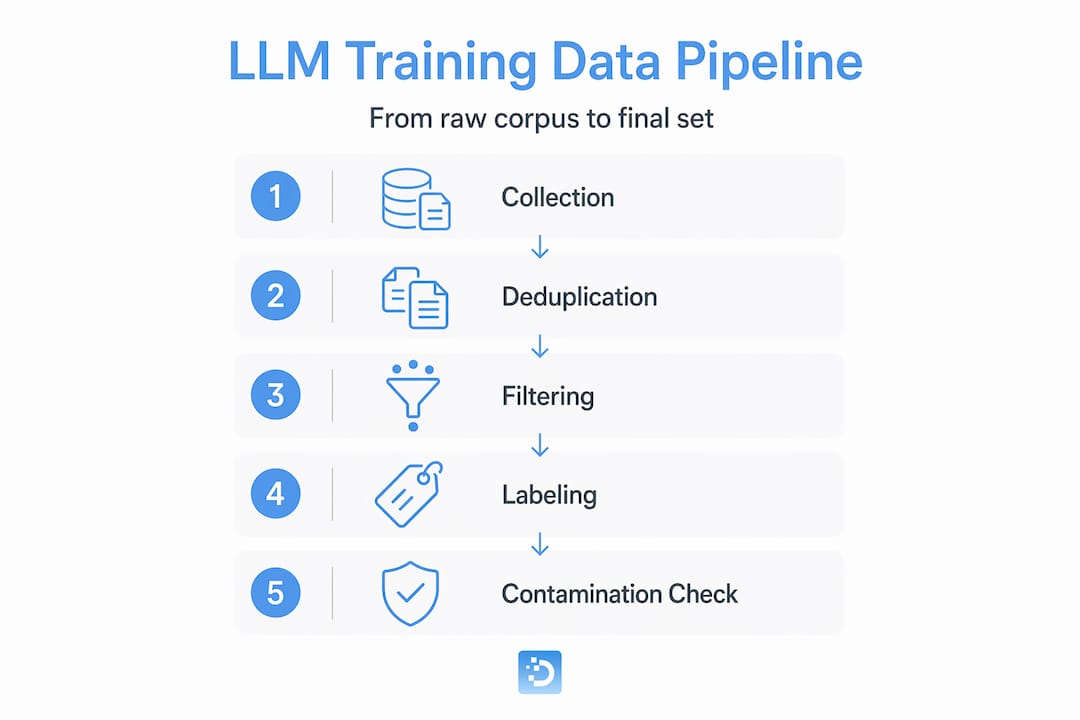
The standard curation pipeline for large-scale pretraining data typically follows these steps:
- Crawl and collect raw text from web sources, books, or licensed content.
- Exact deduplication using document hashes to remove identical copies.
- Near-duplicate detection using MinHash-based LSH across n-gram shingles.
- Substring detection to catch smaller repeated passages that appear across many documents.
- Quality scoring using perplexity models, heuristics, or a trained classifier.
- Domain blending to balance coverage across topics and text types.
- Contamination filtering to strip any overlap with evaluation benchmarks.
Recent large-scale datasets like RedPajama-V2 demonstrate that skipping any of these steps measurably degrades downstream benchmark performance. The steps aren’t bureaucratic overhead. They directly affect what the model learns.
The contamination filter in step seven deserves special attention. If your training set contains examples from standard benchmarks like MMLU, HellaSwag, or HumanEval, your evaluation results are meaningless. This isn’t hypothetical. It happens regularly when teams move fast and treat deduplication as a single-pass operation.
Pro Tip: Run your benchmark test sets through substring and near-duplicate search against your training corpus before any training run, not after. Catching contamination after training wastes compute and invalidates your evaluation metrics entirely.
Once your deduplication pipeline is solid, the next question is whether you’re streamlining deduplication for LLMs at the right granularity. Document-level dedup is not enough for long-form content. Sentence and paragraph-level dedup often reveals a much higher redundancy rate than teams expect, sometimes above 30% in raw web crawls.
Getting your data preprocessing workflow right at this stage saves significant compute downstream and reduces the risk of overfitting to repeated patterns.
Why data quality filtering moves the needle in LLM benchmarks
Beyond removing redundancy, filtering for true quality is the next unlock for LLM success.
There is now strong empirical evidence that quality beats volume. Comprehensive quality filtering in datasets like FineWeb-2 enables strong benchmark performance with a fraction of the raw token count that unfiltered pipelines require. In practical terms, this means you can train a competitive model on less compute if your data is properly filtered, or train a substantially better model on the same budget.
“Training-data quality filtering can improve benchmark performance or reach baseline performance using a smaller fraction of tokens.” — FineWeb-2 study, 2024
There are two main categories of quality filters your team should apply:
- Heuristic filters: Rules based on document length, punctuation density, repeated n-gram ratios, stop-word coverage, and language identification. These are fast and scalable.
- Model-based filters: A small classifier trained to score documents by predicted quality, often using human-curated reference data as signal. More expensive, but catches subtler noise that heuristics miss.
Using only one type leaves gaps. Heuristic filters miss coherent but low-value text. Model-based filters can overfit to a specific quality definition that doesn’t generalize to your use case. The most robust pipelines use both.
Pro Tip: Don’t treat your quality classifier as a permanent tool. As your target domain evolves or your model’s use case changes, the classifier’s definition of “quality” may become misaligned. Audit it quarterly.
Check your data quality checklist against each filter type to ensure nothing is being left in the pipeline by default. Real case studies on data quality impact consistently show that teams who invest in filtering infrastructure early spend far less time debugging model failures later.
Pitfalls and best practices: Leakage, test contamination, and data auditing
To keep LLMs robust and trustworthy, let’s cover where things can still go wrong and how to monitor your critical data pipeline.
Even teams with solid deduplication and quality filtering pipelines run into problems at the audit layer. The risks here are less about raw data volume and more about traceability and process gaps.
- Benchmark test set leakage: Any overlap between your training data and evaluation benchmarks will inflate scores artificially. Rotate your private test sets regularly. Treat them like production secrets, not shareable artifacts.
- PII and sensitive content contamination: Web-scraped data often includes personally identifiable information, medical details, or legally sensitive content. Implement detection models at the collection stage, not as a post-processing afterthought.
- Traceability gaps: When a model produces problematic outputs post-deployment, you need to trace that behavior back to specific training examples. Probe-based attribution methods allow teams to surface and mitigate harmful behaviors by identifying the implicated training data directly.
- Schema drift between pipeline phases: When data schema conventions change mid-project without versioning, SFT and RLHF datasets can silently diverge from what the pretraining pipeline assumed.
- Single-phase auditing: Auditing only at the end of the pipeline misses errors introduced at ingestion. Build audit checkpoints at every phase transition.
Benchmark contamination is a real and documented failure mode. The solution is procedural: maintain strict data provenance records, run contamination scans before each training run, and keep your evaluation sets in isolated, versioned storage that your data pipeline never touches.
Review your large-scale data collection best practices before scaling any pipeline. And when preparing for compliance or model reviews, dataset standardization for audits makes the difference between a clean audit trail and an unresolvable investigation.
The uncomfortable truth: There’s no one-size-fits-all training set
Here’s the perspective that most vendor guides won’t give you: the idea that there is a single, correct training data recipe for LLMs is wrong. Every published recipe, whether it’s the blend used for GPT-4, Llama 3, or any open-weights model, reflects a specific team’s decisions at a specific point in time for a specific target use case. Those decisions are not transferable wholesale to your project.
Data requirements shift when your use case changes. A medical question-answering model needs different quality signals, different deduplication thresholds, and different contamination checks than a code generation model. What worked for a general assistant model will underfit a specialized vertical agent. The AI data quality checklist you use today may need to be rebuilt six months from now as benchmarks evolve and your model’s scope expands.
The teams building durable LLM capabilities are not the ones with the biggest datasets. They’re the ones with the best measurement infrastructure. That means real traceability, phase-specific auditing, and the operational discipline to revisit pipeline assumptions on a regular cadence. Data pipeline tuning should be a living practice, not a one-time deliverable.
Explore purpose-built datasets and data workflows
When you’re ready to move beyond patchwork pipelines and manual vendor coordination, the efficiency gains from a purpose-built data supply chain are immediate.
Dot Data Labs handles the full stack: sourcing, deduplication, quality filtering, labeling, contamination checks, and delivery in model-ready formats. Whether you need a one-off custom dataset built to your exact schema or an ongoing data pipeline feeding your training infrastructure, DOT Data Labs can scope it against your compliance requirements from day one. Explore training-ready data criteria and see how AI-driven model training can raise your benchmark results without scaling your internal headcount.
Frequently asked questions
What is the difference between pretraining and post-training data in LLMs?
Pretraining uses large, broad text corpora while post-training uses narrower, instruction- or preference-structured examples designed to align model behavior to specific tasks.
Why is deduplication important for LLM datasets?
Deduplication methods including exact, near-duplicate, and substring detection reduce memorization risks and improve generalization by removing redundant content before training.
How does data quality filtering affect LLM benchmarks?
Quality filtering can achieve strong benchmark results with significantly fewer tokens, meaning better models at lower compute cost.
What risks should I audit for in training data pipelines?
Audit for benchmark and test set leakage, PII exposure, schema drift between pipeline phases, and missing traceability at each stage.
Do LLMs perform better with more data or better data?
Higher-quality filtered data can match or outperform larger unfiltered datasets, making quality at least as important as raw volume in modern training pipelines.