
Annotation Data: A 2026 Practical Guide for ML Teams
TL;DR:
- Annotation data provides meaningful labels that enable machine learning models to learn accurately. Its quality directly influences AI performance across industries such as healthcare, automotive, and finance.
What is annotation data and why does it matter for AI?
Annotation data is raw data that has been labeled, tagged, or structured so that a machine learning model can learn from it. Without it, a model sees pixels, characters, or waveforms with no context. With it, those same inputs carry meaning: “this region is a tumor,” “this sentence is negative,” “this object is a pedestrian moving left.”
The core function of labeled data in supervised learning is to supply the correct answers during training. A model learns by comparing its predictions against those labels and adjusting until the gap closes. Remove the labels and the model learns blindly, which is a serious problem when the application is medical diagnosis or a self-driving vehicle making split-second decisions.
Every annotated dataset is built from three components:
- Labels: the category, value, or tag assigned to a data point (e.g., “cat,” “fraudulent,” “positive sentiment”)
- Tags and attributes: secondary descriptors that add context (e.g., bounding box coordinates, confidence scores, speaker ID)
- Metadata: information about the annotation itself, such as annotator ID, timestamp, and tool version
The practical significance of annotation data extends well beyond model training. Labeled datasets also drive validation, testing, and ongoing model monitoring. Teams that treat annotation as a one-time task rather than a continuous workflow tend to discover this the hard way when model performance degrades after deployment.
What are the main types of annotation data?
The type of annotation you need depends entirely on your data modality and the task your model must perform. Using the wrong method wastes budget and produces labels your model cannot use effectively.
-
Classification annotation: assigns a single label to an entire data point. An image gets tagged “dog” or “cat.” A sentence gets labeled “positive” or “negative.” This is the simplest form and works well for tasks where the whole input belongs to one category.
-
Object detection with bounding boxes: draws rectangular boxes around objects of interest within an image or video frame, each box paired with a class label. Autonomous vehicle perception systems rely heavily on this method to locate pedestrians, cyclists, and traffic signs.
-
Semantic segmentation: assigns a class label to every pixel in an image, producing a precise outline of each object rather than a rough rectangle. Medical imaging teams use this to delineate tumor boundaries with the accuracy that clinical applications demand.
-
Instance segmentation: extends semantic segmentation by distinguishing between separate instances of the same class. Two overlapping cars get separate masks, not one merged region.
-
Keypoint and skeleton annotation: marks specific points on an object, typically joints on a human body, to capture pose and motion. Fitness apps, sports analytics platforms, and robotics training pipelines all depend on this method.
-
Video annotation and temporal tracking: applies labels across frames while maintaining object identity over time. A pedestrian detected in frame 1 carries the same ID through frame 300, even when partially occluded. This temporal consistency is what separates useful video training data from a collection of disconnected images.
-
3D annotation: labels point cloud data captured by LiDAR sensors, placing 3D bounding boxes or meshes around objects in space. Autonomous driving and warehouse robotics teams need depth information that 2D images simply cannot provide.
-
Text annotation: covers named entity recognition (tagging “Apple” as an organization), sentiment labeling, intent classification, and relation extraction. Large language model training pipelines consume text annotation at enormous scale.
-
Audio annotation: transcribes speech, labels speaker segments, tags environmental sounds, or marks emotion in voice recordings. Voice assistant training and call-center analytics both depend on accurate audio labels.
-
Optical flow annotation: captures the direction and speed of motion between frames, used in video understanding and action recognition models. This is a specialized technique most teams encounter when building video-based AI systems.
Pro Tip: Before selecting an annotation type, map it to your model’s output layer. A segmentation model needs pixel masks; a detection model needs bounding boxes. Mismatching annotation type to model architecture is one of the most common and costly mistakes in early-stage ML projects.
How annotation data powers AI across industries
Annotated data enables AI across a wider range of industries than most teams initially expect. The same core workflow, label raw data so a model can generalize from it, applies whether the input is a chest X-ray, a financial transaction, or a warehouse camera feed.
-
Autonomous vehicles: bounding box and 3D LiDAR annotation for pedestrian detection, lane marking, and obstacle avoidance. A single training dataset for a perception model can require millions of labeled frames across varied weather and lighting conditions.
-
Healthcare and medical imaging: pixel-level segmentation of tumors, lesions, and anatomical structures in CT scans and MRIs. Annotation here requires domain experts, often radiologists, because label errors carry direct clinical risk.
-
Retail and e-commerce: product image classification, shelf inventory tracking via object detection, and visual search. Retailers use annotated image data to automate stock audits and power recommendation engines.
-
Finance and fintech: transaction records labeled as fraudulent or legitimate, document fields tagged for extraction, and sentiment labels applied to earnings call transcripts. Fraud detection models are only as reliable as the labeled transaction histories they train on.
-
Natural language processing and LLMs: intent classification, named entity recognition, question-answer pair generation, and preference ranking for reinforcement learning from human feedback (RLHF). The quality of text annotation directly shapes how well a language model follows instructions.
-
Agriculture: drone imagery annotated for crop disease, weed detection, and yield estimation. Computer vision models trained on labeled aerial data help farmers make decisions that would otherwise require manual field inspection.
-
Manufacturing and quality control: defect detection on production lines using annotated images of acceptable and defective parts. A model trained on well-labeled defect data can inspect thousands of units per hour.
The diversity of data types involved in these applications is worth noting. Images, text, audio, video, sensor readings, and point clouds all require different annotation approaches and different tooling. Teams building multimodal models often manage several annotation workflows simultaneously, which is where a coordinated data annotation service becomes operationally critical rather than just convenient.
Why annotation quality determines whether your model succeeds

Poor annotation quality does not just reduce accuracy. It produces models that fail in ways that are hard to diagnose because the errors are baked into the training data itself.

The standard measure of annotation consistency is Inter-Annotator Agreement (IAA), which quantifies how often two or more annotators assign the same label to the same data point. Low IAA scores signal ambiguous guidelines, undertrained annotators, or tasks that need clearer definitions before labeling continues. Catching this early is far cheaper than retraining a model on a corrupted dataset.
Quality control in annotation workflows typically involves several layers:
- Gold standard datasets: a set of expert-verified labels used to benchmark annotator performance and catch systematic errors before they spread through the full dataset
- Annotator guidelines: detailed, example-rich instructions that reduce ambiguity and keep labeling consistent across large teams
- Validator roles: a second tier of reviewers who audit a sample of completed annotations against the gold standard
- Iterative review cycles: regular checkpoints where annotation quality is measured and guidelines are updated based on observed errors
The human-versus-automated annotation question comes up in every project at scale. Human annotators remain the ground truth source for supervised learning, particularly in specialized domains where AI pre-labeling tools lack the domain knowledge to catch subtle errors. The practical approach most teams land on is a hybrid: AI tools generate initial draft labels, and human reviewers verify, correct, and approve. This combination handles volume without sacrificing the accuracy that sensitive applications require.
Ethical and privacy considerations sit alongside quality concerns. Annotation workflows that involve personal data, medical records, or biometric information must comply with applicable regulations such as HIPAA in healthcare or GDPR for data involving EU residents. Responsible annotation practice means scoping data collection and labeling against these requirements before work begins, not after.
Label drift is a related risk that gets less attention than it deserves. Over long annotation projects, annotators gradually shift their interpretation of guidelines, producing labels in month three that are subtly inconsistent with labels from month one. Periodic calibration sessions and ongoing gold standard testing are the practical defenses against this.
Annotation data at scale: how DOT Data Labs approaches enterprise projects
Scaling annotation from a pilot dataset to a production pipeline introduces problems that small teams rarely anticipate: annotator coordination, quality consistency across thousands of hours of work, format standardization, and delivery timelines that align with model training schedules.
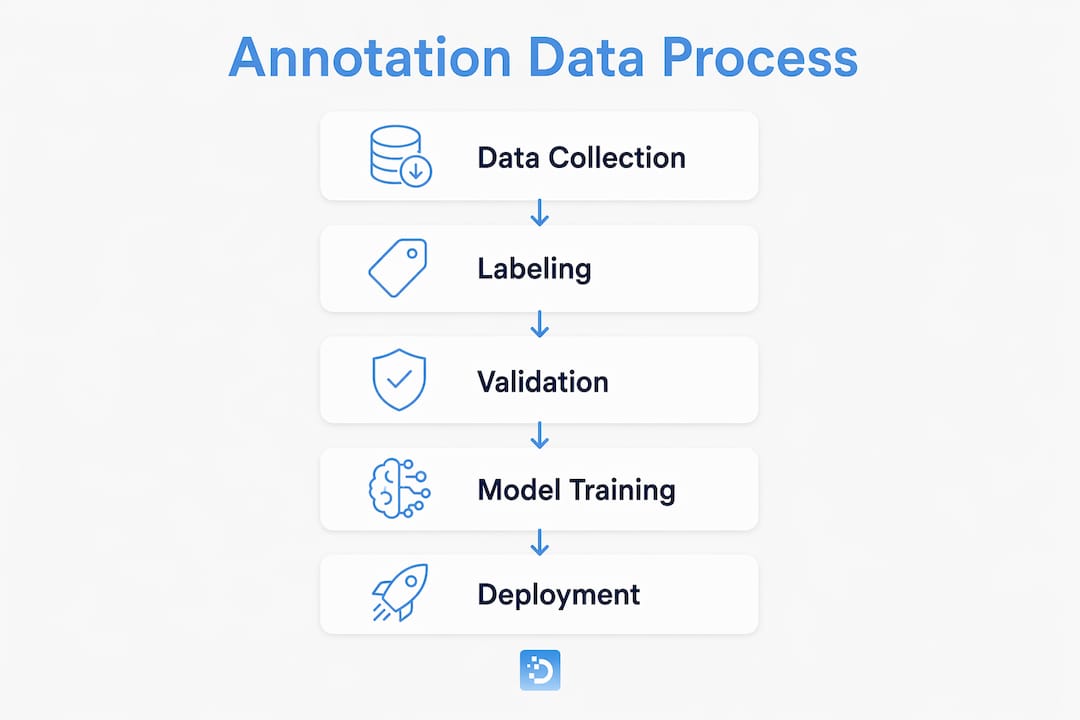
DOT Data Labs manages the full data pipeline from raw data sourcing through final delivery, covering every stage where quality can be gained or lost. The workflow runs as follows:
- Sourcing and collection: identifying the right raw data origins, web scraping at scale, and ingesting data from client-specified sources
- Cleaning and deduplication: removing corrupt files, near-duplicates, and out-of-scope content before annotation begins
- Annotation and labeling: human annotators working against detailed guidelines, with AI-augmented pre-labeling applied where it accelerates throughput without compromising accuracy
- Validation: multi-tier review against gold standard datasets, IAA scoring, and iterative correction cycles
- Delivery: model-ready output in the client’s required format, whether JSON, CSV, COCO, or a custom schema
Three delivery models cover the range of what ML teams actually need. Off-the-shelf datasets are pre-built and available for immediate licensing, useful when a team needs to move fast and the domain is well-covered. One-off custom datasets are scoped and built to exact specifications, from raw collection through validated output. Ongoing data pipelines feed cleaned, labeled data into a client’s training infrastructure continuously, which matters for models that need to stay current with shifting real-world distributions.
The AI augmentation layer deserves a direct explanation. DOT Data Labs uses AI tools to generate initial draft labels on high-volume tasks, then routes those drafts to human reviewers who verify and correct them. This is not a shortcut that trades quality for speed. It is the same hybrid human-AI workflow that research consistently identifies as the most effective approach for combining throughput with accuracy. The human review step is non-negotiable, particularly for healthcare, automotive, and finance datasets where label errors carry real downstream risk.
Pro Tip: When scoping a large annotation project, ask your vendor how they handle annotator calibration across the full project duration, not just at kickoff. Label drift is a slow, invisible problem that compounds over weeks. A vendor with no answer to this question is a vendor without a quality system.
For teams evaluating whether to build annotation capacity in-house or outsource it, the 32 million Q&A dataset example is instructive. Delivering that volume in under 30 days requires parallel annotator teams, automated quality checks, and a delivery infrastructure that most internal data teams do not have standing by. The scalability challenges of annotation at enterprise scale are real, and they tend to surface at the worst possible moment: when a model training run is waiting on data.
AI-driven market analysis is also reshaping how teams think about annotation investment, with more organizations treating labeled datasets as long-term strategic assets rather than one-time project costs.
Key Takeaways
Annotation data is the single most direct lever teams have over model accuracy: better labels produce better models, and no amount of architecture tuning compensates for a corrupted training set.
| Point | Details |
|---|---|
| Annotation type must match the task | Classification, detection, segmentation, and keypoint annotation each serve different model architectures; choosing the wrong type wastes budget. |
| IAA scores catch quality problems early | Measuring Inter-Annotator Agreement before a full labeling run prevents errors from compounding across millions of samples. |
| Hybrid human-AI workflows outperform either alone | AI pre-labeling handles volume; human review catches the errors that matter in sensitive domains like healthcare and autonomous driving. |
| Label drift is a long-project risk | Periodic calibration against a gold standard dataset keeps annotation consistent from month one through project completion. |
| Scale requires a coordinated pipeline | DOT Data Labs delivered a 32 million Q&A dataset in under 30 days by running sourcing, annotation, and validation in parallel. |