
Data Annotations: A Practical 2026 Guide for ML Teams
TL;DR:
- High-quality data annotations are crucial for improving machine learning models and boosting organizational revenue. Implementing a structured workflow, including clear guidelines, AI-assisted pre-labeling, and continuous evaluation, enhances accuracy and compliance. Proper annotation practices save costs and ensure model performance aligns with production demands.
Data annotations are structured labels applied to raw data that tell a machine learning model what it is looking at. Without them, a neural network sees pixels, tokens, or sensor readings with no context. With them, it learns to detect tumors, transcribe speech, or steer a vehicle. Organizations that integrate structured human-in-the-loop AI workflows are about 4 times more likely to report revenue growth than teams running isolated pilots. That gap exists almost entirely because of data quality, and data quality starts with annotation. The industry standard for measuring annotation quality now draws on epistemic frameworks like the Triangular Annotation Framework, which defines high-quality training data across three dimensions: factual accuracy, reasoning completeness, and honest uncertainty expression.
What are the main types of data annotations?
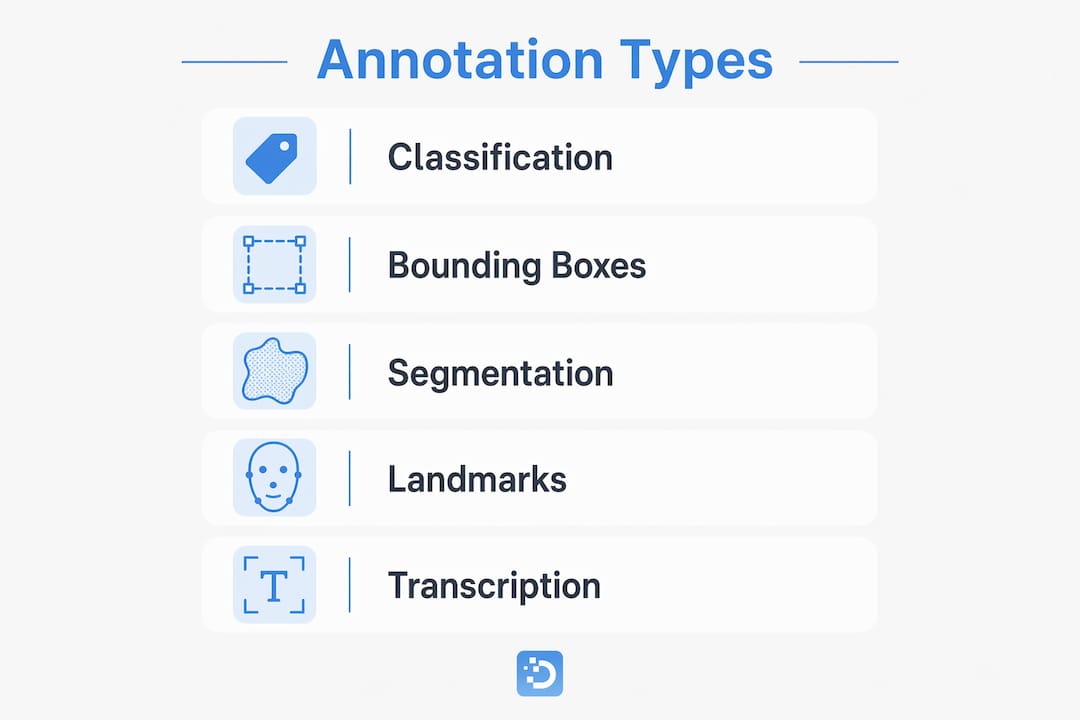
Annotation types span a wide spectrum, from simple text classification to complex 3D spatial labeling. Choosing the wrong type for your task wastes annotator time and produces training signal your model cannot use.
The most common types, and their primary use cases, are:
- Classification labels assign a single category to an entire sample. Use these for sentiment analysis, document routing, or image-level tagging.
- Bounding boxes draw a rectangle around an object in an image or video frame. They are the default choice for object detection tasks where exact boundaries are not needed.
- Polygons and segmentation masks trace the precise outline of an object. Segmentation masks go pixel-by-pixel and are required for tasks like medical image analysis or autonomous driving scene parsing.
- Keypoints mark specific anatomical or structural landmarks, such as joints in a human pose estimation model or facial feature points for expression recognition.
- Polylines label linear structures like lane markings, roads, or cables in aerial imagery.
- 3D cuboids annotate objects in LiDAR or depth-camera point clouds, critical for robotics and automotive perception.
- Event annotations mark the start and end of a specific occurrence in time-series or video data, such as a fall detection event or a machine fault signal.
| Annotation type | Data modality | Typical use case | Complexity |
|---|---|---|---|
| Classification | Text, image, audio | Sentiment, routing, tagging | Low |
| Bounding box | Image, video | Object detection | Low to medium |
| Segmentation mask | Image, video | Scene parsing, medical imaging | High |
| Keypoints | Image, video | Pose estimation, facial landmarks | Medium |
| 3D cuboid | LiDAR, point cloud | Autonomous vehicles, robotics | Very high |
| Event annotation | Time series, video | Anomaly detection, activity recognition | Medium to high |
Annotation granularity directly affects model performance. A bounding box model trained on vehicle detection will underperform a segmentation model on tasks that require precise object boundaries, even if both datasets cover the same images.
How does a modern annotation workflow operate?
A production-grade annotation pipeline has three distinct phases: curation, labeling, and evaluation. Skipping any one of them creates compounding errors downstream.
-
Curation. Select high-signal data slices before a single label is applied. This means filtering out duplicates, near-duplicates, and low-quality samples. A dataset of 100,000 well-chosen images consistently outperforms one of 1 million random images for the same task. Good curation also means stratifying your data to cover edge cases your model will encounter in production.
-
Labeling. Define a clear annotation schema and written guidelines before annotators start. The schema specifies label taxonomy, edge case rules, and examples of correct and incorrect labels. Human annotators handle ambiguous or high-stakes samples. AI-assisted pre-labeling handles high-confidence, repetitive cases. Model-assisted labeling reaches up to 95% of human performance at a fraction of the cost, making it the default starting point for most teams in 2026.
-
Evaluation. Measure inter-annotator agreement, label error rate, and model performance on held-out validation sets after each labeling batch. Feed those metrics back into the curation and labeling steps. This closed loop is what active learning formalizes: the model flags its own low-confidence predictions, and those samples get prioritized for human review in the next annotation cycle.
Pro Tip: Write annotation guidelines as if you are onboarding someone who has never seen your domain. Ambiguity in guidelines is the single largest source of label inconsistency, and inconsistency is harder to fix than missing data.
What are the best practices for data annotation in 2026?

2026 best practices center on one principle: data quality beats data quantity. Leading teams have moved away from bulk labeling toward targeted, high-precision workflows that combine foundation model pre-labeling, active learning, and human review.
Foundation model pre-labeling
Large vision and language foundation models now generate draft annotations at scale. A human annotator then corrects rather than creates from scratch. This cuts labeling time significantly while preserving accuracy on standard cases. The human effort concentrates on the 5–15% of samples where the model is uncertain or wrong.
Human-in-the-loop quality assurance
Human-in-the-loop is not a fallback. It is the control layer that determines which samples get human review based on model confidence scores, risk stakes, and whether a labeling decision is reversible. High-stakes samples, such as medical or safety-critical labels, always route to expert human review regardless of model confidence.
Synthetic data and data programming
Synthetic data generation fills gaps in rare class coverage without expensive real-world collection. Data programming uses labeling functions, short code snippets that encode domain rules, to generate weak labels at scale. Both techniques work best when combined with a human review pass on a representative sample.
Privacy-preserving annotation
Teams handling personal data now apply anonymization, differential privacy, and access controls before annotation begins. Every dataset DOT Data Labs delivers is scoped against applicable data protection regulations before collection starts, which removes compliance risk from the annotation pipeline entirely.
Key metrics every team should track:
- Inter-annotator agreement (IAA): Cohen’s Kappa above 0.8 is the accepted threshold for production-quality labels.
- Label error rate: Target below 2% for most supervised learning tasks.
- Throughput per annotator per hour: Tracks efficiency and flags annotator fatigue or guideline confusion.
- Model performance delta per labeling batch: Directly connects annotation investment to model improvement.
Pro Tip: Run a small inter-annotator agreement study on 200–500 samples before scaling any labeling effort. If Kappa is below 0.7, fix the guidelines. Scaling a broken schema multiplies the problem.
How to implement reliable annotations in your AI training projects
Reliable annotation at scale requires decisions made before labeling starts, not after errors appear. The Triangular Annotation Framework offers a practical structure: evaluate every label against factual accuracy, reasoning completeness, and honest uncertainty expression. This prevents annotators from defaulting to social consensus, where they agree with each other rather than with objective ground truth.
A practical implementation checklist:
- Define your label taxonomy and edge case rules in a written schema before recruiting annotators.
- Apply shift-left quality assurance by validating data format, label schema compliance, and sample quality before annotation begins. Catching errors at this stage costs up to 100 times less than fixing them after labeling is complete.
- Use AI-assisted pre-labeling for high-volume, low-ambiguity samples. Reserve human expert review for ambiguous, rare, or high-stakes cases.
- Maintain full traceability: log annotator ID, timestamp, label version, and any overrides. Rich, traceable human feedback is now the standard for governance and model auditing.
- Run continuous feedback loops. After each model training cycle, identify the samples where the model fails and route them back to annotation for correction or augmentation.
Auditability is not optional for teams operating under GDPR, HIPAA, or emerging AI Act requirements. A labeled dataset with no provenance record is a liability, not an asset. For teams looking to scale annotation efficiently, the combination of shift-left QA and active learning is the most cost-effective path in 2026.
Pro Tip: Treat your annotation guidelines as a living document. Version-control them alongside your model code. When model performance drops after a data refresh, the first place to check is whether the guidelines changed between batches.
Key Takeaways
High-quality data annotations require a structured pipeline combining clear schemas, AI-assisted pre-labeling, human expert review, and continuous feedback loops tied directly to model performance metrics.
| Point | Details |
|---|---|
| Annotation type selection | Match the annotation type to the task; using bounding boxes where segmentation is needed degrades model accuracy. |
| Shift-left QA saves cost | Catching label errors before annotation begins costs up to 100 times less than fixing them post-labeling. |
| Human-in-the-loop is the control layer | Route high-confidence samples to AI pre-labeling and ambiguous or high-stakes samples to expert human review. |
| IAA above 0.8 is the quality bar | Cohen’s Kappa below 0.8 signals guideline problems that will compound at scale. |
| Traceability is a compliance requirement | Log annotator ID, timestamps, and overrides to satisfy GDPR, HIPAA, and AI Act audit requirements. |
The uncomfortable truth about annotation quality I’ve learned the hard way
Most annotation failures I have seen are not technology failures. They are guideline failures. A team spends weeks selecting a labeling platform, integrates a foundation model pre-labeler, and then ships annotation guidelines that fit on a single slide. Six weeks later, inter-annotator agreement is at 0.6 and the model is underperforming a baseline trained on half the data.
The epistemic gatekeeper problem is real. Annotators under time pressure converge on what their peers labeled, not on what is objectively correct. I have watched this happen on medical imaging projects, on NLP tasks, and on autonomous driving datasets. The fix is not more annotators. The fix is better guidelines, regular calibration sessions, and a culture where annotators are rewarded for flagging uncertainty rather than hiding it.
Automation is genuinely useful. Foundation model pre-labeling has changed what is economically possible. But the teams getting the most out of it are the ones who treat human review as a precision instrument, not a cost to minimize. The 78% of executives who lack confidence passing AI audits are mostly dealing with datasets where human oversight was treated as optional. It was not.
— Oleg
DOT Data Labs handles annotation so your team can focus on modeling
ML teams that build annotation pipelines from scratch spend months on tooling, vendor management, and quality control before a single model trains on production-ready data.
DOT Data Labs covers the full annotation supply chain: schema design, human labeling, AI-assisted pre-labeling, quality validation, and delivery in model-ready formats. Recent projects include a 32 million science Q&A dataset delivered in under 30 days and 50,000 hours of talking-head video with aligned subtitles. Every dataset is scoped against applicable data protection regulations before collection begins. Whether you need off-the-shelf datasets for immediate deployment or a fully custom annotation pipeline, DOT Data Labs delivers production-ready data at scale. Contact the team at dotdatalabs.ai to scope your next project.
FAQ
What does data annotation mean in machine learning?
Data annotation means applying structured labels to raw data so a machine learning model can learn from it. Labels can be text categories, bounding boxes, segmentation masks, keypoints, or event markers depending on the task.
What is the difference between manual and automated data annotation?
Manual data annotation uses human annotators to label each sample, which is accurate but slow. Automated annotation uses AI pre-labeling to generate draft labels at scale, with humans reviewing uncertain or high-stakes cases.
How do image data annotations differ from text annotations?
Image data annotations assign spatial labels such as bounding boxes, polygons, or segmentation masks to visual content. Text annotations assign semantic labels such as categories, named entities, or sentiment scores to written content.
What is a good inter-annotator agreement score?
Cohen’s Kappa above 0.8 is the accepted threshold for production-quality labeled datasets. Scores below 0.7 indicate guideline ambiguity that needs to be resolved before scaling the labeling effort.
How does shift-left QA improve annotation pipelines?
Shift-left validation catches data format errors, schema violations, and quality issues before annotation begins. Fixing errors at this stage costs up to 100 times less than correcting them after labeling is complete.