
Data Train: Programs, Pipelines, and AI Training Data
“Data train” covers two distinct but connected ideas. The first is structured academic programs, like the U Bremen Research Alliance’s Data Train initiative, designed to build research data management and data science skills in early-career researchers. The second is the curated machine learning data that teaches AI models to recognize patterns and make predictions. Both matter to anyone working at the intersection of research and applied AI.
Here is what both contexts share:
- Educational programs build competencies in data literacy, FAIR principles, and research data stewardship through structured curricula and certification.
- Training data refers to labeled or unlabeled datasets fed into machine learning models during the learning phase.
- Data quality is the common thread. Poor data produces poor models and poor research outcomes, regardless of which context you are working in.
- Preprocessing and governance apply to both: academic programs teach them as skills; AI teams apply them as operational workflows.
How Data Train educational programs are structured
The U Bremen Data Train program is one of the clearest examples of a formal, cross-disciplinary data education initiative. It runs across two tracks designed for different experience levels and career goals.
The Starter Track covers foundational concepts: data literacy, research data management (RDM), FAIR data principles, and the ethical, legal, and social dimensions of working with data. It is the entry point for researchers who are new to structured data work.
The Operator Tracks go deeper. They alternate yearly between two specializations: Data Steward and Data Scientist. The Data Steward track focuses on governance, documentation, and long-term data usability. The Data Scientist track covers computational analysis, programming, AI applications, and data visualization. Both tracks are application-oriented, combining lectures with hands-on workshops.

Completion leads to a Certificate of Advanced Studies, a formal credential that signals professional-level competency in research data management and data science.
| Track | Content Focus | Format | Target Participants |
|---|---|---|---|
| Starter Track | Data literacy, RDM, FAIR principles, ethics | Lectures and workshops | Early-career researchers, new data practitioners |
| Operator: Data Steward | Governance, documentation, data stewardship | Intensive workshops | Researchers managing institutional data |
| Operator: Data Scientist | Programming, AI applications, visualization | Hands-on, application-oriented | Researchers pursuing computational methods |
Key skills participants develop across both tracks:
- Applying FAIR data principles to real research datasets
- Designing and maintaining data management plans
- Using programming tools for data analysis and visualization
- Understanding legal and ethical obligations in data handling
- Communicating data findings to interdisciplinary audiences
Programs like this matter beyond academia. The skills they teach, particularly around data governance and preprocessing, map directly onto what AI teams need when building production-grade training datasets. Organizations building data literacy programs for IT and research staff face the same foundational challenge: people need structured frameworks before they can work with data reliably.
What training data actually is in machine learning
Training data is the dataset a model learns from. Stanford HAI defines it as the information used to teach an algorithm to perform a task, whether that is classifying images, generating text, or detecting fraud. Without it, there is no model.
The type of training data you use determines which learning paradigm you are working in:
- Labeled data (supervised learning): Each example carries a correct answer. A dataset of images tagged as “cat” or “dog” is the classic case. The model learns to map inputs to outputs.
- Unlabeled data (unsupervised learning): No labels. The model finds structure on its own, grouping similar inputs or identifying anomalies.
- Semi-supervised data: A small labeled set combined with a large unlabeled set. Useful when labeling at scale is expensive.
- Synthetic data: Artificially generated examples that mimic real-world distributions. Valuable when real data is scarce or sensitive.
- Reinforcement learning data: Not a static dataset but a feedback signal. The model learns by taking actions and receiving rewards or penalties.
IBM’s training data overview makes a point worth repeating: each data type serves specific AI tasks and directly shapes model design. Choosing the wrong type is not a minor technical error. It sends the entire project in the wrong direction.
One distinction that trips up a lot of teams is the difference between training, validation, and test datasets. They are not interchangeable:
- Training data is what the model learns from.
- Validation data is used during training to tune hyperparameters and catch overfitting early.
- Test data is held out entirely and used only for final performance evaluation.
Proper dataset splitting is what separates a model that generalizes from one that just memorizes its training examples.
The data preparation lifecycle: from raw data to model-ready
Raw data is almost never usable as-is. The preprocessing pipeline transforms it into something a model can actually learn from. These are the core steps:
- Data profiling: Audit the raw dataset. Identify missing values, duplicates, outliers, and format inconsistencies before touching anything else.
- Data cleaning: Fix or remove errors. Impute missing values using mean, median, or mode depending on the distribution. Delete duplicate rows. Correct formatting issues.
- Data integration: Merge data from multiple sources into a single unified dataset. This is harder than it sounds when sources use different schemas, naming conventions, or units.
- Data transformation: Convert data into a form the model can process. This includes normalization (Min-Max or Z-Score), encoding categorical variables (one-hot or label encoding), and log transformations to reduce skew.
- Data reduction: Trim the dataset to what matters. Principal Component Analysis (PCA) reduces dimensionality. Feature selection methods, including filter, wrapper, and embedded approaches, remove irrelevant variables without losing predictive signal.
Common problems at each stage:
- Class imbalance: One category dominates the dataset. The model learns to predict the majority class and ignores the rest. Strategies like oversampling, undersampling, or synthetic minority generation (SMOTE) address this. For a detailed breakdown, see how to handle data imbalance in AI training datasets.
- Noise: Errors introduced by faulty sensors, manual entry mistakes, or transmission issues. Noisy data obscures real patterns.
- Missing values: Handled by imputation or deletion, depending on how much data is missing and why.
Pro Tip: Invest heavily in preprocessing before you touch model architecture. The garbage-in, garbage-out problem is the most common cause of underperforming models. A cleaner dataset almost always outperforms a fancier model trained on dirty data.
A solid data preprocessing workflow is not a one-time task. Production AI systems require ongoing data validation as new data enters the pipeline and distributions shift over time.

Why FAIR data principles matter for research and AI
FAIR principles, developed to improve the reusability of research data, stand for Findable, Accessible, Interoperable, and Reusable. They originated in academic research but apply directly to AI data management.
- Findable: Data has a persistent identifier and rich metadata so it can be located by both humans and automated systems.
- Accessible: Data can be retrieved using open, standardized protocols. Access controls are documented and transparent.
- Interoperable: Data uses shared vocabularies and formats so it can be combined with other datasets without manual reconciliation.
- Reusable: Data is described with enough detail that someone else can use it confidently, including provenance, collection methods, and any known limitations.
The U Bremen Data Train Operator Track for Data Stewards embeds these principles directly into its curriculum. Participants learn to apply FAIR standards to real datasets, write data management plans, and document provenance. That is not just academic rigor. It is the same discipline that makes AI training datasets auditable and reproducible.
Ethical and legal dimensions sit alongside the technical ones. Data Train programs cover consent, privacy regulations, and the social implications of data collection. For AI teams, these translate into concrete requirements: checking data sources for licensing compliance, auditing for demographic bias, and documenting collection methods so models can be evaluated fairly.
The benefits of applying FAIR principles to training data:
- Faster onboarding for new team members who need to understand existing datasets
- Easier compliance audits when regulators or clients ask about data provenance
- Higher reuse value across multiple model versions or projects
- Reduced risk of silent data drift going undetected in production pipelines
Platforms and use cases for training data management
Curated training data powers a wide range of AI applications. Natural language processing models need text corpora with intent labels or sentiment annotations. Computer vision systems require images tagged with bounding boxes, segmentation masks, or classification labels. Autonomous vehicle systems consume sensor fusion data combining LiDAR, camera, and radar inputs, all precisely labeled for object detection and path planning.
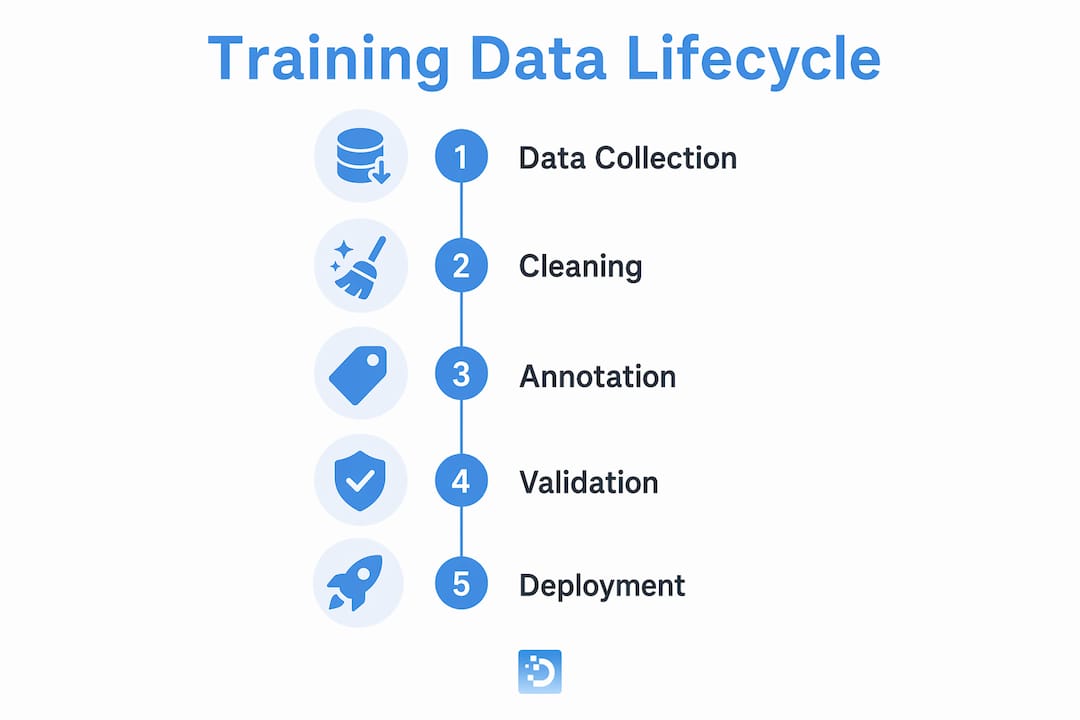
DataTrain.AI is one platform built specifically for enterprise-scale training data workflows. Its capabilities include data annotation, labeling, model evaluation, and pipeline management. The core value is consolidating what would otherwise be a fragmented set of tools into a single workflow, reducing handoff errors and accelerating iteration cycles.
Key platform capabilities that matter for production AI teams:
- Annotation tooling: Bounding boxes, polygons, keypoints, and text spans, with quality control built into the workflow.
- Labeling workforce management: Routing tasks to annotators, tracking inter-annotator agreement, and flagging low-confidence labels for review.
- Model evaluation integration: Connecting labeled validation sets directly to model performance dashboards.
- Pipeline orchestration: Scheduling batch data ingestion, transformation, and delivery to training infrastructure.
Scaling any of these creates real challenges. Labeling accuracy degrades as task complexity increases and annotator fatigue sets in. Data sourcing becomes harder when the domain is specialized, such as medical imaging or legal documents, and general-purpose annotators lack the expertise to label correctly. Workflow scaling requires either more annotators or better automation, and usually both.
For teams that need ongoing data delivery rather than a one-time dataset, real-time AI data pipelines solve a different problem: keeping training data fresh as the world changes and the model’s operating environment shifts.
DOT Data Labs handles the full training data supply chain
Building and maintaining production-grade training data is operationally demanding. Sourcing, cleaning, labeling, validating, and delivering at scale requires either a dedicated internal team or a vendor who covers the full stack.
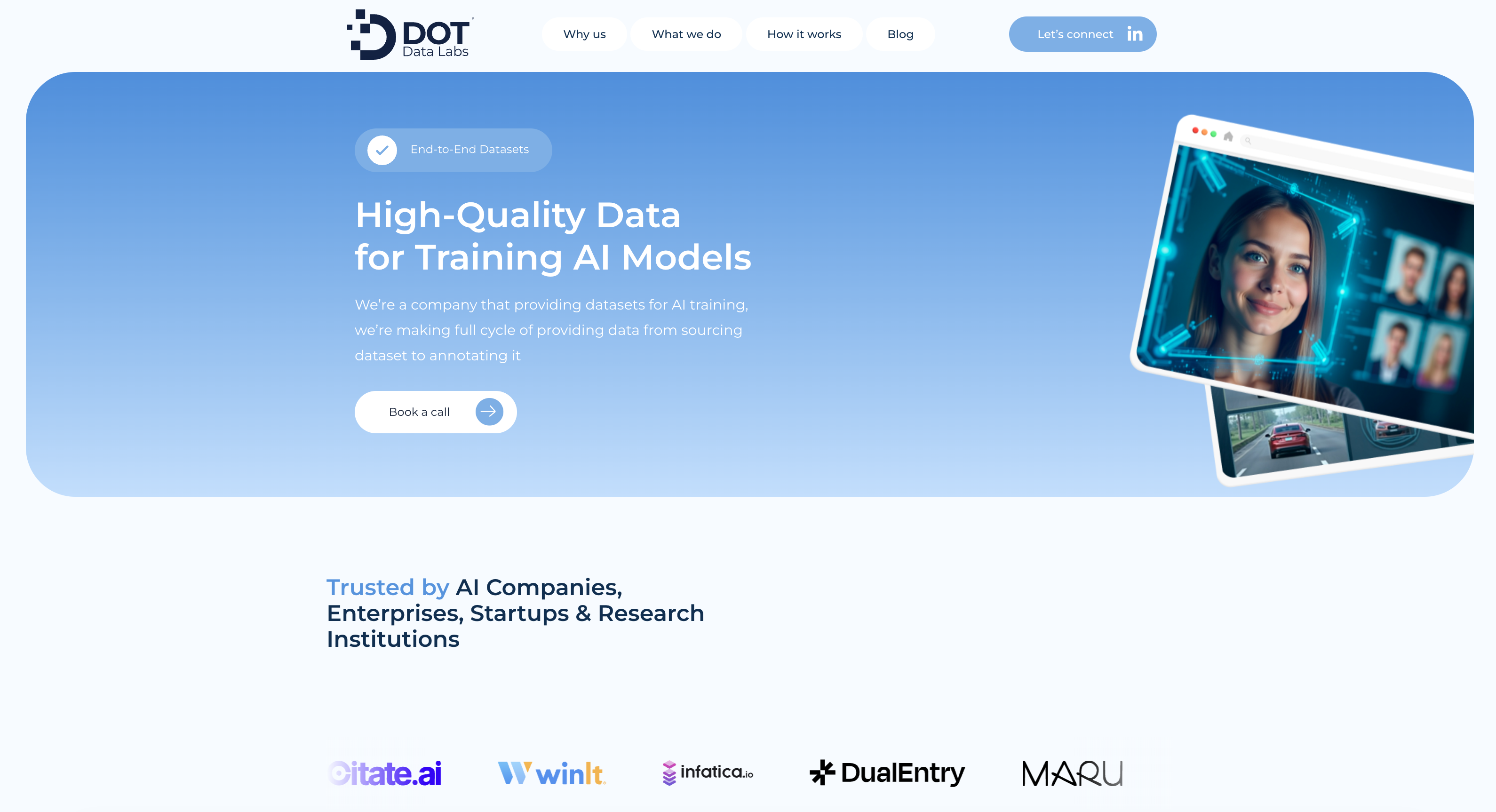
DOT Data Labs handles every stage of that supply chain, from raw data collection and web scraping through cleaning, deduplication, human annotation, and final delivery in model-ready formats. Recent projects include large-scale science Q&A datasets delivered rapidly and extensive collections of talking-head video with aligned subtitles processed for AI training. For teams that need professional annotation and labeling services without building internal tooling, DOT Data Labs covers both one-off custom builds and ongoing data pipelines.
Key Takeaways
High-quality training data, built on rigorous preprocessing and governed by clear data principles, is the single most controllable variable in AI model performance.
| Point | Details |
|---|---|
| Data Train covers two contexts | Academic programs like U Bremen’s initiative build RDM skills; training data refers to curated ML datasets. |
| Preprocessing determines model quality | Steps like cleaning, transformation, and reduction directly control whether a model learns real patterns or noise. |
| FAIR principles apply beyond academia | Findable, Accessible, Interoperable, Reusable standards improve auditability and reuse in AI data pipelines. |
| Dataset splits are non-negotiable | Training, validation, and test sets serve distinct roles; conflating them produces models that fail in production. |
| Platform and pipeline choice affects scale | Enterprise annotation platforms and managed data pipelines reduce labeling errors and accelerate model iteration. |