
How to handle data imbalance in AI training datasets
TL;DR:
- Data imbalance can cause models to ignore minority classes, leading to silent but critical failures. Proper assessment, including stratified splits and class distribution analysis, is essential before applying techniques like class weighting or SMOTE. Using evaluation metrics such as PR-AUC and F1-score, along with careful pipeline hygiene, ensures reliable performance in imbalanced datasets.
A model that scores 98% accuracy but misses every fraud case is not a good model. It is a liability. Knowing how to handle data imbalance is one of the most consequential skills an ML team can have, yet it is routinely underestimated until a model fails in production. Imbalanced training data causes models to learn the majority class well and ignore the minority class almost entirely, creating silent failures in fraud detection, medical diagnosis, and cybersecurity. This guide covers the practical strategies your team needs to get it right.
Assessing imbalance and preparing your dataset
Before you apply any fix, you need to know what you are dealing with. Imbalance severity falls into three tiers: mild (1:5 to 1:20), moderate (1:20 to 1:100), and severe (1:100 and above). A mild imbalance often needs nothing more than class weighting. A severe imbalance in a medical screening model is a fundamentally different problem that may require data collection, not just resampling.
Start with a visual and statistical analysis of class separability. Plot class distributions, check overlap in feature space using PCA or UMAP, and run basic separability checks before touching any algorithm. If your minority class is well-separated from the majority, even basic methods will work well. High overlap or class disjuncts, where minority samples appear as isolated islands in feature space, signal that no algorithm will save a poorly constructed dataset.

Here is how imbalance ratios map to typical handling approaches:
| Imbalance level | Ratio range | Recommended starting point |
|---|---|---|
| Mild | 1:5 to 1:20 | Class weighting |
| Moderate | 1:20 to 1:100 | Class weighting + SMOTE variants |
| Severe | 1:100+ | SMOTE + ensemble methods or data collection |
Key preparation steps before training:
- Calculate per-class sample counts and visualize distributions
- Inspect feature distributions within each class for overlap and noise
- Use stratified train-test splits that preserve minority class ratios
- Map false positive and false negative costs for your business use case
Your classification dataset strategies should be defined at this stage, not retrofitted after a poor training run.
Pro Tip: Always compute your imbalance ratio on the training split alone, not the full dataset. Splitting first and measuring second ensures your ratio reflects what the model actually trains on.
Core techniques for handling imbalanced data
With proper preparation, you can now apply core imbalance handling techniques tailored to your data and model. Class weighting is often the simplest and most effective starting point, especially for tree-based models. It modifies the loss function so that errors on minority class samples cost more, with zero data modification required.
SMOTE (Synthetic Minority Oversampling Technique) creates synthetic minority samples by interpolating between existing ones. It is more powerful than simple duplication because it adds variety rather than repetition. For noisy data, SMOTEENN and BorderlineSMOTE reduce the risk of generating synthetic points in ambiguous regions. The tradeoff is added complexity and a higher risk of overfitting if not validated carefully.
Here is a comparison of the core methods:
| Method | Data modified | Risk | Best for |
|---|---|---|---|
| Class weighting | No | Low | Tree-based, neural networks |
| SMOTE | Yes (oversample) | Medium | Moderate imbalance, clean data |
| Undersampling | Yes (reduce) | Information loss | Very large majority class |
| Threshold tuning | No | Low | Any trained model post-training |
A practical approach for dealing with data imbalance:
- Start with class weights and train a baseline model
- Evaluate using F1-score and PR-AUC, not accuracy
- If minority recall is still low, add SMOTE within your pipeline
- Try BorderlineSMOTE if standard SMOTE produces noisy results
- Tune the decision threshold on your validation set to match business cost priorities
- Compare results against baseline using the same evaluation metrics
The best classification dataset practices always include deciding the resampling strategy before pipeline construction, not mid-experiment. Applying data transformation for imbalance correctly inside your pipeline structure is what separates reliable results from misleading ones.
Pro Tip: If you are using XGBoost or LightGBM, set the "scale_pos_weight` parameter to the ratio of negative to positive samples. It handles imbalance natively with no extra code.
Avoiding common pitfalls and data leakage in imbalance handling
Understanding core techniques is crucial, but equally vital is avoiding pitfalls that can invalidate your results. The most damaging mistake teams make is applying oversampling before the train-test split. When synthetic minority samples bleed into the test set, your evaluation is measuring performance on data the model has effectively already seen.
Resampling must happen only inside each cross-validation fold, applied strictly to the training portion. Libraries like imblearn.pipeline handle this automatically, but you have to use them correctly. A pipeline that includes SMOTE, scaling, and the estimator in sequence is safer than chaining operations manually.
Misconfigured resampling pipelines can inflate reported metrics by 10 to 20%, creating models that appear production-ready but collapse on real data.
Critical pipeline hygiene checks:
- Split data into train and test sets first, before any transformation
- Apply scaling and encoding inside the pipeline, not before it
- Use
StratifiedKFoldfor cross-validation to maintain class ratios in every fold - Never fit scalers or encoders on test data
- Log which resampling steps were applied and in what order for reproducibility
Creating high-quality datasets starts with disciplined pipeline design. Shortcuts taken at this stage show up as expensive surprises after deployment.
Choosing the right evaluation metrics for imbalanced datasets
Now that you can handle imbalance properly, ensure you measure model success with meaningful metrics. Accuracy is the wrong tool entirely for imbalanced problems. A model predicting “not fraud” for every transaction in a 99:1 imbalanced dataset achieves 99% accuracy while being completely useless.
PR-AUC and F1-score better reflect minority class performance and should be your primary reporting metrics. PR-AUC measures the tradeoff between precision and recall across all thresholds, making it sensitive to how well your model handles rare events. F1-score gives you a single number that balances both.
For use cases where false negatives are more costly than false positives, such as cancer screening, use F-beta with beta greater than 1 to weight recall more heavily.
Metrics to track for imbalanced classification evaluation:
- Precision-Recall AUC: Best for severe imbalance and rare event detection
- F1-score: Good general-purpose metric balancing precision and recall
- F-beta: Adjusts the precision-recall tradeoff by business cost
- Confusion matrix: Exposes false negative rates by subgroup, not just overall
- Matthews Correlation Coefficient (MCC): Particularly useful for binary classification with extreme imbalance
Implementing an effective imbalanced data training workflow
Having discussed metrics, let’s synthesize everything into a practical training workflow. Following a structured process is what separates teams that solve data imbalance once from teams that keep rediscovering the same problems.
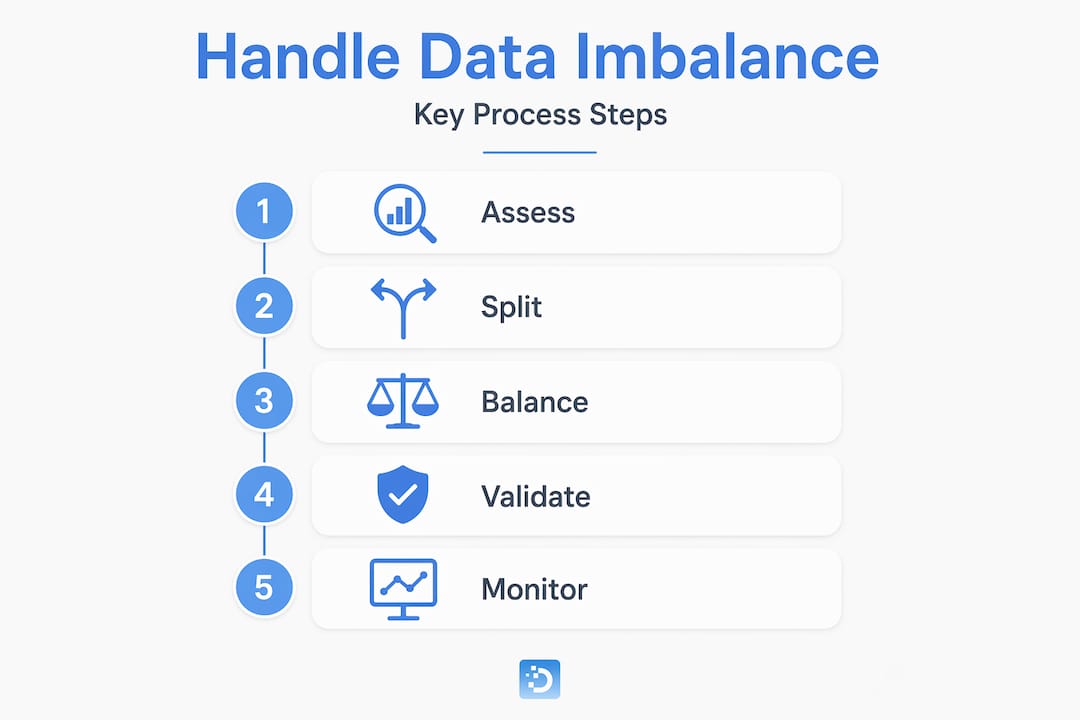
A robust imbalanced classification workflow includes stratified splits, proper pipeline construction, threshold tuning, and post-deployment monitoring:
- Stratified train-test split preserving class ratios in both sets
- Build an imblearn pipeline with scaling, optional resampling, and your estimator in sequence
- Run stratified cross-validation so resampling stays inside each training fold
- Train with class weights or SMOTE based on your imbalance severity assessment
- Tune the decision threshold on validation data to match your precision-recall priority
- Evaluate using PR-AUC, F1-score, and confusion matrices across subgroups
- Monitor post-deployment for data drift and recalibrate class weights as distributions shift
| Workflow stage | Key action | Common mistake |
|---|---|---|
| Data splitting | Stratified split | Random split loses minority class |
| Pipeline setup | SMOTE inside CV loop | Applying SMOTE before split |
| Threshold setting | Tune on validation set | Using default 0.5 threshold |
| Post-deployment | Monitor class distributions | Ignoring drift over time |
Apply data transformation workflow principles at every stage, and document each decision. When a model drifts in production, your team needs to trace which step to revisit. Your high-quality ML datasets guide should include the full audit trail of how imbalance was handled.
Pro Tip: After deployment, set an alert when your model’s predicted positive rate drops significantly below its training positive rate. That signal usually means the class distribution in production has shifted and your weights need updating.
Why starting simple and understanding your data wins in imbalance handling
Here is the opinion most articles on this topic skip. Teams reach for SMOTE before they fully understand their data, and that is where the trouble starts. The effectiveness of imbalance techniques depends heavily on data difficulty factors like class overlap, noise levels, and small disjuncts, not just on the ratio. SMOTE applied to a noisy, overlapping dataset can make things actively worse by generating synthetic points right in the decision boundary.
The teams that handle imbalance well tend to follow a simple rule: earn the right to use complex methods by exhausting the simple ones first. Class weighting is transparent, fast, and leaves your data untouched. It is also often good enough. Paired with threshold tuning, it solves a large portion of real-world imbalance problems without introducing the risks that resampling carries.
SMOTE and its variants are genuinely useful. But they belong at step three, not step one. The complexity they add requires more validation effort, more careful pipeline construction, and more explanation when someone asks why the model behaves unexpectedly in production. Maintainability matters for any model that runs for months.
Business cost understanding should be the anchor for every technique decision. Not which method is technically fashionable, but which type of error costs your organization more. A fraud model and a medical screening model have completely different tradeoffs. Treating them with the same default approach is how teams ship models that look fine in evaluation and fail at the worst possible moment.
The best imbalance strategy is the simplest one that meets your classification dataset best practices and business requirements. Complexity is not a virtue here.
Partner with Dot Data Labs for custom AI training data solutions
Handling imbalance is far easier when your training data starts from a strong foundation. Poorly collected, unbalanced raw data creates problems that no resampling technique can fully fix.

At Dot Data Labs, we help ML teams source and deliver training datasets that are structurally sound before they hit your pipeline. That means controlled sampling strategies to ensure meaningful minority class representation from the start, rigorous labeling QA, and delivery in model-ready formats. If your current dataset needs structural improvement, our team builds against your exact specifications. Explore our training-ready data best practices and dataset curation tips to see how upstream data quality changes the imbalance conversation entirely.
Frequently asked questions
What is data imbalance and why does it matter for AI models?
Data imbalance occurs when some classes have far fewer samples than others, causing models to underperform on rare but often critical outcomes. This issue is prevalent in fraud detection, medical diagnosis, and cybersecurity, where missing a minority class event carries serious real-world cost.
Can I use accuracy to evaluate models with imbalanced data?
No. Accuracy exceeds 99% in severely imbalanced datasets while the model misses every minority case entirely. Use Precision-Recall AUC or F1-score as your primary evaluation metrics instead.
When should I apply resampling techniques like SMOTE?
Apply resampling only after performing your train-test split, and only inside cross-validation training folds. Resampling before splitting contaminates the test set with synthetic data the model has already learned from, inflating reported performance.
Which imbalance handling method is best for tree-based models?
Class weighting is generally the better choice for tree-based models like XGBoost or Random Forest. Oversampling with SMOTE can introduce redundant, noisy points that degrade the model’s ability to find clean decision boundaries.
How can I set the optimal decision threshold for imbalanced classification?
Evaluate your model’s predicted probabilities on a held-out validation set and select the threshold that maximizes your target metric, whether F1-score, recall, or a business cost-weighted measure. The default 0.5 threshold is rarely optimal for imbalanced classification problems.