
Deduplication Logic for ML Engineers: 2026 Guide

TL;DR:
- Deduplication logic uses various algorithms to identify and remove duplicate or similar data, improving storage efficiency and data quality. Implementing layered methods—exact, near-duplicate, and semantic—ensures comprehensive dataset cleansing crucial for high-quality machine learning models. Integrating deduplication as a core, ongoing component of data pipelines enhances model performance and reduces redundancy-related costs.
Deduplication logic is the set of rules and algorithms that detect and remove duplicate or near-duplicate data by comparing chunks or entire records, retaining only unique instances to optimize storage and data quality. For data scientists and ML engineers, understanding this process is not optional. Duplicate records in training datasets introduce bias, inflate storage costs, and degrade model performance in ways that are hard to diagnose after the fact. This guide covers exact, near-duplicate, and semantic deduplication techniques, with implementation strategies drawn from systems like NetApp, Element451, and NVIDIA NeMo Curator.
What is deduplication logic and how does it work?
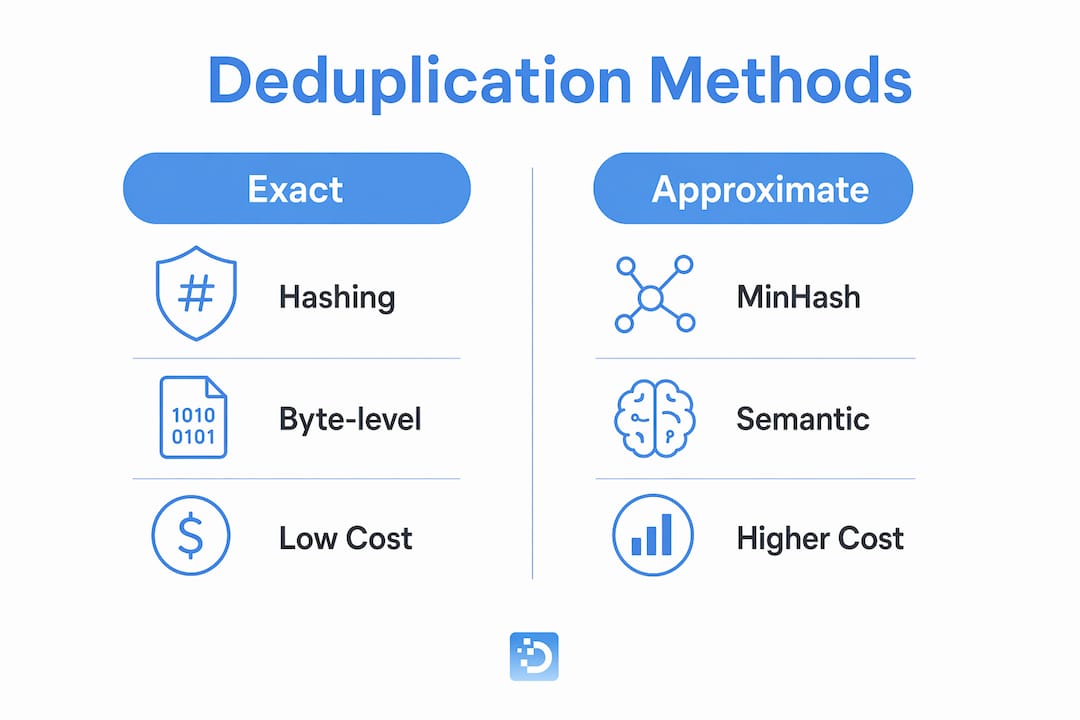
Deduplication logic operates through three distinct detection methods, each suited to a different type of duplicate. The method you choose determines both the accuracy and the computational cost of your pipeline.

Exact deduplication is the most precise approach. NetApp’s inline system scans 4KB blocks, generates cryptographic fingerprints, performs a hash-store lookup, and then verifies byte-by-byte before deduplicating. That final verification step is what separates production-grade systems from naive implementations. Hash collisions are rare but real, and skipping byte-level confirmation introduces silent data corruption.
Near-duplicate detection handles the more common case: content that is similar but not identical. MinHash with LSH compresses documents into compact signatures that estimate Jaccard similarity, then uses Locality-Sensitive Hashing to bucket similar signatures together for candidate selection. This two-stage approach keeps the method scalable. You generate candidates cheaply, then verify only the promising pairs.
Semantic deduplication goes further. It uses embeddings and cosine similarity to identify content that is meaningfully redundant even when the wording is completely different. NVIDIA NeMo Curator implements all three layers: exact, fuzzy via MinHash and LSH, and semantic via embeddings. That layered architecture reflects a core truth about real-world datasets: no single method catches everything.
Here is a direct comparison of the three approaches:
| Method | Technique | Best For | Compute Cost |
|---|---|---|---|
| Exact | Cryptographic hashing + byte verification | Identical records or files | Low |
| Near-duplicate | MinHash + LSH | Similar text with minor edits | Medium |
| Semantic | Embeddings + cosine similarity | Paraphrased or reworded content | High |
Pro Tip: Start with exact deduplication as a first pass. It is cheap and eliminates the easiest wins before you spend compute on MinHash or embedding-based methods.
How do you implement deduplication logic at scale?
Scaling deduplication logic introduces tradeoffs that do not appear in small-scale tests. The four decisions below determine whether your system holds up under production load.
-
Inline vs. background processing. Inline deduplication runs during the write operation. It is immediate but resource-intensive and adds latency to the critical path. Background deduplication runs post-write, requiring temporary storage but offloading compute away from live operations. For ML data pipelines processing large batch ingestions, background deduplication is usually the right call.
-
Scoring and weighted field matching. Not all fields carry equal weight. Element451’s deduplication system uses probabilistic scoring across multiple fields, requiring matches on certain required fields before a duplicate alert fires. The system only flags records above a 70% duplicate probability threshold. This multi-field weighting approach significantly reduces false positives compared to single-field matching.
-
Chunk boundary strategy. Fixed-size chunking is simple but fragile. Insert one character at the start of a document and every chunk boundary shifts, destroying deduplication matches. Content-defined chunking uses rolling fingerprints to stabilize boundaries under edits, producing far better deduplication ratios. For text-heavy ML datasets, content-defined chunking is the correct default.
-
Reference counting and concurrency. In distributed systems, reference count operations must be atomic. Non-atomic increments and decrements in concurrent environments cause two failure modes: premature chunk deletion and duplicate chunk writes. Both corrupt your dataset silently. Use atomic compare-and-swap operations or a dedicated reference counting service.
Pro Tip: In ML pipelines, run deduplication before annotation. Labeling duplicate records wastes annotation budget and introduces label inconsistency if annotators make different decisions on the same content.
Which tools implement deduplication logic for AI data?
Several production systems implement deduplication logic with meaningfully different architectures. Understanding their designs helps you evaluate what fits your stack.
-
NetApp uses fingerprint-based inline and background deduplication at the block level. Its byte-by-byte verification after hash matching eliminates false positives from hash collisions. This is a storage-layer solution, not an application-layer one.
-
Element451 applies probabilistic scoring with required matching fields and a tiered decision model. Certain high-confidence exact matches auto-merge. Weaker probabilistic matches route to manual review to prevent false merges. This tiered decisioning pattern is directly applicable to ML dataset curation.
-
NVIDIA NeMo Curator implements the most complete layered approach for AI data specifically. It runs exact deduplication, fuzzy deduplication via MinHash and LSH, and semantic deduplication via embeddings in sequence. Each layer catches what the previous one misses. This is the architecture to study if you are building a large-scale LLM training data pipeline.
| Tool | Dedup Types | Primary Use Case | Verification Method |
|---|---|---|---|
| NetApp | Exact (block-level) | Storage systems | Byte-by-byte |
| Element451 | Probabilistic scoring | CRM records | Weighted field scoring |
| NVIDIA NeMo Curator | Exact, fuzzy, semantic | LLM training data | Embeddings + LSH |
How does deduplication logic improve ML dataset quality?
Duplicate records in training data are not just a storage problem. They are a model quality problem. A model trained on a dataset where 15% of examples are duplicates will overfit to those repeated patterns. The effect shows up as inflated training accuracy that does not transfer to evaluation sets.
Removing duplicates before training reduces this bias directly. It also cuts storage costs and speeds up training runs by shrinking the effective dataset size without losing information density. For large-scale LLM pretraining, where datasets routinely exceed hundreds of billions of tokens, deduplication can reduce dataset size by 20–30% while improving downstream benchmark performance.
The practical recommendations for ML teams are straightforward:
- Apply exact deduplication first, using SHA-256 or MD5 hashing on normalized text.
- Follow with MinHash and LSH for near-duplicate detection across paraphrased content.
- Reserve semantic deduplication for high-value datasets where compute cost is justified.
- Set similarity thresholds conservatively at first. Aggressive deduplication can remove legitimate linguistic variation that models need to learn from.
Pro Tip: Log every record removed during deduplication with its match score and matched record ID. This audit trail lets you tune thresholds later without rerunning the full pipeline from scratch.
Key takeaways
Deduplication logic requires a layered strategy combining exact, near-duplicate, and semantic methods to reliably clean ML training data at scale.
| Point | Details |
|---|---|
| Three core methods exist | Exact hashing, MinHash with LSH, and semantic embeddings each catch different duplicate types. |
| Inline vs. background tradeoff | Background deduplication reduces pipeline latency; inline deduplication is immediate but resource-heavy. |
| Chunking strategy matters | Content-defined chunking outperforms fixed-size chunking for datasets that undergo frequent edits. |
| Scoring reduces false positives | Weighted multi-field scoring with probability thresholds, as used by Element451, prevents incorrect merges. |
| Dedup before annotation | Running deduplication before labeling saves annotation budget and prevents label inconsistency. |
The part most teams get wrong about deduplication
I have seen ML teams treat deduplication as a one-time preprocessing step. Run it once before training, check the box, move on. That approach works until your data pipeline starts ingesting new data continuously. At that point, deduplication logic needs to be part of the pipeline architecture, not a batch script someone runs manually.
The other mistake I see consistently is choosing a single deduplication method and applying it universally. Exact hashing is fast and cheap, so teams default to it. But for text data, especially web-scraped content used in LLM training, near-duplicate and semantic methods catch a large share of the actual redundancy that exact matching misses entirely. The layered approach in NeMo Curator exists because no single method is sufficient for diverse datasets.
My honest recommendation: treat deduplication logic as a first-class component of your data pipeline, not an afterthought. Define your similarity thresholds explicitly, log every removal decision, and revisit those thresholds after each training run. The feedback loop between model performance and deduplication aggressiveness is where the real quality gains come from.
— Oleg
Get production-ready deduplicated training data

DOT Data Labs builds AI training datasets with deduplication built into every stage of the data supply chain. Whether you need a one-off custom dataset or an ongoing data pipeline with continuous cleaning and validation, the team handles exact, near-duplicate, and semantic deduplication before any data reaches your training infrastructure. Recent projects include a 32 million record science Q&A dataset delivered in under 30 days, processed with full deduplication and quality validation. If your current pipeline is producing training data with uncontrolled redundancy, contact DOT Data Labs to scope a cleaner, faster path to model-ready output.
FAQ
What is deduplication logic in simple terms?
Deduplication logic is the set of rules and algorithms that compare data records or chunks to identify and remove duplicates, storing only one copy and replacing the rest with references to it.
What is the difference between exact and semantic deduplication?
Exact deduplication uses cryptographic hashing to find byte-identical records. Semantic deduplication uses embeddings and cosine similarity to find records that are meaningfully redundant even when the wording differs.
How does MinHash work in near-duplicate detection?
MinHash compresses documents into compact signatures that estimate Jaccard similarity. LSH then groups similar signatures into buckets for efficient candidate pair selection without comparing every document against every other.
Should deduplication run before or after data labeling?
Deduplication should always run before labeling. Annotating duplicate records wastes budget and risks label inconsistency when different annotators make different decisions on the same content.
What threshold should i use for duplicate probability scoring?
Element451 uses a 70% duplicate probability threshold as a practical starting point. Set your threshold conservatively at first and tighten it based on false positive rates observed in your specific dataset.