
Data transformation for AI: Clean, structure, and optimize ML datasets

TL;DR:
- Data transformation is essential for converting raw data into clean, structured inputs for models.
- Automation helps with routine tasks but complex transformation logic still requires human oversight.
- Ongoing monitoring, versioning, and governance are crucial for scalable, reliable AI production pipelines.
Raw data is almost never ready for machine learning. Most AI teams discover this the hard way, watching model performance collapse because their input data was noisy, inconsistently formatted, or riddled with missing values. Data transformation is the process that bridges the gap between raw collected data and a model that actually learns. This guide walks through the core techniques, practical frameworks, and governance strategies that ML engineers and AI startups need to build reliable, production-grade training datasets. You will also see some surprising benchmark numbers that reveal just how hard this problem really is.
Key Takeaways
| Point | Details |
|---|---|
| Raw data isn’t enough | Effective AI models require transformed data, not just raw input. |
| Cleaning unlocks accuracy | Noise, missing values, and outliers must be systematically addressed before training. |
| Feature engineering drives performance | Well-designed features, encoding, and scaling are crucial for high-impact results. |
| Automation has limits | Current AI agents excel at loading, but complex transformations still need expert oversight. |
| Governance enables scale | ETL and ELT strategies must be chosen to balance speed, flexibility, and regulatory needs. |
What is data transformation in machine learning?
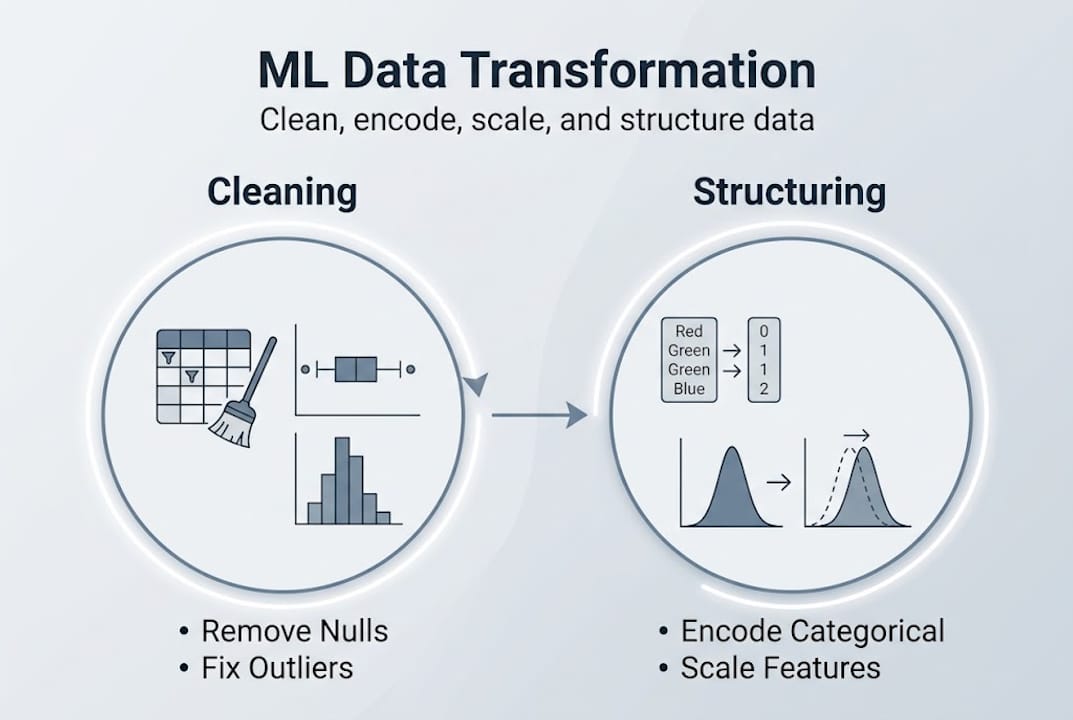
At its core, data transformation in machine learning is the process of converting raw data into a suitable format for analysis and model training by addressing issues like noise, missing values, outliers, and non-normality through cleaning, encoding, scaling, and feature engineering. That definition sounds clean and simple. In practice, it is one of the most time-consuming, high-stakes parts of building any AI system.
Think of it this way: a model is only as good as the signal it receives. If your training data contains duplicate records, inconsistent category labels, or columns with 40% missing values, the model will learn the wrong patterns. Garbage in, garbage out is not a cliché in this field. It is a daily reality.
The primary objectives of data transformation are:
- Converting raw data into usable formats that match your model’s expected input schema
- Resolving data quality issues such as noise, duplicates, and structural inconsistencies
- Encoding categorical variables so that algorithms can process non-numeric information
- Scaling numeric features to prevent high-magnitude variables from dominating model learning
- Engineering new features that capture relationships the raw data does not directly express
A well-executed data preprocessing workflow treats each of these objectives as a distinct pipeline stage, not a single cleanup pass. Teams that conflate all of these into one vague “data cleaning” step tend to produce datasets that underperform at training time.
“The quality of your transformation pipeline directly determines the ceiling of your model’s performance. No amount of architecture tuning will compensate for poorly structured training data.”
The core data transformation concepts that underpin this work are well established, but applying them correctly at scale requires both technical rigor and operational discipline. The dataset cleansing steps that work for a 10,000-row dataset often need significant rethinking when applied to datasets with tens of millions of records.
With this context established, let’s dig deeper into the practical techniques, starting with cleaning and preprocessing raw data.
Essential techniques for cleaning and preprocessing data
Cleaning raw data is not a single action. It is a structured sequence of decisions, each one affecting downstream model behavior. Here is a practical order of operations that ML teams can follow:
- Audit your schema first. Before touching any values, confirm that every field matches its expected data type. A timestamp stored as a string will break downstream feature engineering silently.
- Detect and handle missing values. Decide whether to impute, drop, or flag missing entries based on missingness rate and feature importance. Columns missing more than 60% of values are usually dropped entirely.
- Identify and treat outliers. Use interquartile range (IQR) clipping or z-score filtering to cap extreme values. Do not blindly remove outliers without understanding whether they represent real signal.
- Deduplicate records. Exact and fuzzy deduplication both matter. Exact duplicates inflate training counts; near-duplicates introduce bias by over-representing certain patterns.
- Standardize categorical labels. “New York,” “new york,” and “NY” are the same city but will be treated as three separate categories by most encoders without normalization.
- Validate referential integrity. If your dataset joins multiple tables, check that foreign key relationships are intact after the join. Broken joins are a common source of label leakage.
| Step | Technique | Common edge case |
|---|---|---|
| Missing values | Mean/median imputation, flag column | Imputing target-correlated features causes leakage |
| Outliers | IQR clipping, z-score filter | Legitimate extreme values in fraud or medical data |
| Duplicates | Hash-based exact match, fuzzy match | Near-duplicates from web scraping |
| Categorical labels | Lowercasing, alias mapping | Unseen values at inference time |
| Schema validation | Type casting, format enforcement | Timezone inconsistencies across data sources |
ML preprocessing tutorials highlight that edge cases in preprocessing include handling zero-variance features, unseen categorical values, data drift, timezone inconsistencies, label leakage from improper joins or imputation, and training-serving skew from differing statistics or encoders. These are not rare problems. They show up in nearly every production pipeline.
Training-serving skew deserves special attention. This happens when the statistics used to normalize training data (like mean and standard deviation) differ from what gets applied at inference time. The result is a model that performs well on your validation set but degrades in production. The fix is straightforward: fit your scalers and encoders on training data only, then apply the same fitted objects to validation, test, and serving data.
Pro Tip: Always save your fitted preprocessing objects (scalers, encoders, imputers) as serialized artifacts alongside your trained model. If you retrain the model, regenerate these artifacts from the new training split. Never reuse old preprocessing objects with new model weights.
Use a data quality checklist before any training run to confirm that your dataset cleansing pipeline has executed correctly and completely.
Once data is cleaned and preprocessed, the next step is encoding and scaling features for optimal model input.
Feature engineering, encoding, and scaling: Best practices
Feature engineering is where domain knowledge meets statistical modeling. It is the process of creating new input variables from existing ones to help a model learn patterns more effectively. A few well-engineered features can outperform dozens of raw columns.
Common feature engineering approaches include:
- Interaction terms: Multiply two related numeric features to capture their combined effect (for example, price per square foot from price and area)
- Date decomposition: Extract day of week, month, hour, and quarter from timestamp fields to expose temporal patterns
- Aggregation features: Compute rolling averages, counts, or maximums over time windows for sequential data
- Text-derived features: Character counts, word counts, or embedding vectors from free-text fields
- Ratio features: Normalize absolute counts by a baseline (for example, clicks divided by impressions for CTR)
Encoding and scaling are closely related but distinct operations. Encoding converts categorical variables into numeric representations. Scaling adjusts the range or distribution of numeric variables.

| Method | Use case | Key limitation |
|---|---|---|
| One-hot encoding | Low-cardinality categoricals | High memory cost for many categories |
| Label encoding | Ordinal categoricals with natural order | Implies false numeric ordering for nominal data |
| Target encoding | High-cardinality categoricals | Requires careful cross-validation to avoid leakage |
| Min-max scaling | Features with known bounds | Sensitive to outliers |
| Standard scaling | Normally distributed features | Assumes approximate normality |
| Robust scaling | Data with significant outliers | Less affected by extreme values |
The core data transformation concepts behind encoding and scaling are well documented, but teams frequently make two critical errors. First, they apply one-hot encoding to high-cardinality fields (like zip codes or product IDs with thousands of unique values), which creates extremely sparse, memory-intensive feature matrices. Second, they skip scaling entirely for tree-based models, which is fine, but then apply the same pipeline to a neural network without adding scaling, which causes training instability.
Zero-variance features are another common trap. A column where every row has the same value contributes zero information to a model. Normalizing it produces division-by-zero errors or meaningless outputs. Always filter these out before scaling.
Pro Tip: For high-cardinality categoricals, try embedding layers (in neural networks) or frequency encoding as a lightweight alternative to one-hot encoding. Both approaches preserve information without exploding your feature matrix size.
Good dataset structuring techniques account for both the encoding strategy and the downstream model architecture. A feature set designed for gradient boosting will look different from one optimized for a transformer-based model. Understanding dataset size rules also helps you decide how aggressively to engineer features versus relying on the model to learn representations from raw inputs.
After mastering feature engineering and encoding, it’s vital to understand how different data processing strategies and automation tools impact scalability and reliability.
Automation and governance: Scaling transformations for AI production
Automation is the natural goal once you have a working transformation pipeline. The appeal is obvious: less manual work, faster iteration, fewer human errors. But the current state of AI-driven automation for data transformation is more limited than most teams expect.
According to ELT benchmark findings, top AI agents achieve 57% success on data extraction and loading tasks but drop to only 3.9% success on complex data transformation stages involving SQL queries for data models. That gap is not a minor performance difference. It reflects a fundamental challenge: transformation logic requires contextual understanding of business rules, schema relationships, and data semantics that current agents cannot reliably infer.
The KramaBench automation study adds further nuance: LLMs identify roughly 42% of data tasks but implement only 20% correctly, highlighting the gap between recognition and reliable execution in complex transformation workflows.
This does not mean automation is useless. It means you need to be strategic about where you apply it. Automation works well for:
- Schema validation and type checking
- Exact deduplication using hash-based matching
- Applying pre-fitted encoders and scalers to new data batches
- Logging and alerting on data drift or schema changes
- Orchestrating pipeline steps with tools like Airflow or Prefect
Complex transformation logic, including custom feature engineering, entity resolution across sources, and context-dependent imputation, still requires human design and oversight.
Governance strategy also shapes how your transformation pipeline scales. The choice between ETL (Extract, Transform, Load) and ELT (Extract, Load, Transform) is not just architectural. According to ETL and ELT comparison research, ETL offers stronger upfront governance but is slower and less flexible, while ELT enables faster iteration and raw data preservation, making it ideal for ML experimentation but requiring robust warehouse governance for sensitive raw data.
For ML teams, ELT is often the better fit during early experimentation because you preserve the raw data and can re-run transformations as your feature requirements evolve. As you move toward production, you need to layer in governance controls: access restrictions on raw tables, audit logs for transformation jobs, and schema versioning to track changes over time.
Recommended governance actions for scaling transformation in production:
- Version your transformation code alongside your model code in the same repository
- Log every pipeline run with input record counts, output record counts, and any rows dropped or modified
- Monitor for data drift by comparing feature distributions between training and serving data on a scheduled basis
- Document your schema with field definitions, expected ranges, and encoding decisions in a shared data catalog
- Test transformation logic with unit tests that cover edge cases like null inputs, unseen categories, and out-of-range values
Good data automation practices and solid structuring data for AI methods work together to reduce manual overhead while maintaining quality. Be aware of CSV data pitfalls that can silently corrupt transformation outputs, and build large-scale collection pipelines with transformation governance baked in from the start.
With technical approaches and automation explored, what does all this mean for teams building scalable, reliable AI pipelines?
Why most AI teams underestimate data transformation—and what actually works
Most AI startups we work with initially treat data transformation as a one-time task. They clean the data once, train the model, and move on. Then they hit production and discover that the real world sends data that looks nothing like their training set.
The uncomfortable truth is that transformation is not a phase. It is an ongoing operational responsibility. The teams that build the most reliable AI systems treat their transformation pipelines with the same rigor they apply to model architecture. They version it, test it, monitor it, and iterate on it continuously.
The other mistake we see constantly is over-relying on automation before the transformation logic is well understood. Automating a broken process just produces broken outputs faster. Get your preprocessing workflow best practices locked down manually first. Document every decision. Then automate.
Transformation is where model performance is actually won or lost. Not in the architecture. Not in the hyperparameters. In the data.
Take your data transformation further with Dot Data Labs
If you’re looking to optimize your data transformation and model outcomes, explore these specialized resources from Dot Data Labs.
At DOT Data Labs, we build large-scale, structured, machine-ready datasets designed specifically for LLM fine-tuning, model training, RAG pipelines, and classification systems. Our production pipelines handle the full transformation lifecycle, from raw acquisition through schema design, encoding, and AI-optimized formatting.

Whether you need guidance on production dataset structuring, a machine-ready dataset guide to inform your next build, or a dataset optimization guide to improve existing training data, DOT Data Labs has the resources and production expertise to help your team move faster with higher-quality inputs. Reach out to discuss a custom dataset built to your exact schema and model requirements.
Frequently asked questions
Why does data transformation matter so much in machine learning?
Transforming data addresses noise, missing values, and outliers, ensuring models receive clean, structured input that drives accuracy and reliability. As GeeksforGeeks explains, transformation covers everything from encoding to feature engineering, all of which directly shape what a model learns.
How do AI teams handle unseen categorical values during transformation?
AI teams typically assign an “unknown” category to values not seen during training, preserving data integrity and avoiding runtime errors. This is one of several critical edge cases that must be explicitly handled in any production preprocessing pipeline.
Is data transformation fully automatable by AI agents?
AI agents handle extraction and loading well, but current benchmarks show they achieve only 3.9% success on complex transformation tasks, meaning human design and oversight remain essential for reliable production pipelines.
What is the difference between ETL and ELT in data transformation?
ETL provides stronger upfront governance and is slower, while ELT allows faster iteration but requires robust governance for sensitive raw data. Research shows ELT is favored in ML experimentation contexts where raw data preservation and rapid iteration are priorities.