
What Is Feature Labeling? A Guide for AI Practitioners

TL;DR:
- High-quality feature labeling determines the maximum accuracy a supervised machine learning model can achieve. Labels are the ground truth that define the model’s learning limits and must be consistent and well-enforced. Proper schema design, version control, and bias auditing are essential for reliable, production-ready datasets.
Feature labeling is defined as the process of identifying, categorizing, and assigning input variables (features) and output variables (labels) within a supervised machine learning dataset. The quality of that labeling, not the algorithm or data volume, sets the ceiling on model accuracy. Poor label quality is the primary factor limiting model success, because labels serve as the ground truth that defines what a model can ever learn to predict. Teams that treat labeling as a secondary task consistently produce models that fail in production. DOT Data Labs works with AI teams across the US, Europe, and Asia to fix exactly this problem at scale.
What is feature labeling in machine learning?

Features and labels are the two structural pillars of every supervised learning dataset. Features are the independent input variables a model uses to identify patterns. Labels are the dependent output variables the model learns to predict.
The distinction sounds simple. In practice, it requires deliberate decisions about which variables belong in each role:
- Features (predictors/attributes): Pixel values in an image, a patient’s age, a transaction amount, or a vehicle’s speed. These are the measurable inputs available at inference time.
- Labels (targets/outcomes): “Spam” or “not spam,” a house price, a cancer diagnosis, or a collision risk score. These are what the model produces as output.
- Role flexibility: The same variable can shift roles depending on the research objective. Tomorrow’s temperature is a label in a forecasting model and a feature in a crop yield model.
- Naming conventions: Features also appear in literature as predictors, attributes, or independent variables. Labels appear as targets, outcomes, or dependent variables. Knowing both naming conventions prevents confusion when reading research papers or vendor documentation.
The feature-versus-label distinction is not intrinsic to the data. It is a decision made by the practitioner based on the business problem being solved. That decision encodes prior domain knowledge and shapes every downstream modeling choice.
How to perform effective feature labeling
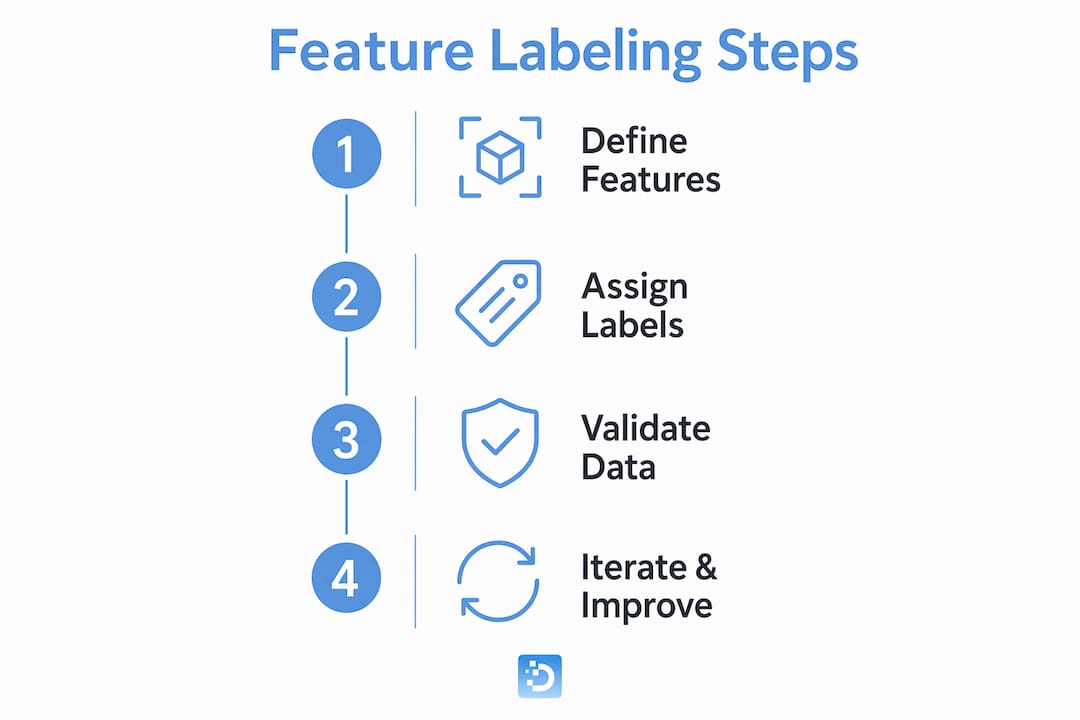
Effective feature labeling follows a structured process. Skipping steps here creates problems that no amount of model tuning can fix later.
-
Define the prediction target first. Write a one-sentence problem statement before touching the data. “Predict whether a loan application will default within 90 days” forces clarity on what the label is before any feature selection begins.
-
Isolate the feature matrix and label vector. Using a tool like pandas, separate features from the label column explicitly:
X = df.drop("label_column", axis=1)andy = df["label_column"]. This preprocessing step removes ambiguity and improves downstream efficiency. -
Exclude irrelevant metadata. Drop record IDs, row numbers, and timestamps unless time itself is a meaningful predictor. These columns add noise and can introduce data leakage.
-
Define a label schema and enforce it. Specify the data type, allowed values, and precise definition for every label before annotation begins. In signal processing workflows, strict label schemas for Attribute and Region of Interest labels are required for consistent automated extraction.
-
Validate for bias and leakage before training. Audit every feature to confirm it contains only information available at prediction time. Check label distributions for class imbalance that could skew model behavior.
-
Version control your label definitions. Maintaining version control on label definitions prevents concept drift, the gradual degradation of model accuracy that occurs when real-world data distributions shift but labels do not.
Pro Tip: Build a data dictionary alongside your label schema. Document each feature’s source, update frequency, and known limitations. This single artifact prevents the most common labeling errors when team members rotate or the dataset is reused for a new model.
What are the common mistakes in feature labeling?
Poor labeling decisions degrade model performance in ways that are difficult to diagnose after the fact. The damage is often invisible until the model reaches production.
- Data leakage: This occurs when a feature contains information that would not be available at prediction time. A fraud detection model trained with a “fraud_confirmed” flag as a feature will score perfectly in testing and fail completely in production. Auditing features for inference-time availability is the single most important quality check.
- Label ambiguity: When annotators apply different definitions to the same label, the training set becomes internally inconsistent. A medical imaging team where one radiologist labels “suspicious” and another labels “benign” for the same lesion produces a dataset that teaches the model nothing reliable.
- Subjective label bias: Labels are Bayesian priors. They encode the worldview of whoever defined them. A hiring model trained on historical promotion data inherits whatever biases existed in past promotion decisions.
- Concept drift: The real world changes. A label defined in 2022 may not mean the same thing in 2026. Without version control and periodic audits, models silently degrade.
“High label quality, not data volume, sets the predictive accuracy ceiling for AI models. Team consensus on label definitions ensures consistency across the entire training set. No algorithm compensates for a dataset where the ground truth is wrong.”
The checklist for auditing label quality is short: confirm the label definition is written down, confirm every annotator uses the same definition, confirm no feature contains future information, and confirm the label distribution matches the real-world distribution you expect to encounter.
Feature labeling examples across real-world AI workflows
Feature labeling decisions look different across industries, but the underlying structure is identical: define inputs, define the target, enforce consistency.
| Industry | Features | Label | Task type |
|---|---|---|---|
| Automotive | Camera frames, LiDAR point clouds, vehicle speed | Object class (pedestrian, vehicle, cyclist) | Classification |
| Healthcare | Lab values, imaging pixels, patient history | Diagnosis code or risk score | Classification / Regression |
| Finance | Transaction amount, merchant category, time of day | Fraud (yes/no) or default probability | Classification / Regression |
| Signal processing | Frequency bands, amplitude, time windows | Attribute label or Region of Interest (ROI) | Segmentation |
In automotive AI training data, a single mislabeled pedestrian bounding box propagates through thousands of training iterations. The cost of that error is not a lower accuracy score. It is a vehicle that fails to brake.
In signal processing, MATLAB guidelines formalize this with Attribute and ROI label types, each requiring defined schemas for data type and description. Automated labeling at scale reduces human noise and improves annotation consistency across large training sets.
Classification dataset preparation follows the same logic regardless of domain: the label must be unambiguous, the features must be inference-available, and the schema must be enforced before a single annotation is written.
Key Takeaways
Feature labeling quality, not data volume, is the single variable that most directly determines whether a supervised model succeeds or fails in production.
| Point | Details |
|---|---|
| Labels define the ceiling | Poor label quality caps model accuracy regardless of dataset size or algorithm choice. |
| Role assignment is a decision | The same variable can be a feature or a label depending on the prediction objective. |
| Schema enforcement prevents drift | Written label definitions and version control stop concept drift before it degrades production models. |
| Leakage is the silent killer | Features containing future or target information produce models that fail the moment they leave the test environment. |
| Automation reduces human noise | Strict label schemas and automated annotation tools improve consistency across large-scale training sets. |
Why labeling is engineering work, not a data task
I have reviewed enough failed ML projects to say this clearly: the teams that treat labeling as a data preparation chore, something to hand off and forget, are the teams that come back six months later asking why their model degraded.
Labeling is an ongoing Bayesian process. Every label definition encodes an assumption about the world. When the world changes, the label must change with it. That requires version control, audit trails, and a team that has agreed in writing on what each label means. I have seen models built on datasets where three annotators used three different definitions of the same label. The model learned the average of three conflicting worldviews. It was useless.
The practitioners who build reliable models treat feature and label quality as foundational engineering work. They write schemas before they write code. They audit label distributions before they train. They version their label definitions the same way they version their model weights. That discipline is what separates models that work in production from models that work in notebooks.
— Oleg
DOT Data Labs: expert labeling for production-ready AI
Building a labeled dataset that holds up in production requires more than annotation tools. It requires schema design, bias auditing, version control, and domain expertise applied consistently at scale.

DOT Data Labs delivers data annotation and labeling services built for production AI teams. From one-off custom datasets to ongoing data pipelines that continuously feed cleaned, labeled data into your training infrastructure, the full data supply chain is covered. Recent projects include a 32 million science Q&A dataset delivered in under 30 days and 50,000 hours of annotated talking-head video. If your model accuracy is plateauing, the label quality is the first place to look. Start with DOT Data Labs to find out what your dataset is actually missing.
FAQ
What is the feature labeling definition in machine learning?
Feature labeling is the process of identifying input variables (features) and assigning target output variables (labels) in a supervised learning dataset. The quality of those assignments directly determines the maximum accuracy a model can achieve.
How do features and labels differ?
Features are independent input variables available at prediction time, such as pixel values or transaction amounts. Labels are the dependent output variables a model learns to predict, such as a fraud flag or a diagnosis code.
What causes data leakage in feature labeling?
Data leakage occurs when a feature contains information that would not be available at inference time, causing a model to overfit during training and fail in production. Auditing every feature for inference-time availability prevents this.
Why does label quality matter more than data volume?
High label quality sets the predictive accuracy ceiling for any model. Adding more data with inconsistent or incorrect labels amplifies errors rather than correcting them, making label schema enforcement more valuable than raw dataset size.
How do you prevent concept drift in labeled datasets?
Maintaining version control on label definitions and auditing label distributions periodically prevents concept drift. When real-world data distributions shift, label definitions must be updated and models retrained on the revised ground truth.