
Schema Design Process: A 2026 Guide for Data Architects

TL;DR:
- Designing a database schema involves a staged, iterative process that ensures data organization, integrity, and scalability. Starting with requirements analysis, teams create a technology-agnostic conceptual model, then translate it into normalized logical tables, and finally adapt physical structures to the target engine. Validating with real data and queries is essential before deployment to prevent costly performance issues and future refactoring.
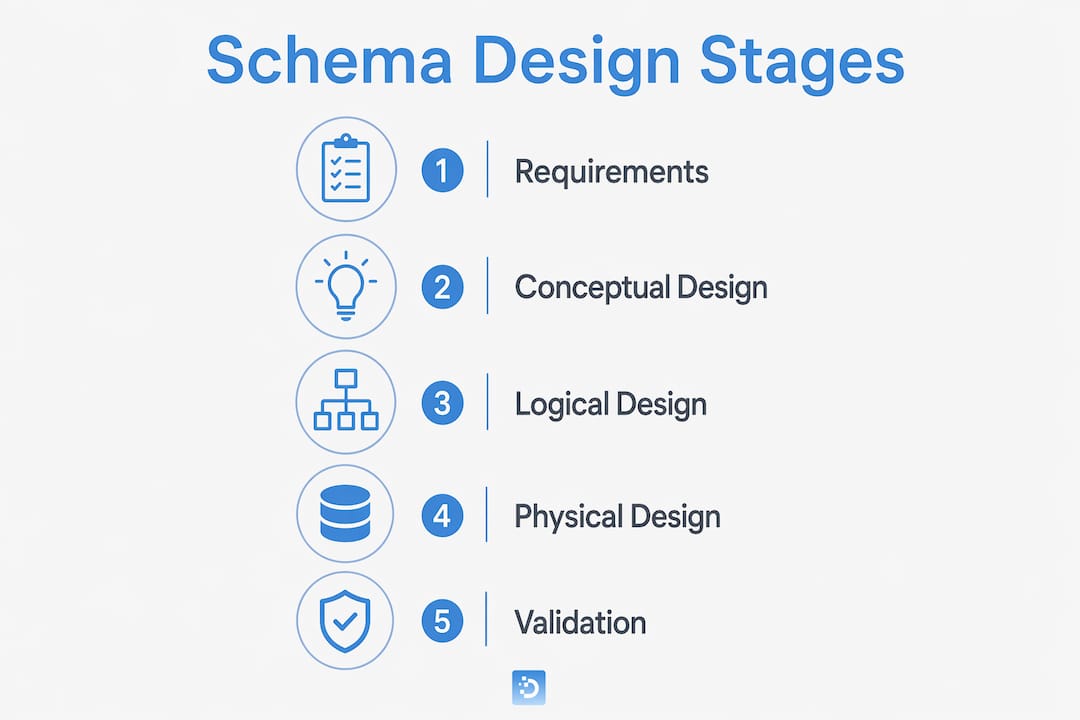
The schema design process is the methodical creation of database structures that organize data efficiently, support application requirements, and maintain data integrity through iterative refinement across conceptual, logical, and physical stages. A well-executed schema is not just a technical artifact. It is the foundation that determines whether a database scales gracefully or collapses under production load. The four-stage lifecycle of Requirements Analysis, Conceptual Design, Logical Design, and Physical Design gives architects a clear sequence with built-in feedback loops. Skip any stage and you introduce fragility that compounds over time.
What are the key stages of the schema design process?
The schema design process follows a structured sequence, but each stage informs the others. Treat it as iterative, not linear.
-
Requirements analysis. Define business rules, constraints, and workload patterns before touching a table. Deep domain understanding is the foundation of a schema that can evolve. Without it, you build structures that fit today’s assumptions and break under tomorrow’s requirements.
-
Conceptual design. Produce a technology-agnostic Entity-Relationship (ER) diagram that captures entities, attributes, and relationships. This stage is deliberately free of database engine concerns. Logical models should remain technology-agnostic so that physical decisions do not contaminate the domain model.
-
Logical design. Translate the ER diagram into tables, columns, primary keys, and foreign keys. Apply normalization to at least Third Normal Form (3NF). 3NF eliminates transitive dependencies, improving update consistency across the entire database.
-
Physical design. Map the logical schema to the target database engine. Choose index types, partitioning strategies, and storage parameters based on actual workload patterns. Physical design must exploit specific engine features for peak performance.
-
Iterative feedback. Validate with representative sample data and real queries at each stage. Schema evolution is not an afterthought. Planning for future change from day one prevents costly refactors later.
Pro Tip: Run a brief domain modeling workshop with stakeholders before writing a single CREATE TABLE statement. Thirty minutes of alignment at the requirements stage saves weeks of schema migration work later.
How to balance normalization and denormalization in schema design?

Normalization and denormalization are not opposites. They are tools applied at different points based on evidence, not instinct.
Start every schema at 3NF. This baseline eliminates redundancy and transitive dependencies, giving you a clean, consistent structure. Higher normal forms (4NF, 5NF) are rarely necessary outside data warehousing contexts.
The risk of going too far with normalization is real. Excessive joins increase query complexity and latency. When architects normalize beyond what the workload requires, they trade write simplicity for read pain. The correct response is not to abandon normalization. It is to measure first.
Use EXPLAIN ANALYZE or equivalent query profiling tools to identify specific bottlenecks. Denormalization driven by profiling evidence reduces integrity risk and maintenance cost compared to denormalization driven by assumption. Key criteria for informed denormalization include:
- High read-to-write ratio on the affected tables
- Infrequent updates on the columns being duplicated
- Measurable latency impact confirmed by profiling
- No caching layer available to absorb the read pressure
Caching layers (Redis, Memcached, or application-level caches) often eliminate the need for denormalization entirely. Reach for them before restructuring your schema.
Pro Tip: Document every denormalization decision inline using COMMENT ON TABLE or COMMENT ON COLUMN. Future engineers will not remember why a column was duplicated. The comment will.
What are modern best practices in schema design and validation?
Database schema creation in 2026 has moved well beyond hand-written DDL scripts checked into a shared folder. The following practices define how high-performing engineering teams work today.
| Practice | What it means | Why it matters |
|---|---|---|
| Declarative schema management | Schema defined as versioned migration files | Reduces errors and ensures consistency across environments |
| UUID v7 primary keys | Time-sortable universally unique identifiers | Balances uniqueness and sortability over traditional integer sequences |
| Strategic indexing | Indexes added only for confirmed query patterns | Prevents index bloat that degrades write performance |
| In-database documentation | COMMENT ON TABLE and COMMENT ON COLUMN | Prevents drift between documentation and implementation |
| Constrained JSON columns | JSON used sparingly with CHECK constraints | Preserves flexibility without sacrificing data integrity |
Validating schema designs before deployment is non-negotiable. Load representative sample data and run the actual queries your application will execute. Skipping this step leads to bottlenecks that are expensive to fix in production. A schema that passes a whiteboard review but fails under real query load is not a finished schema.
For teams working on scalable schema performance, the combination of declarative management and pre-deployment validation is the most reliable path to production-ready database structures.
How does physical schema design impact performance and scalability?
Physical design is where architectural decisions meet real hardware and real workloads. Getting it wrong at this stage is expensive to fix.
Tailoring physical structures to your target database engine is not optional. PostgreSQL 18, for example, introduces optimizations for parallel query execution and partitioning that earlier versions do not support. Ignoring engine capabilities leaves performance on the table and limits scalability potential.
Partitioning strategies vary by use case. Horizontal partitioning (range or list) splits rows across partitions by a key value, which works well for time-series data. Vertical partitioning separates columns into different tables, reducing row width for frequently accessed queries. Sharding distributes data across multiple database instances for extreme scale. Each approach carries trade-offs in query complexity and maintenance overhead.
Index design deserves the same rigor as table design. Composite index column order matters: place the most selective column first. Avoid indexing every column by default. Each index adds overhead on INSERT, UPDATE, and DELETE operations. Materialized views offer a middle path, acting as selective denormalization without altering the base schema. They precompute expensive aggregations and store the results for fast reads.
Performance modeling before deployment helps teams understand concurrency limits, memory requirements, and workload distribution. A schema that handles 100 concurrent users gracefully may degrade sharply at 10,000 without proper partitioning and connection pooling in place.
What common mistakes should be avoided in the schema design process?
The most expensive schema mistakes share one trait: they are all avoidable with discipline at the requirements and validation stages.
- Jumping into table creation early. Building tables before fully mapping the domain produces fragile schemas. Inadequate domain understanding is the single most common root cause of schemas that require major refactors within 12 months.
- Skipping validation with real queries. A schema that looks correct on paper often fails under actual application queries. Test with production-representative data before deployment.
- Inconsistent naming conventions. Mixed conventions (snake_case vs. camelCase, singular vs. plural table names) create confusion across teams and complicate automated tooling.
- Excessive indexing. Every index adds write overhead. Index only the columns your confirmed query patterns require.
- Neglecting schema documentation. Undocumented schemas drift from their original intent. Use native database comments to keep documentation co-located with the schema itself.
- Ignoring evolution needs. A schema with no migration strategy accumulates technical debt. Build versioned migration files from the start.
Pro Tip: Treat your schema like production code. Require peer review for every migration file, just as you would for application code changes.
Key takeaways
A disciplined schema design process, starting with requirements analysis and ending with validated physical implementation, is the most reliable path to a database that scales and survives change.
| Point | Details |
|---|---|
| Follow the four-stage lifecycle | Requirements, conceptual, logical, and physical design each serve a distinct purpose and feed back into each other. |
| Normalize to 3NF first | Start at Third Normal Form to eliminate redundancy, then denormalize only when profiling confirms a bottleneck. |
| Validate before deployment | Test with representative sample data and real queries to catch performance issues before they reach production. |
| Use declarative schema management | Versioned migration files reduce errors and keep development and production environments consistent. |
| Document inside the database | COMMENT ON TABLE and COMMENT ON COLUMN prevent drift between design intent and implementation reality. |
Where I’ve seen schema design go wrong
The most persistent mistake I see is treating the schema design process as a one-time event rather than an ongoing discipline. Teams rush through requirements analysis, produce a schema that works for the initial use case, and then spend the next two years patching it with workarounds. The technical debt accumulates quietly until a major feature request forces a painful migration.
The second mistake is denormalizing too early. I have watched engineers add redundant columns at the first sign of a slow query, without running a single EXPLAIN ANALYZE. That instinct feels productive. It is not. Measure first, always.
What actually works is starting with a thorough domain model, normalizing to 3NF, and then treating every subsequent change as a migration that requires review. Modern declarative schema management tools make this straightforward. The teams that adopt this practice early spend far less time on emergency fixes and far more time building features. Schema documentation written inside the database itself is the detail most teams skip and most teams regret skipping. It costs almost nothing and pays back consistently.
— Oleg
How DOT Data Labs approaches schema consistency in AI training data
Schema consistency is as critical in AI training datasets as it is in production databases. Inconsistent field naming, mismatched data types, and undocumented structural changes in training data directly degrade model performance.

DOT Data Labs builds custom AI training datasets with schema consistency workflows built into every stage of the data supply chain. From raw collection through cleaning, labeling, and final delivery, every dataset ships in a validated, model-ready format. Teams working on large-scale projects can also access ongoing data pipelines that continuously deliver structured, labeled data aligned to a consistent schema. If your training data structure is as important as your model architecture, DOT Data Labs is built for that standard.
FAQ
What is the schema design process?
The schema design process is a structured, iterative sequence of stages including requirements analysis, conceptual design, logical design, and physical design that produces a database structure aligned to application needs and performance requirements.
Why is normalization important in database schema creation?
Normalization to Third Normal Form (3NF) eliminates redundancy and transitive dependencies, which improves update consistency and reduces the risk of data anomalies across the database.
When should you denormalize a schema?
Denormalize only after EXPLAIN ANALYZE profiling confirms a specific bottleneck caused by a high read-to-write ratio. Premature denormalization introduces integrity risks and increases maintenance costs.
What is declarative schema management?
Declarative schema management defines the database structure as versioned migration files, ensuring consistent and repeatable schema changes across development and production environments.
How do you validate a schema design before deployment?
Load representative sample data and execute the actual queries your application will run. This approach catches performance bottlenecks and structural issues before they reach production.