
How to Design Data Schemas for Scalable Performance

TL;DR:
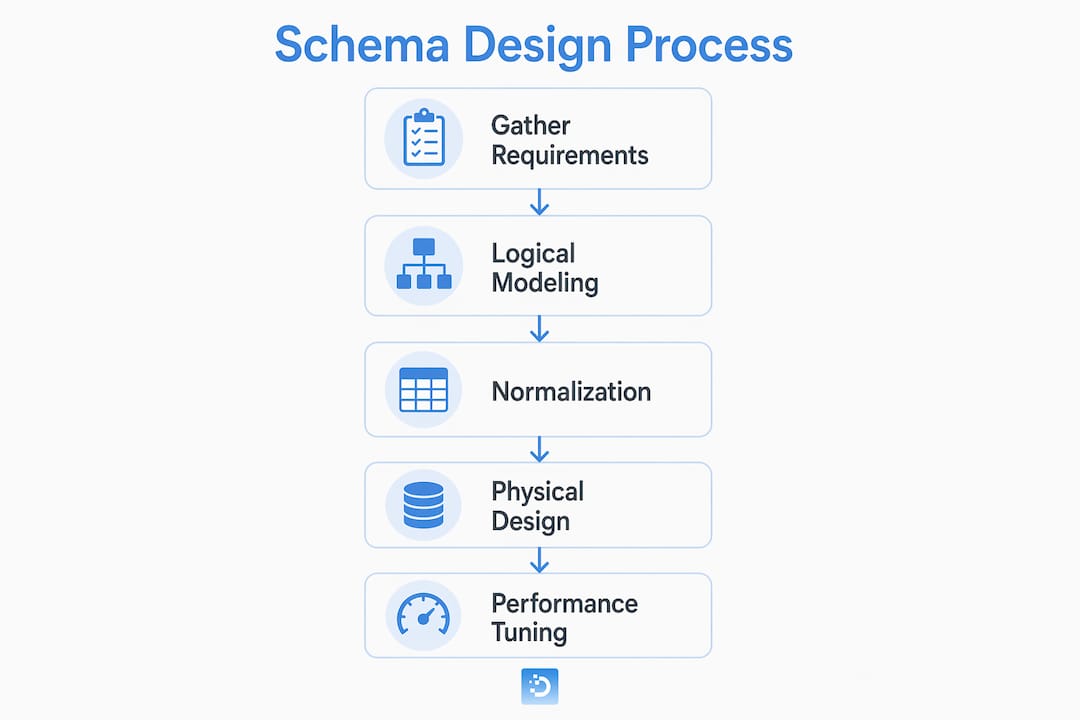
- Effective data schema design begins with requirements gathering and schema sketching before logical modeling, ensuring alignment with business needs. Logical schema design involves creating platform-independent ERDs, normalizing data to 3NF, and establishing clear relationships and keys to prevent redundancy. Physical design then optimizes indexes, data types, and partitioning based on workload patterns, enhancing query performance and scalability.
Data schema design is the practice of structuring data logically and physically to enable efficient storage, retrieval, and management aligned with business needs and workload patterns. A well-designed schema is the difference between a database that scales cleanly and one that collapses under query load or becomes unmaintainable within a year. The process spans two distinct stages: logical design, where you define entities, relationships, and normalization rules independent of any platform, and physical design, where you translate that model into platform-specific tables, indexes, and partitions. Skipping either stage produces schemas that are either technically correct but slow, or fast but brittle.
How to design data schemas: start with requirements, not tables
The most common mistake in schema design is opening a SQL editor before understanding what the data needs to do. A production-ready workflow begins with requirements gathering, entity definition, normalization, key assignment, and only then physical implementation. Teams that skip this phase build schemas around the data they have, not the queries they need to serve.

Start by mapping the core business questions your schema must answer. Who are the users? What do they create, read, update, or delete? What reports or analytical queries will run against this data daily? Each answer points to a table, an attribute, or a relationship. For an e-commerce system, questions like “What did a customer order last month?” immediately surface entities: Customer, Order, OrderItem, and Product.
Useful techniques for this phase include:
- Entity inventory: List every noun in your business domain. Each noun is a candidate table.
- Attribute mapping: For each entity, list the facts you need to store. Avoid storing derived values that can be computed at query time.
- User role analysis: Different roles access different data. A warehouse manager queries inventory; a finance team queries revenue. Both access patterns must inform the schema.
- Query sketching: Write the five most critical queries before you write a single CREATE TABLE statement. If a query is hard to express, your entity model is probably wrong.
Pro Tip: Use a planning template or a tool like dbdiagram.io to sketch your domain concepts visually before writing any DDL. A one-hour whiteboard session here saves days of refactoring later.
What is logical schema design and why does it matter?
Logical schema design maps your entities and relationships into a technology-agnostic entity-relationship diagram (ERD) with defined cardinality, primary keys, and foreign keys. Databricks separates conceptual and physical schema stages precisely because conflating them forces premature optimization decisions that distort the data model.
The three cardinality types you will encounter in every schema are:
- One-to-one: A user has exactly one profile. Rarely needs a separate table unless the second entity is optional or large.
- One-to-many: A customer places many orders. The foreign key lives on the “many” side, in this case the Orders table.
- Many-to-many: A product belongs to many categories; a category contains many products. Requires a junction table (ProductCategory) with composite or surrogate keys.
Normalization is the process of eliminating redundancy by organizing attributes into the correct tables. Third Normal Form (3NF) is the standard target for transactional schemas. First Normal Form (1NF) removes repeating groups. Second Normal Form (2NF) removes partial dependencies on composite keys. Third Normal Form (3NF) removes transitive dependencies, where a non-key column depends on another non-key column. A schema in 3NF is clean, consistent, and free of update anomalies.
Surrogate keys such as UUIDs are more stable identifiers than natural keys, which may change or become ambiguous in complex domains. Use surrogate primary keys by default and reserve natural keys for unique constraints only.
Pro Tip: Denormalization is a deliberate performance choice, not a design shortcut. Apply it only after profiling shows that join costs are genuinely hurting query latency. Document every denormalization decision with the reason and the query it serves.
| Approach | Best for |
|---|---|
| Normalized (3NF) | Transactional systems with frequent writes and updates |
| Star schema | Analytical workloads with aggregation-heavy queries |
| Denormalized flat tables | High-read, low-write reporting layers |
How does physical schema design affect query performance?
Physical design translates your logical ERD into platform-specific DDL with data types, constraints, indexes, and partitioning strategies tuned for your actual workload. Schema design should follow dominant data access and query patterns to align indexing and partitioning for scalable performance. Misaligned indexes cause full table scans even on normalized schemas.
Key decisions at the physical design stage:
- Data types: Use the smallest type that fits the data. Store timestamps as TIMESTAMP, not VARCHAR. Use INTEGER over BIGINT unless row counts exceed 2 billion.
- Constraints: Define NOT NULL, UNIQUE, and CHECK constraints at the schema level. Constraints enforced by the database are cheaper than application-level validation.
- Index strategy: Create indexes on columns that appear in WHERE clauses, JOIN conditions, and ORDER BY expressions. Avoid indexing low-cardinality columns like boolean flags.
- Partitioning: Range partitioning suits time-series data. Hash partitioning distributes rows evenly across nodes. List partitioning works for categorical splits like region or status.
Partition pruning enables performance by scanning only relevant partitions during queries, with zone maps further pruning disk blocks based on non-partition key predicates. A well-partitioned table on a date column can reduce query IO by orders of magnitude compared to a full scan.
For distributed databases, sharding key selection is a schema-level decision with major scalability consequences. Sharding keys must appear in all sharded tables to minimize expensive multi-shard operations. Organizing related tables under a single root shard key keeps related data co-located and avoids cross-shard joins.
Pro Tip: Run EXPLAIN ANALYZE on your five critical queries against a populated test dataset before deploying any schema to production. Index decisions made without real query plans are guesswork.
How do you manage schema evolution in event-driven systems?
Event-driven architectures create a specific schema problem: schema proliferation. Teams often create one schema per event variant, which produces dozens of near-identical tables that are expensive to query and maintain. Consolidating schemas with overlapping structures using discriminator enum fields and nullable attribute blocks reduces table count, enables single-table queries, and supports backward-compatible evolution.
Practical patterns for managing schema complexity in event pipelines:
- Discriminator fields: Add an "event_type` enum column to a consolidated event table. Filter by type at query time instead of joining across tables.
- Nullable blocks: Group optional attributes into nullable columns. New event variants add new nullable columns without breaking existing consumers.
- Schema validation at ingestion: Treating schema validation as an explicit contract boundary that logs failures enables reliable detection and replay-based remediation of malformed data.
- Version-controlled migrations: Store all DDL changes in a migration tool like Flyway or Liquibase. Every schema change is a tracked, reversible commit.
Schema validation is the cheapest bug fix in any data pipeline. Catching a malformed record at ingestion costs microseconds. Catching it after it has propagated through three downstream tables costs days.
Pro Tip: Build a replay mechanism into your ingestion layer from day one. When a schema mismatch is detected, log the raw event to a dead-letter queue and replay it after the schema is corrected. This prevents silent data loss.
Common schema design mistakes and how to avoid them
Even experienced engineers repeat the same schema errors. Recognizing them early saves significant rework.
- Skipping requirements gathering. Schemas built without query sketching optimize for storage, not retrieval. The result is a normalized schema that requires eight joins to answer a basic business question.
- Ignoring workload patterns in index design. Strong naming conventions improve schema readability and onboarding ease, but naming is irrelevant if the indexes are wrong. Profile your queries before finalizing index choices.
- Over-normalization. A schema in 5NF is theoretically pure and practically unusable for analytics. Know when to stop normalizing.
- Misconfigured sharding keys. A sharding key chosen for convenience rather than access patterns causes cross-shard joins on every major query, destroying horizontal scalability.
- No schema validation at ingestion. Silent schema mismatches corrupt datasets gradually. Schema validation at ingestion boundaries prevents this by enforcing expected data shapes and logging invalid records for early detection.
Pro Tip: Treat every schema migration as a two-phase deployment: first add the new column or table, then backfill data, then remove the old structure. Never drop columns in the same release that adds their replacements.
Key takeaways
Effective data schema design requires a structured sequence from requirements gathering through logical modeling to physical implementation, with validation at every stage.
| Point | Details |
|---|---|
| Requirements before tables | Sketch your five critical queries before writing any DDL to validate your entity model. |
| Logical design is platform-agnostic | Build your ERD and normalize to 3NF before choosing a database engine or storage format. |
| Physical design follows workload | Align indexes, partitioning, and sharding keys with real query access patterns, not theoretical ideals. |
| Consolidate event schemas | Use discriminator enums and nullable blocks to prevent schema proliferation in event-driven pipelines. |
| Validate at ingestion | Schema validation at pipeline entry points catches malformed data before it corrupts downstream tables. |
Schema design is a product decision, not just a technical one
I have reviewed schemas built by experienced engineers that were technically flawless and operationally useless. The normalization was correct. The indexes were present. The queries ran for 45 seconds because nobody had asked what the data would actually be used for before the first table was created.
The schemas I have seen hold up under real scale share one trait: they were designed around access patterns, not around the data itself. The team asked “what does the business need to retrieve?” before asking “how should we store this?” That inversion sounds simple. It is surprisingly rare.
For AI and analytics projects specifically, I recommend treating the schema as a living document rather than a one-time artifact. Build in a review cycle every time a new model or report type is introduced. The grain of your fact tables will drift if you do not actively manage it. Dimensional modeling, as described in dimensional modeling principles, gives you a contract for what each row means. Honor that contract or your downstream models will produce inconsistent results.
The teams that get this right also version-control their schemas from day one, document every denormalization decision, and run EXPLAIN ANALYZE before every production deployment. These are not advanced practices. They are the baseline for schemas that survive contact with real workloads.
— Oleg
How DOT Data Labs supports your data pipeline from schema to model

A well-designed schema is only as useful as the data flowing through it. DOT Data Labs builds and delivers production-ready datasets that are structured, labeled, and validated to fit your schema requirements from the start. Whether you need a one-off custom dataset scoped to your exact specifications or an ongoing data pipeline that continuously feeds cleaned, structured data into your training infrastructure, DOT Data Labs handles the full supply chain. Teams working on AI training data can also explore dataset structuring techniques that complement sound schema design for model-ready output. No vendor juggling, no internal tooling required.
FAQ
What is a data schema?
A data schema is a formal definition of the structure, relationships, and constraints of data within a database or data system. It specifies tables, columns, data types, keys, and indexes that govern how data is stored and accessed.
What is the difference between logical and physical schema design?
Logical design defines entities, relationships, and normalization rules independent of any database platform. Physical design translates that logical model into platform-specific DDL with data types, indexes, partitions, and storage configurations tuned for workload performance.
How do you choose a sharding key?
A sharding key should match the dominant query access pattern so that related data is co-located on the same shard. Oracle recommends that sharding keys appear in all sharded tables to minimize cross-shard joins and maintain scalability.
When should you denormalize a schema?
Denormalize only after profiling confirms that join costs are causing measurable query latency in production or staging. Document every denormalization decision with the specific query it serves and the performance gain it delivers.
What tools help with schema design and migration?
ERD tools like dbdiagram.io and DbSchema support logical modeling and visualization. Migration tools like Flyway and Liquibase version-control DDL changes and support repeatable, reversible schema deployments across environments.