
Schema Consistency Workflow for AI Training Data Quality
TL;DR:
- A schema consistency workflow validates and synchronizes data schemas across AI pipelines to prevent silent data corruption. It relies on ingestion validation, schema-as-code management, and automated CI/CD enforcement to ensure data integrity and model performance. Implementing these measures early reduces costly debugging and maintains trustworthy training datasets.
A schema consistency workflow is the process of systematically validating and synchronizing data schemas across AI training pipelines to prevent silent data corruption and maintain data integrity at every stage. Without this process, corrupt or mismatched records enter your training sets undetected, degrading model performance in ways that are expensive to diagnose after the fact. Bad data from manual processes costs the global economy $1.8 trillion annually. That number reflects exactly what happens when schema management is reactive rather than built into the pipeline from day one. Tools like Pydantic, Zod, and Liquibase, combined with centralized schema repositories and CI/CD automation, give data engineering teams the infrastructure to catch schema errors in hours rather than incident responses.
What are the key components of a schema consistency workflow?
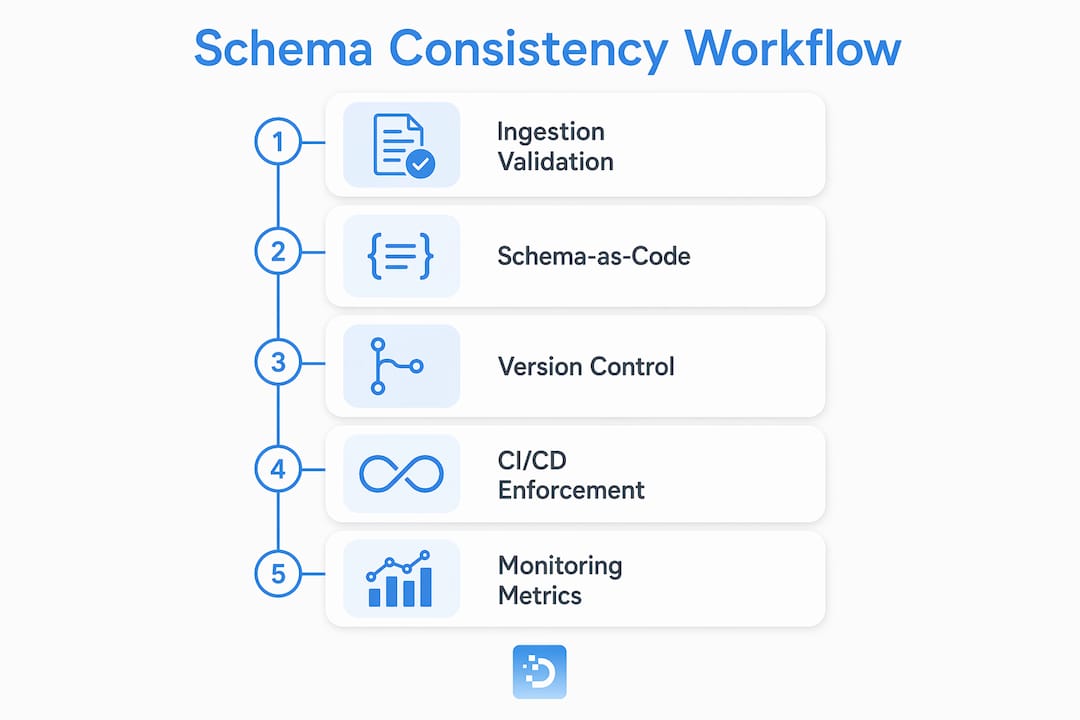
A schema consistency workflow rests on three pillars: validation at data intake, schema-as-code management, and automated enforcement through CI/CD pipelines. Each pillar addresses a different failure mode, and skipping any one of them creates gaps that compound over time.

Schema validation at ingestion is where most teams get the highest return. Schema validation at ingestion is more effective than scattered error handling code and saves hours of debugging by catching errors at the boundary where data first enters your system. Libraries like Pydantic (Python), Zod (TypeScript), Valibot, and ArkType each implement schema-as-code patterns that let you define expected data structures as executable code rather than documentation. Standard Schema, a cross-library interface specification, allows teams to swap validation libraries without rewriting integration logic.
Schema-as-code with version control treats every schema definition the same way you treat application code. Managing schemas via repository and CI/CD is an industry standard for maintaining long-term consistency and avoiding drift. Tools like Liquibase and dbt enable declarative schema management, where changes are tracked, reviewed, and deployed through the same pull request workflow your engineers already use. This creates an audit trail for every schema change and makes rollbacks straightforward.
CI/CD pipeline enforcement closes the loop by running schema validation checks automatically on every deployment. When a schema change breaks a downstream consumer, the pipeline fails before the change reaches production.
| Tool | Primary use case | Language ecosystem |
|---|---|---|
| Pydantic | Runtime data validation and parsing | Python |
| Zod | Schema declaration and validation | TypeScript |
| Valibot | Lightweight schema validation | TypeScript |
| Liquibase | Database schema version control | Language-agnostic |
| dbt | Data transformation and schema management | SQL/Python |
Pro Tip: Store your schema definitions in a dedicated repository directory (e.g., "/schemas`) and require peer review for all changes. This single practice eliminates the majority of undocumented schema drift.
How to implement schema validation to prevent silent data corruption
Silent data corruption is when invalid or malformed records pass through a pipeline without triggering errors, accumulating quietly until they surface as degraded model performance or unexplained training failures. Implementing validation at the data intake boundary is the most cost-effective fix, measured in hours of implementation versus incident responses that never need to happen.
Here is a practical sequence for standing up schema validation at ingestion:
- Define your schema explicitly. Write a Pydantic model or Zod schema that captures every field, its type, and any constraints (e.g., non-null, range limits, enum values). Do not rely on implicit assumptions about upstream data.
- Validate at the first touch point. Run validation the moment data enters your system, whether from an API call, a file upload, or a streaming source. Reject invalid records immediately rather than passing them downstream.
- Log every rejection with context. Capture the field that failed, the value received, and the schema version in effect. This log is your primary diagnostic tool.
- Route invalid records to a quarantine store. Do not discard them. Quarantined records let you audit failure patterns and recover data after schema fixes.
- Alert on rejection rate thresholds. A spike in invalid records almost always signals an upstream change. Catching it early prevents corrupt data from accumulating in your training set.
“Early and continuous schema validation produces clearer error messages and prevents the gradual accumulation of corrupt data.” — DEV Community
Pro Tip: Track your invalid record rate as a pipeline health metric. A rate that climbs from 0.1% to 2% over two weeks is a leading indicator of schema drift, not a rounding error.
What strategies ensure schema consistency across distributed systems?
Distributed AI training pipelines introduce consistency challenges that single-system validation cannot solve. Consistency errors in distributed systems originate from redundancy, network latency, schema evolution across services, and concurrency conflicts. Each source requires a different architectural response.
The four primary synchronization strategies are:
- Master-slave replication: One authoritative source propagates schema changes to read replicas. Simple to implement, but replication lag can cause temporary inconsistencies in high-throughput pipelines.
- Two-phase commit: Guarantees atomic schema changes across multiple nodes. The consistency guarantee is strong, but latency cost is high. Use it for critical schema migrations, not routine updates.
- Eventual consistency: Accepts temporary divergence in exchange for availability and partition tolerance. Appropriate for non-critical metadata fields where brief inconsistency does not affect training outcomes.
- Data sharding: Partitions data across nodes to reduce contention. Sharding and replication strategies differ in cost and consistency guarantees; the right choice depends on workload criticality and your specific AI use case.
Change Data Capture (CDC) deserves special attention for teams running live migrations. CDC enables live migrations by streaming real-time database changes to downstream consumers, maintaining full data consistency without stopping writes. Stripe uses this approach to move petabytes between database shards while keeping payment processing live. For AI training pipelines, CDC means you can migrate schema versions without taking your data ingestion offline.
Governance matters as much as architecture here. Consistency strategy decisions must align with business reliability needs, especially for AI models that depend on trustworthy data. Define consistency SLAs for each data source, document them, and monitor against them in production.
How to troubleshoot common schema consistency mistakes
Most schema consistency failures trace back to three root causes: validation happening too late in the pipeline, schema changes made without version control, and invalid record logs that nobody reads.
The most expensive mistake is implementing validation after data creation rather than at ingestion. By the time corrupt records reach your training set, they have already influenced downstream processes. Fixing the schema does not retroactively clean the data.
Practical troubleshooting steps when consistency breaks down:
- Check your invalid record rate first. A sudden spike identifies when the problem started and often points directly to the upstream source.
- Compare the current schema version against the version in effect when the error rate increased. Schema drift between versions is the most common cause of silent failures.
- Run automated regression tests against your schema definitions on every pipeline deployment. This catches breaking changes before they reach production data.
- Review your CI/CD pipeline logs for schema validation step failures that were bypassed or suppressed.
Thorough documentation and rare exceptions reduce technical debt and cognitive load for new team members. Every exception to your schema validation rules should be documented with a justification and a review date. Undocumented exceptions accumulate into systemic fragility.
Disconnected workflows cost teams more than 425 hours annually in time spent waiting for and searching for accurate data versions. That figure represents real engineering capacity that could go toward building models instead of chasing data quality issues.
Pro Tip: Treat your schema validation step as a first-class citizen in your AI data pipeline. Give it its own monitoring dashboard, not just a line in a general pipeline log.
Key takeaways
A schema consistency workflow built on ingestion-time validation, schema-as-code version control, and automated CI/CD enforcement is the most cost-effective way to protect AI training data quality.
| Point | Details |
|---|---|
| Validate at ingestion | Catch schema errors at the first touch point to prevent corrupt records from entering training sets. |
| Treat schemas as code | Store schema definitions in version control and enforce changes through pull request review. |
| Monitor rejection rates | Track invalid record rates as a leading indicator of schema drift before it affects model performance. |
| Choose the right sync strategy | Match your consistency model (CDC, replication, eventual consistency) to your workload’s reliability requirements. |
| Document every exception | Undocumented schema exceptions accumulate into technical debt that degrades pipeline reliability over time. |
Schema consistency as a foundation, not a feature
I have seen teams spend weeks debugging model performance regressions that traced back to a single upstream API change that silently altered a field type three months earlier. The fix took four hours. The investigation took three weeks. That asymmetry is what makes schema consistency feel abstract until it bites you.
My honest view is that most teams treat schema validation as a nice-to-have until they have their first serious data corruption incident. After that, they treat it as infrastructure. The smarter move is to build it as infrastructure from the start, before you have 50 million training records that need auditing.
The teams I have seen get this right share one habit: they treat schema changes with the same rigor as application code changes. No schema modification ships without a pull request, a reviewer, and a migration plan. That discipline feels slow in the short term. It pays back in months of avoided debugging.
The other thing worth saying plainly: flexibility and strictness are not opposites in schema management. You can allow optional fields and nullable types while still enforcing that every record passes validation. The goal is not a rigid schema that breaks on every upstream change. The goal is a schema that fails loudly when something unexpected happens, so you know immediately rather than three months later.
— Oleg
How DOT Data Labs supports your data quality workflow
Schema consistency is only as strong as the data feeding your pipeline. DOT Data Labs delivers AI training datasets that arrive validated, structured, and model-ready, so your schema validation layer is checking clean data rather than compensating for upstream chaos. Every dataset DOT Data Labs produces goes through quality validation before delivery, including structural consistency checks aligned to your target schema.
For teams running ongoing data pipelines, DOT Data Labs builds continuous feeds with schema validation baked into the delivery process. Whether you need a one-off custom dataset or a real-time pipeline feeding your training infrastructure, the output is always structured to your specifications. Talk to the team about scoping a data pipeline that fits your schema requirements from day one.
FAQ
What is a schema consistency workflow?
A schema consistency workflow is a structured process for validating and synchronizing data schemas across pipeline stages to prevent corrupt or mismatched records from entering AI training sets. It typically includes ingestion-time validation, version-controlled schema definitions, and automated CI/CD checks.
Which tools are best for schema validation in Python pipelines?
Pydantic is the most widely used schema validation library for Python data pipelines. It enables schema-as-code patterns where data structures are defined as Python classes and validated at runtime against incoming records.
How does schema drift cause AI model degradation?
Schema drift occurs when upstream data sources change field types, names, or structures without updating downstream consumers. Invalid records accumulate silently in training sets, introducing noise that degrades model accuracy over time without triggering obvious pipeline errors.
What is Change Data Capture and when should I use it?
Change Data Capture (CDC) streams real-time database changes to downstream systems, maintaining data consistency during live migrations without stopping writes. Use CDC when you need to migrate schema versions or move data between systems while keeping your ingestion pipeline active.
How often should schema definitions be reviewed?
Schema definitions should be reviewed whenever an upstream data source changes and as part of any major model retraining cycle. Teams running continuous pipelines benefit from monthly schema audits to catch gradual drift before it affects training data quality.