
What Is API-Ready Data? A Guide for Data Engineers
TL;DR:
- API-ready data is structured and documented to enable autonomous consumption by applications and AI systems. It features real-time access, semantic consistency, discoverability, row-level governance, and unified storage for seamless integration. Implementing these standards accelerates model development, ensures regulatory compliance, and treats data as a strategic product.
API-ready data is defined as data structured, governed, and documented so that applications can consume it directly through APIs without manual transformation or human interpretation. Unlike conventionally clean data, which is deduplicated and formatted for human review, API-ready data must carry detailed semantic metadata that allows AI agents and downstream systems to understand it autonomously. The concept sits at the intersection of data engineering, API design, and AI governance. For data engineers and data scientists building production AI pipelines, understanding this API data definition is the difference between a dataset that accelerates model deployment and one that stalls it.
What is API-ready data and why does it matter?
API-ready data is data that meets five core characteristics: real-time accessibility, semantic consistency, discoverability, governance at the transaction level, and unified storage for both structured and unstructured content. Each pillar addresses a specific failure mode in data integration. A dataset missing even one of these properties will create friction in automated workflows, whether that means an AI agent misreading a field, a compliance audit failing, or a downstream model receiving stale records.

The distinction from traditional clean data is worth stating directly. Clean data is human-readable and deduplicated. API-ready data goes further by being machine-interpretable, with semantic metadata that describes field meanings, relationships, and constraints. A fraud detection model, for example, needs to retain anomalies that a standard cleaning process would remove. Readiness depends on context, not on a universal checklist. A dataset ready for a recommendation engine is not automatically ready for a regulatory compliance workflow.
Here are the five features of API-ready data that every data engineer should verify before declaring a dataset production-ready:
- Real-time accessibility. Data must reflect current state, not a snapshot from a batch job run hours earlier.
- Semantic consistency. Field names, data types, and value formats must mean the same thing across every domain that touches the API.
- Discoverability. Metadata catalogs, such as those built on Apache Atlas or DataHub, must expose datasets so agents can find and query them without human guidance.
- Row-level governance. Access controls, audit trails, and replayability must operate at the record level, not just the table level.
- Unified storage. A lakehouse architecture, such as Delta Lake or Apache Iceberg, bridges structured tables and unstructured files under a single query interface.
Pro Tip: Before labeling any dataset as API-ready, run it through a metadata completeness check. If a field lacks a description, a data type constraint, and an ownership tag, it is not ready for autonomous consumption.
How does API-ready data improve AI model training?
Adopting API-first, machine-readable data strategies accelerates model training by 40% and improves precision scores by 7 percentage points. That is not a marginal gain. It means a team running a six-week training cycle could complete it in under four weeks using the same compute budget.
The mechanism behind this improvement is straightforward. When data arrives with rich semantic metadata, the model training pipeline spends less time on preprocessing and schema reconciliation. Agentic and generative AI workflows require structured semantic metadata and richer reference materials than simpler pattern-recognition models. Providing that metadata at the data layer removes a bottleneck that otherwise sits inside the training loop itself.
Versioned API contracts compound this benefit. When a data schema changes, a versioned contract ensures downstream models receive a clear signal rather than silently ingesting malformed records. Failing to implement semantic versioning and machine-readable API contracts risks breaking downstream AI agent workflows entirely. Teams that treat schema changes as a deployment event, complete with changelogs and deprecation windows, avoid the silent data drift that corrupts model performance over time.
Observability at the data layer also supports regulatory compliance. Row-level access controls, audit trails, and replayability satisfy emerging regulatory requirements for autonomous systems, including those under the EU AI Act and sector-specific frameworks in finance and healthcare. For teams building AI-driven model training pipelines, this governance layer is not optional.
What are the common pitfalls when preparing API-ready data?
Most teams underestimate how far clean data falls short of API-ready data. The following mistakes appear repeatedly in production data engineering projects.
- Treating cleanliness as readiness. A deduplicated, null-free dataset is a starting point, not a finish line. Without semantic metadata and machine-readable documentation, it cannot be consumed autonomously.
- Skipping machine-readable API documentation. Every API must provide an explicit, machine-readable schema for requests, parameters, and responses. Human-readable docs in Confluence or Notion do not substitute. AI agents that encounter undocumented fields will guess, and they will guess wrong.
- Neglecting metadata standardization. Making data open is insufficient. Protocols like Croissant and MCP enable autonomous agent discovery. Without them, even a well-structured dataset remains invisible to automated pipelines.
- Ignoring versioning. A schema change without a versioned contract breaks every downstream workflow that depends on that API. Treat schema updates the same way you treat software releases.
- Siloing data and platform teams. API-ready data requires alignment between the engineers who build the API layer and the scientists who define what the model needs. Without that alignment, metadata standards drift and governance gaps appear.
Pro Tip: Map every dataset to a specific AI use case before defining its readiness criteria. A dataset that retains fraud anomalies for a detection model should not be cleaned to the same standard as a dataset feeding a content recommendation engine.
How to prepare and maintain API-ready data pipelines
Preparing API-ready data is a repeatable process when broken into clear stages. The table below summarizes the core steps and the tools or standards that apply to each.
| Stage | Action | Tools and standards |
|---|---|---|
| Define readiness criteria | Scope requirements against the specific AI use case | Alation, Collibra |
| Document the API schema | Write machine-readable specs for every endpoint | OpenAPI 3.x, JSON Schema |
| Implement access control | Apply OAuth 2.0 scopes at the field or row level | OAuth 2.0, OPA |
| Unify storage | Consolidate structured and unstructured data | Delta Lake, Apache Iceberg |
| Build metadata catalogs | Tag every dataset with ownership, lineage, and constraints | DataHub, Apache Atlas |
| Monitor data quality | Track freshness, completeness, and schema drift continuously | Great Expectations, Monte Carlo |
| Govern as a product | Assign SLAs, changelogs, and deprecation policies | Internal data product frameworks |
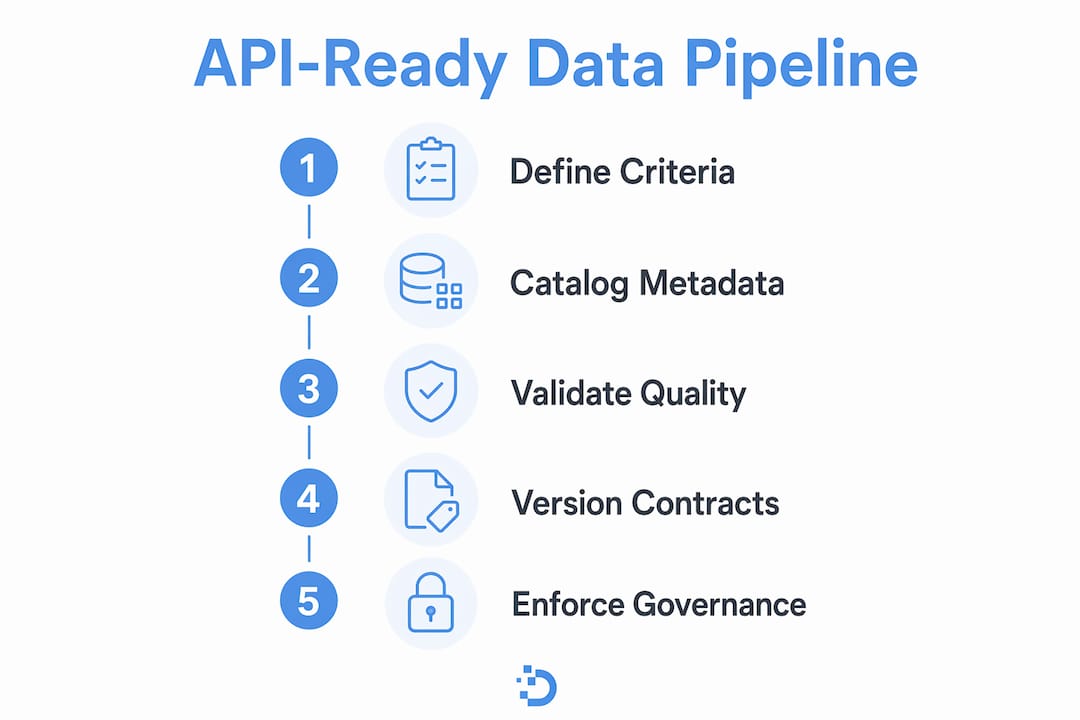
Treating datasets as strategic products, complete with contracts, metadata, policies, and oversight, is the single most durable practice in this list. It shifts the team’s mindset from “we delivered a file” to “we maintain a service.” That shift is what separates teams that ship reliable AI products from those that spend their time debugging silent data failures.
For teams building or auditing their AI data pipeline, the practical starting point is the metadata catalog. If you cannot answer who owns a dataset, when it was last validated, and what schema version it conforms to, you are not ready to expose it through an API.
Key takeaways
API-ready data requires five specific properties plus product-level governance to support reliable AI and integration workflows.
| Point | Details |
|---|---|
| API-ready data vs. clean data | Clean data is human-readable; API-ready data adds machine-interpretable semantic metadata for autonomous consumption. |
| Five core features | Real-time accessibility, semantic consistency, discoverability, row-level governance, and unified storage define API readiness. |
| Training performance gains | API-first data strategies reduce model training cycles by 40% and improve precision scores by 7 points. |
| Versioning is non-negotiable | Machine-readable API contracts with semantic versioning prevent downstream workflow failures when schemas change. |
| Treat data as a product | Assign SLAs, changelogs, and ownership to every dataset to maintain long-term API readiness. |
Why I think most teams are solving the wrong problem
The teams I see struggling with API-ready data are not struggling because they lack good engineers. They are struggling because they defined the problem as a data quality problem when it is actually a data contract problem.
Cleaning data is a solved problem. Tooling like Great Expectations, dbt, and Monte Carlo handles it well. But no amount of cleaning produces a dataset that an AI agent can discover, interpret, and consume without human help. That requires metadata standards, versioned schemas, and governance at the record level. These are organizational decisions as much as technical ones.
The regulatory pressure is also accelerating faster than most teams expect. Frameworks like the EU AI Act are pushing observability and auditability requirements down to the data layer, not just the model layer. Teams that built their pipelines around human-centric documentation will need to rebuild them around machine-readable interfaces. The teams that treat their data acquisition workflow as a product from day one will absorb that pressure without a crisis. Everyone else will face a costly retrofit.
My practical advice: pick one production dataset this quarter and run it through the five-pillar checklist above. The gaps you find will tell you exactly where to invest next.
— Oleg
Build on a foundation of production-ready data
If your team is working toward API-ready data pipelines but is spending too much time on sourcing, cleaning, and structuring raw datasets, DOT Data Labs removes that bottleneck. DOT Data Labs delivers curated, compliant AI training datasets across text, video, and structured data formats, with full metadata, labeling, and quality validation included. For teams that need continuous data flow, DOT Data Labs also builds and maintains ongoing AI data pipelines that feed cleaned, structured, and labeled data directly into your training infrastructure. From a 32 million record science Q&A dataset delivered in under 30 days to 50,000 hours of annotated video, the focus is always on data that is ready to use from day one.
FAQ
What is the difference between clean data and API-ready data?
Clean data is deduplicated and formatted for human review. API-ready data adds machine-readable semantic metadata, versioned schemas, and row-level governance so automated systems can consume it without human intervention.
What are the five features of API-ready data?
The five core features are real-time accessibility, semantic consistency, discoverability via metadata catalogs, governance at the transaction level, and unified storage for structured and unstructured data.
Does API-ready data require a specific storage architecture?
A lakehouse architecture, such as Delta Lake or Apache Iceberg, is the most practical foundation. It unifies structured tables and unstructured files under a single query interface, which is a requirement for full API readiness.
Why is metadata standardization critical for AI agents?
AI agents cannot interpret undocumented fields. Protocols like Croissant and MCP allow agents to discover and interact with datasets autonomously. Without standardized metadata, even well-structured data remains inaccessible to automated pipelines.
How does semantic versioning protect downstream AI workflows?
Semantic versioning ensures that schema changes are communicated as explicit contract updates. Without it, a minor field rename or type change can silently corrupt every downstream model or integration that depends on that API.