
AI-driven model training: Better data, smarter results

TL;DR:
- Modern AI techniques allow for over 99% reduction in labeled data while maintaining model performance.
- Synthetic data generation and active learning significantly improve dataset quality and reduce labeling costs.
- Combining synthetic and real data with targeted curation leads to more robust and reliable AI models.
Most ML engineers instinctively reach for more data when a model underperforms. It feels logical. More examples, better generalization, right? Recent research flips that assumption hard. Teams are now cutting their labeled training examples by over 99% while matching or exceeding the performance of models trained on massive datasets. That is not a typo. The shift comes from applying AI directly to dataset production and curation, not from collecting ever-larger raw data pools. This article breaks down the concrete techniques making that possible, so you can apply them to your own model training pipelines.
Key Takeaways
| Point | Details |
|---|---|
| AI enables data efficiency | LLM-driven synthetic data and active learning drastically reduce the volume of labeled examples needed for high-performance models. |
| Blended data yields best results | Combining synthetic and real-world data offers superior accuracy compared to using either in isolation. |
| Active learning cuts costs | AI-powered sample selection can shrink necessary labels by over 99% while maintaining expert-level model alignment. |
| Edge case focus improves robustness | Leveraging anomaly detection and human-in-the-loop reviews strengthens models against rare scenarios for safer deployment. |
How AI transforms model training: Beyond brute force data collection
The traditional approach to model training follows a familiar pattern. Collect as much labeled data as you can afford, clean it minimally, and feed it into your model. This worked well enough when compute was cheap and labeling budgets were generous. But it created a false equation in many engineering teams: data volume equals model quality. That equation is breaking down fast.
The role of datasets in modern AI has shifted from quantity-driven to quality-driven. Teams that understand this distinction are shipping better models faster. Those still chasing volume are burning labeling budget on diminishing returns.
Here is where AI changes the game. Instead of acting as the model being trained, AI now acts as an active participant in building the training data itself. Three core functions define this new role:
- Synthetic data generation: LLMs produce training examples that follow domain-specific patterns, filling gaps in rare categories or underrepresented scenarios without expensive human annotation.
- Annotation acceleration: LLMs pre-label large batches of raw data, reducing the human annotation workload to review and correction rather than creation from scratch.
- Active sampling: AI identifies which unlabeled data points carry the most information, so labeling budget concentrates where it matters most.
“The goal is no longer to label everything. The goal is to label the right things, generate what you cannot collect, and let AI manage the rest of the pipeline.”
One of the clearest demonstrations of AI-driven data generation comes from recent LLM benchmarking. GPT-4o achieves a PGR (Performance Gap Recovered) of up to 46.8% on average across domains in the AGORABENCH benchmark. PGR measures how much of the performance gap between a weaker student model and a stronger teacher model gets closed by using synthetic training data. A 46.8% average PGR is substantial. It means synthetic data generated by a capable LLM can transfer a significant portion of that teacher model’s capability to a smaller, cheaper model you actually deploy.
Understanding what PGR means in practice matters here. If your deployed model scores 70% on a benchmark and your target is 90%, the gap is 20 points. A 46.8% PGR closes roughly 9 to 10 of those points using only synthetically generated training examples, without touching your real data collection pipeline. That is a meaningful shift in how you allocate engineering resources.
The concept of high-quality AI datasets and data pre-processing as an AI-optimized step rather than a manual one are no longer theoretical. They are production techniques used by research teams and startups right now.
Synthetic data: Augmenting and optimizing real-world datasets
Synthetic data is not a new concept. What is new is the quality ceiling that modern LLMs have raised. Generating synthetic training examples used to mean templated variations or rule-based augmentation. Today, GPT-4o and Claude produce nuanced, contextually accurate training examples across domains from legal reasoning to clinical summarization to code generation.

What LLM-based synthetic data generation actually looks like in practice involves prompting a teacher model to produce input-output pairs that match your target task’s format and distribution. You specify constraints: length, vocabulary, domain terminology, output structure. The model produces hundreds or thousands of labeled examples that you use to fine-tune a smaller student model. This is called knowledge distillation via data synthesis.
The AGORABENCH benchmark provides the most rigorous comparison available for this technique. Here is how the top performers compare:
| Method | Average PGR | Domains covered |
|---|---|---|
| GPT-4o synthetic data | 46.8% | Multi-domain |
| Claude synthetic data | ~38% | Multi-domain |
| Real data only (baseline) | 0% (reference) | Multi-domain |
| Synthetic only (smaller LLM) | 15 to 22% | Multi-domain |
Synthetic data performance drops notably when generated by weaker models, which reinforces an important decision point: the quality of your synthetic data is bounded by the capability of the model generating it.
So when should you blend synthetic and real data rather than use one or the other exclusively? The answer depends on your task and data availability.
Use synthetic data alone when you have near-zero real labeled examples and need a fast baseline. It will underperform compared to blended approaches but is far better than no training data.
Use real data alone when you have abundant, high-quality labeled examples and your edge case distribution is well-represented. This is increasingly rare in vertical AI use cases.
Use blended datasets in almost every other production scenario. The synthetic data approach works best when real examples anchor the distribution and synthetic examples fill the gaps in rare categories or low-frequency events.
Pro Tip: When blending, maintain a ratio of at least 30% real data for classification and fine-tuning tasks. Going below this threshold tends to introduce distribution drift where your model behaves well on synthetic patterns but degrades on real-world inputs.
The most common pitfall teams encounter is using synthetic data without validating its distribution against held-out real examples. A synthetic dataset that looks balanced can silently overrepresent certain phrasings, sentence structures, or domain patterns. Build a simple distributional check into your pipeline before training begins.
Active learning: Reducing labeling costs and unlocking boundary cases
Synthetic data addresses the volume problem. Active learning addresses the selection problem. And the selection problem is often where labeling budgets die quietly.
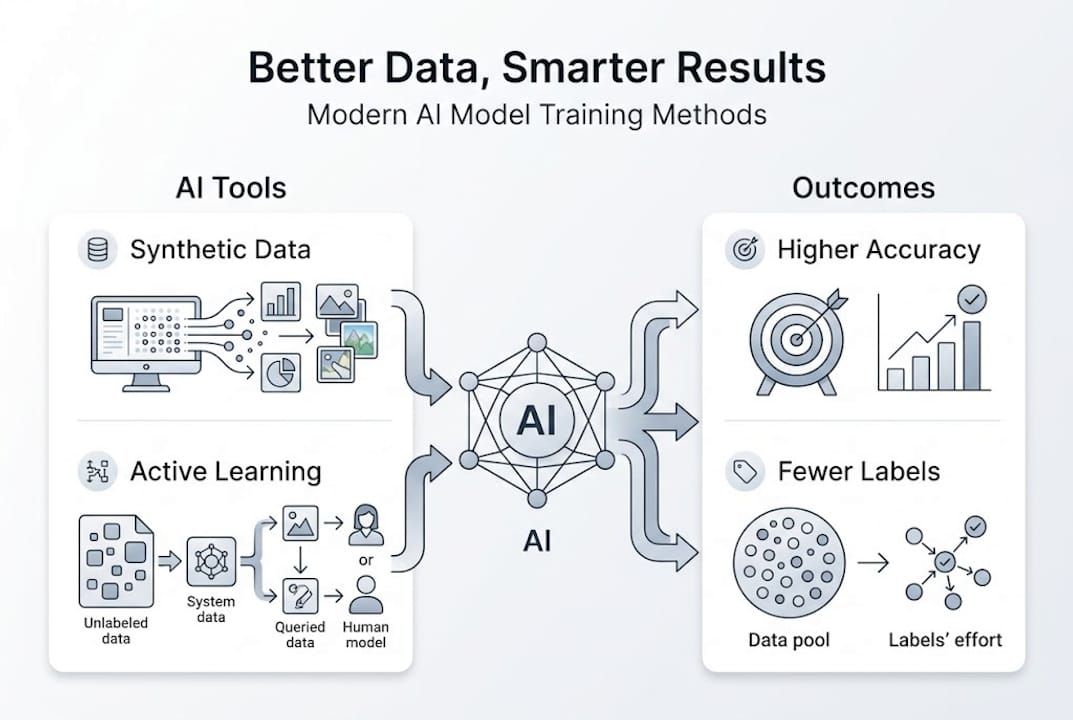
Most labeling pipelines treat all unlabeled data as equally worth labeling. They are not. The majority of your unlabeled pool is redundant: once your model has seen 500 examples of “yes, this is a support ticket about billing,” the 501st adds almost nothing. What your model actually needs are the boundary cases, the examples that sit near its decision boundaries and could go either way.
Active learning is the technique that identifies those boundary cases systematically. The model queries for the examples it is most uncertain about, a human labels those specific examples, and the model retrains. This cycle repeats until performance plateaus. The result is dramatically fewer labels for the same or better model quality.
Here is what modern active learning implementation looks like for a production ML workflow:
- Train an initial model on a small seed dataset (as few as 50 to 100 labeled examples for well-defined tasks).
- Score the unlabeled pool using uncertainty metrics: entropy, least confidence, or margin sampling.
- Select the top N most uncertain examples for human review. N should be small: 20 to 50 per cycle is often enough.
- Label those examples using human annotators or a human-in-the-loop system with LLM pre-labeling.
- Retrain and evaluate, then repeat until your target metric is reached.
The results from real production environments are striking. Active learning with LLMs can reduce the labels needed for LLM fine-tuning from 100,000 down to fewer than 500 examples while maintaining alignment quality that matches expert labeling. Google AI’s implementation of this approach demonstrated that LLMs can identify boundary cases with a precision that makes the traditional high-volume labeling model look wasteful by comparison.
| Labeling approach | Labels required | Alignment quality |
|---|---|---|
| Traditional exhaustive labeling | 100,000+ | High |
| Random sampling | 5,000 to 10,000 | Moderate |
| Active learning with LLMs | Under 500 | High |
These numbers should recalibrate how you budget for data labeling strategies in your next project. The dataset labeling guide for AI startups covers this in detail, but the core principle is clear: spend your labeling budget on uncertainty, not on volume.
Pro Tip: Pair your active learning loop with an LLM that pre-labels each selected example before human review. Your annotator’s job becomes confirmation and correction rather than creation. This typically cuts per-label time by 60 to 70% and improves consistency across annotators.
Building robust models: Handling edge cases and embracing smart data curation
Average performance on standard benchmarks is not the same as production robustness. A model that achieves 92% accuracy on a held-out test set can still fail catastrophically on the 3% of inputs that fall outside its training distribution. These are edge cases, and they are where model reliability actually gets decided in deployment.
The distinction between average-case and edge-case handling is fundamental. Most dataset curation practices optimize for the former. Standard train/test splits weight common examples heavily, which means your model trains and evaluates on a distribution that looks nothing like the rare-but-consequential inputs it will encounter in production.
“A medical AI that performs excellently on common symptoms but fails on rare drug interactions is not a good model. It is a liability.”
Addressing edge cases requires intentional curation, not just more data collection. The three most effective strategies are:
- Anomaly detection during dataset construction: Use clustering or outlier detection to identify underrepresented regions of your data space. Then specifically target those regions for data collection or synthetic generation. This ensures your dataset has intentional coverage of rare scenarios rather than accidental gaps.
- Human-in-the-loop curation for ambiguous examples: Not every ambiguous example should be resolved by majority vote. Some edge cases require domain expert judgment. Build a triage layer into your pipeline that flags genuinely ambiguous examples for expert review rather than routing them through standard annotator workflows.
- Blended real and synthetic data for robustness: Pure synthetic data underperforms natural data in robustness testing, but mixing the two optimally gives you coverage of scenarios that are rare in real data and would be expensive to collect at scale.
The relationship between human judgment and AI curation in robust dataset production is collaborative, not substitutional. AI identifies where the gaps are and generates candidates for rare scenarios. Human experts validate whether those synthetic examples actually represent realistic edge cases or are artifacts of the generation process. This feedback loop is what separates teams building genuinely robust models from those shipping models that look good in demos.
Training-ready data that covers edge cases systematically requires upfront investment in curation strategy. But the payoff is a model that handles production inputs reliably rather than one that requires constant patching as new failure modes surface.
What most teams miss about AI in model training
Here is the uncomfortable reality: most ML teams treat these techniques as separate tools to deploy when convenient rather than as integrated components of a dataset strategy. They run one active learning experiment, see a modest improvement, and conclude it is not worth the pipeline complexity. Or they generate synthetic data for a weekend sprint and measure results against the wrong baseline. The techniques look underwhelming because the strategy around them is absent.
The teams getting the most out of AI-driven dataset production are not the ones with the most sophisticated models. They are the ones with the clearest picture of where their data is failing them. They use AI to audit their existing datasets before generating anything new. They identify which classes are underrepresented, which edge cases are absent, and which labeling inconsistencies are degrading model quality. Then they apply synthetic generation and active learning as targeted interventions.
The hard truth is that data pre-processing discipline and curation strategy matter as much as the AI techniques you stack on top. Automating a flawed data pipeline produces flawed training data faster. The teams that resist AI-assisted curation often do so because they underestimate how much their labeling budget is currently wasted on redundant examples and overrepresented categories.
Real long-term gains come from using AI to focus human judgment on the riskiest dataset gaps. Not from automating everything and hoping the model sorts it out.
Advance your AI model training with Dot Data Labs
For teams moving beyond brute-force data collection, the gap between knowing these techniques and executing them at scale is real.
Dot Data Labs builds large-scale, structured, machine-ready datasets designed around exactly these AI-driven training strategies. From dataset structuring for AI training with clean schema design and entity resolution, to dataset optimization that targets edge case coverage and distributional balance, the production pipeline is built for ML engineers who need training-ready data, not raw data dumps. If your team is ready to stop guessing about dataset quality and start building with precision, the resources and production expertise are there when you need them.
Frequently asked questions
How does synthetic data generated by AI compare to real-world data for model training?
Synthetic data generated by advanced LLMs like GPT-4o can significantly close performance gaps, with GPT-4o reaching 46.8% PGR on AGORABENCH, but combining synthetic with real data yields the highest accuracy and robustness across domains.
How much can active learning with LLMs reduce manual labeling effort?
Active learning with LLMs can reduce labeling requirements from over 100,000 samples to fewer than 500, with no measurable loss in alignment quality compared to exhaustive labeling approaches.
Why should human-in-the-loop systems be used alongside AI in model training?
Human-in-the-loop systems handle the ambiguous and rare examples that pure AI curation misses, ensuring edge case coverage and catching synthetic data artifacts before they degrade production model robustness.
Can purely synthetic data replace natural datasets for AI model training?
No. Purely synthetic datasets underperform compared to natural data on robustness benchmarks; optimal results consistently come from blending synthetic examples with a real data foundation that anchors the training distribution.