
What Is Programmatic Extraction: A 2026 Guide

TL;DR:
- Programmatic extraction automates data retrieval from unstructured sources, replacing manual collection with repeatable pipelines. Using schema validation and appropriate methods like API, headless browser, or LLM-based extraction improves data quality and pipeline reliability. Separating fetching from extraction enables easier model switching and minimizes silent failures in AI training data workflows.
Programmatic extraction is defined as the automated retrieval of structured data from unstructured or semi-structured sources using scripts, APIs, or AI models, replacing manual data collection with repeatable, schema-validated pipelines at scale. The industry term for the most advanced form of this practice is structured extraction, which constrains outputs to typed formats like JSON or SQL schemas. For data scientists and AI teams, understanding what is programmatic extraction means understanding the foundation of every modern training data pipeline. Raw data from websites, PDFs, and APIs is worthless until it is retrieved, cleaned, and structured. Programmatic extraction is the mechanism that makes that transformation repeatable and auditable.
What are the main programmatic extraction methods?
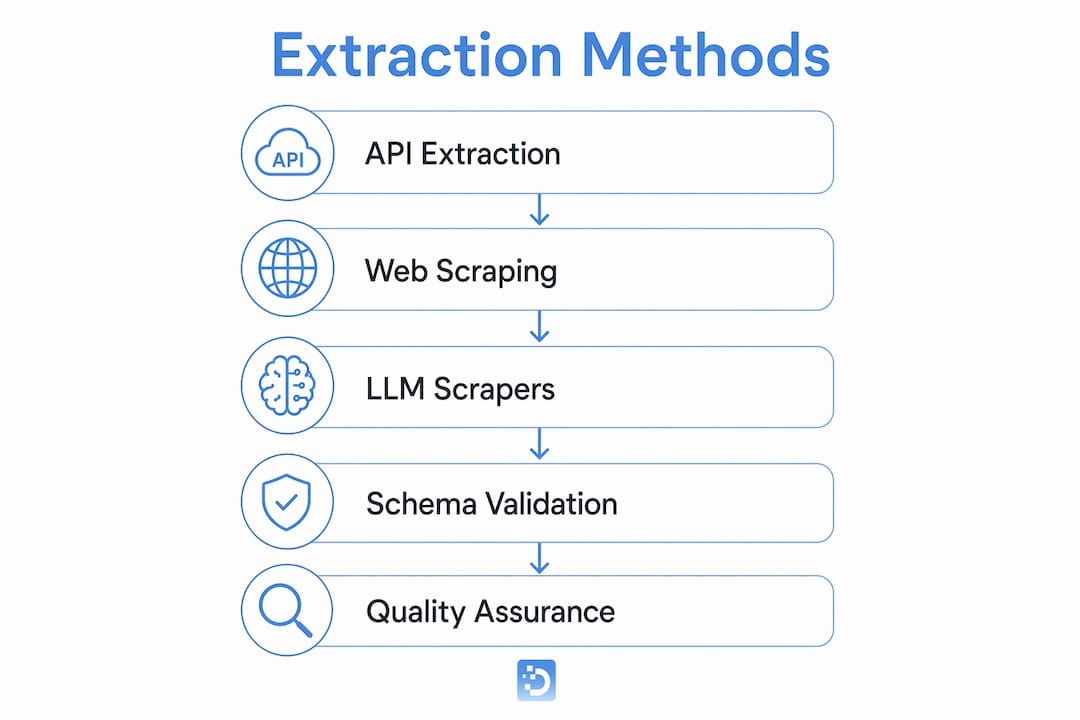
Programmatic data extraction covers three primary techniques, each suited to a different data source type. Choosing the wrong method for your source is the most common reason extraction pipelines fail in production.

API-based extraction is the most reliable method for structured data sources. REST and GraphQL APIs return predictable JSON or XML payloads, making them easy to parse and validate. Rate limits and authentication are the main operational constraints, but the data quality is generally high.
Web scraping with headless browsers handles JavaScript-heavy sites and single-page applications where a standard HTTP request returns an empty DOM. Tools like Playwright and Puppeteer render the full page before extraction begins. This approach is slower and more resource-intensive than API calls, but it is the only viable option for sites that load content dynamically.
Agentic LLM scrapers represent the newest category. These systems use large language models to interpret page structure, generate extraction logic, and self-heal after site changes without manual selector updates. They trade some speed for significantly higher resilience.
| Method | Best for | Main limitation |
|---|---|---|
| API extraction | Structured, authenticated sources | Requires API access |
| Headless browser scraping | JavaScript-heavy or SPA sites | High resource overhead |
| Agentic LLM scraping | Dynamic or frequently changing sites | Slower, higher cost per call |
Pro Tip: Separate your fetching layer (Playwright, Puppeteer) from your extraction logic from day one. Swapping LLMs or parsers later becomes trivial when the browser integration code is isolated.
How do AI and schema validation improve extraction quality?
Modern extraction pipelines use large language models to parse unstructured text into structured formats, but raw LLM output is unreliable without a schema contract. Schema-driven extraction forces the model to produce outputs that conform to a predefined structure, reducing hallucinations and malformed records before they reach your training data.
The standard three-step process works as follows:
- Fetch the input. Retrieve raw HTML, PDF text, or API response using the appropriate method.
- Define the schema. Use Pydantic, Zod, or JSON Schema to specify the exact fields, types, and constraints the output must satisfy. This schema acts as a contract between the extraction model and the downstream pipeline.
- Run constrained extraction. Pass the input and schema to an LLM configured to produce only schema-compliant JSON. Structured output modes in models like GPT-4o or Claude enforce this at the API level.
The practical benefit is significant. Validation layers act as a quality gate that filters out hallucinated or malformed data before it reaches production systems. For AI training data specifically, a single corrupted record in a labeled dataset can propagate errors across thousands of downstream examples.
Schema-first extraction also handles website changes better than traditional CSS selector approaches. When a site redesigns its layout, a selector-based scraper breaks immediately. An LLM-powered extractor guided by a schema adapts without manual intervention, because it understands the semantic meaning of the target fields rather than their DOM position.
Pro Tip: Treat your Pydantic or Zod schema as a versioned artifact. When your data requirements change, update the schema first and let the extraction logic follow. This keeps your pipeline changes auditable.
What challenges exist in building extraction pipelines at scale?
Production extraction pipelines face a different set of problems than prototype scrapers. The gap between a working proof of concept and a reliable pipeline that runs daily is where most engineering time disappears.
- Boilerplate removal. Web pages contain navigation menus, cookie banners, footers, and ads that pollute extracted text. Cleaning boilerplate before extraction reduces noise and improves LLM accuracy on the actual content.
- JavaScript rendering overhead. Headless browsers consume significant memory and CPU. At scale, you need a pool of browser instances with proper lifecycle management, not a single Playwright session.
- Proxy and rate-limit management. Custom scraping solutions require ongoing maintenance for proxies, rate limiting, and error handling. Managed extraction services reduce this overhead but limit flexibility.
- Self-healing feedback loops. Schema validation failures should trigger automatic re-extraction attempts or LLM re-prompting rather than silent failures. Without this loop, bad data accumulates undetected.
- Large document handling. Long PDFs and reports exceed LLM context windows. Chunking with character interval indexing, as implemented in tools like LangExtract, preserves source traceability so extracted entities can be mapped back to their original location in the document.
The build-vs-buy decision depends on your change rate and scale. Custom code gives you full control but carries high maintenance overhead. Managed services handle the infrastructure but constrain your extraction logic. Most production teams at scale end up with a hybrid: managed fetching infrastructure and custom schema definitions.
What are the practical applications in AI workflows?
Programmatic extraction is the first stage in most AI training data pipelines. Without it, data sourcing is manual, slow, and inconsistent.
| Use case | Extraction role | Output format |
|---|---|---|
| Training dataset construction | Automated sourcing from web and documents | Labeled JSON, CSV, JSONL |
| Retrieval-augmented generation (RAG) | Continuous ingestion of updated source documents | Chunked text with metadata |
| Data augmentation | Pulling domain-specific examples at scale | Structured records for labeling |
| Regulatory document parsing | Extracting clauses and entities from PDFs | Typed schema output |
Extraction pipelines for AI training accelerate model development by automating the sourcing and structuring of labeled datasets. A team that previously spent weeks manually collecting domain-specific examples can run the same collection overnight with a well-built extraction pipeline.
Retrieval-augmented generation pipelines depend on extraction quality directly. If the ingested documents contain boilerplate, duplicate content, or malformed records, the retrieval layer surfaces bad context and model responses degrade. Clean extraction is not a preprocessing nicety. It is a performance requirement.
For high-volume ingestion, extraction pipeline checklists that include deduplication, format validation, and provenance tracking are the difference between a dataset you can trust and one you have to audit manually before every training run.
Key Takeaways
Programmatic extraction is the foundation of reliable AI training data pipelines, and schema validation is the single most important quality control mechanism in any production extraction system.
| Point | Details |
|---|---|
| Schema validation is non-negotiable | Pydantic, Zod, or JSON Schema contracts prevent malformed data from reaching training pipelines. |
| Method selection drives quality | Match API extraction, headless scraping, or LLM-based extraction to your source type. |
| Modular architecture reduces maintenance | Separating fetching from extraction logic lets you swap models without rewriting browser code. |
| Self-healing loops cut downtime | Automatic re-extraction on validation failure keeps pipelines running without manual intervention. |
| Extraction quality determines model quality | Boilerplate, duplicates, and malformed records in training data directly degrade model performance. |
The shift I keep watching in production pipelines
The teams I see getting extraction right in 2026 have made one architectural decision that separates them from everyone else: they stopped writing CSS selectors and started writing schemas. That sounds obvious in retrospect, but the migration is harder than it looks. Years of selector-based scraper logic do not disappear overnight, and there is real institutional resistance to replacing “working” code with an LLM-in-the-loop approach that feels less deterministic.
The counterintuitive truth is that LLM-powered schema extraction is more deterministic in practice, not less. A CSS selector breaks silently when a site redesigns. A schema-constrained extractor either produces valid output or fails loudly with a validation error you can catch and retry. Silent failures are the real enemy of data quality, and selectors produce them constantly.
The other pattern worth watching is the separation of fetching from extraction. Teams that treat Playwright as a browser-rendering service and keep their extraction logic completely independent can swap between GPT-4o, Claude, and open-source models in hours. Teams that entangle the two spend weeks on migrations they should not need to do at all.
If you are building or auditing an extraction pipeline right now, the question to ask is not “does it work?” It is “does it fail loudly, recover automatically, and produce auditable output?” If the answer to any of those is no, you have technical debt that will show up in your model’s performance before you find it in your logs.
— Oleg
How DOT Data Labs handles extraction for AI training data
DOT Data Labs builds and operates full extraction pipelines for AI training data, from raw web collection through schema-validated, model-ready output. The team handles the full stack: headless browser scraping at scale, LLM-powered structured extraction, Pydantic-validated output, deduplication, and final delivery in JSONL, CSV, or JSON formats. Recent projects include a 32 million science Q&A dataset delivered in under 30 days and 50,000 hours of talking-head video processed with aligned subtitles. If your team needs high-quality AI training data without building and maintaining the extraction infrastructure internally, DOT Data Labs covers the entire data sourcing and collection process from source identification to validated delivery.
FAQ
What is programmatic extraction in simple terms?
Programmatic extraction is the automated process of pulling structured data from websites, documents, or APIs using scripts or AI models, replacing manual copy-paste workflows with repeatable, validated pipelines.
How does programmatic extraction differ from manual data collection?
Manual collection is slow, inconsistent, and does not scale. Programmatic extraction runs automatically, applies consistent rules, and validates output against a schema before the data enters any downstream system.
What tools are used for programmatic data extraction?
Common tools include Playwright and Puppeteer for headless browser rendering, Pydantic and Zod for schema validation, and LLMs like GPT-4o or Claude for unstructured text parsing into typed JSON outputs.
When should you use API extraction vs. web scraping?
Use API extraction when the source provides a structured endpoint. Use headless browser scraping when the site loads content with JavaScript and a direct HTTP request returns an empty or incomplete DOM.
What is schema-first extraction and why does it matter?
Schema-first extraction defines the required output structure before running any extraction logic. It matters because constrained LLM outputs produce fewer hallucinations and validation errors, which directly improves training data quality.