
What Is Feature Engineering? A Practical ML Guide

TL;DR:
- Feature engineering transforms raw data into meaningful inputs that greatly influence model quality.
- Focusing on recency, ratio, aggregation, and interaction features yields the most significant predictive improvements.
Feature engineering is defined as the process of transforming raw data into meaningful input features that machine learning models can learn from effectively. It accounts for approximately 80% of effort in real-world ML projects, making it the single largest determinant of model quality. That figure matters because it tells you where to spend your time. Choosing a more complex algorithm rarely moves the needle as much as building better features from the same data. The four feature types that drive the most impact are recency, ratio, aggregation, and interaction features.
What is feature engineering and why do features matter more than algorithms?
A feature is a measurable property of your data that a model uses to make predictions. Raw data, such as a timestamp or a product ID, carries almost no predictive signal on its own. A feature derived from that data, such as “days since last purchase” or “revenue per unit sold,” gives the model something it can actually learn from.
The relationship between features and algorithms is not equal. Algorithms amplify the signal contained in features. A model trained on weak features will produce weak predictions regardless of its architecture. A gradient boosted tree trained on well-crafted features will consistently outperform a neural network trained on raw, unprocessed inputs.
“Simple models with well-engineered features consistently outperform complex models using raw features. No algorithm can compensate for poor feature quality.”
This is the core argument for investing in feature engineering before tuning model hyperparameters. The importance of feature engineering shows up most clearly when you compare two teams working on the same problem. The team that spends time understanding the data and crafting meaningful inputs almost always ships a better model, faster.
Pro Tip: Before selecting a model architecture, audit your features first. If you cannot explain why each feature carries predictive signal, it probably does not.

Which feature engineering techniques are most effective in practice?
Four feature types account for the majority of successful outcomes in applied ML work. Mastering these four before reaching for more exotic methods is the right order of operations.
- Recency features capture how recently an event occurred. “Days since last login” or “hours since last transaction” give models a time-sensitive signal that raw timestamps cannot provide.
- Ratio features express one value relative to another. “Revenue per order” or “clicks per impression” compress two variables into a single, interpretable signal.
- Aggregation features summarize behavior at a higher level. “Average order value over the last 30 days” or “total sessions per user per week” give models a statistical view of patterns across time or groups.
- Interaction features capture relationships between two or more variables. Multiplying “price” by “discount rate” creates a feature that neither variable expresses alone.
Beyond these four, common feature engineering techniques include bucketing continuous variables into categories, applying log or square-root transforms to skewed distributions, and generating embeddings for high-cardinality categorical data. Encoding methods such as one-hot encoding and target encoding convert categorical variables into numeric inputs that models can process. Scaling methods such as min-max normalization and standardization bring features onto a comparable range, which matters for distance-based models like k-nearest neighbors and support vector machines.
Feature selection is the final step in this process. Not every feature you create will improve the model. Techniques like recursive feature elimination, mutual information scoring, and LASSO regularization help you identify which features add signal and which add noise. Dropping low-value features reduces model complexity and often improves generalization.
Pro Tip: Start with recency, ratio, aggregation, and interaction features before writing any custom transformation logic. These four types cover the majority of real-world predictive signal.
How does feature engineering fit into the ML workflow?
Feature engineering sits between raw data collection and model training. It is not a single step. It is an iterative loop that runs throughout the entire development cycle. A structured feature engineering workflow follows this sequence:
| Step | What happens |
|---|---|
| Exploratory data analysis | Identify distributions, correlations, and missing values |
| Missing value handling | Impute or remove gaps that would distort model learning |
| Encoding | Convert categorical variables to numeric representations |
| Feature creation | Build recency, ratio, aggregation, and interaction features |
| Scaling | Normalize or standardize numeric inputs |
| Outlier treatment | Cap, remove, or transform extreme values |
| Feature selection | Drop low-signal features using statistical or model-based methods |
| Model feedback | Retrain and evaluate; repeat the loop as needed |
Feature engineering also connects directly to your data preprocessing workflow and ETL infrastructure. Feature engineering integrates tightly with ETL processes, meaning a well-structured data pipeline lays the groundwork for effective feature generation. Teams that treat feature engineering as a one-time task before training consistently underperform teams that build it into their ongoing data pipeline.
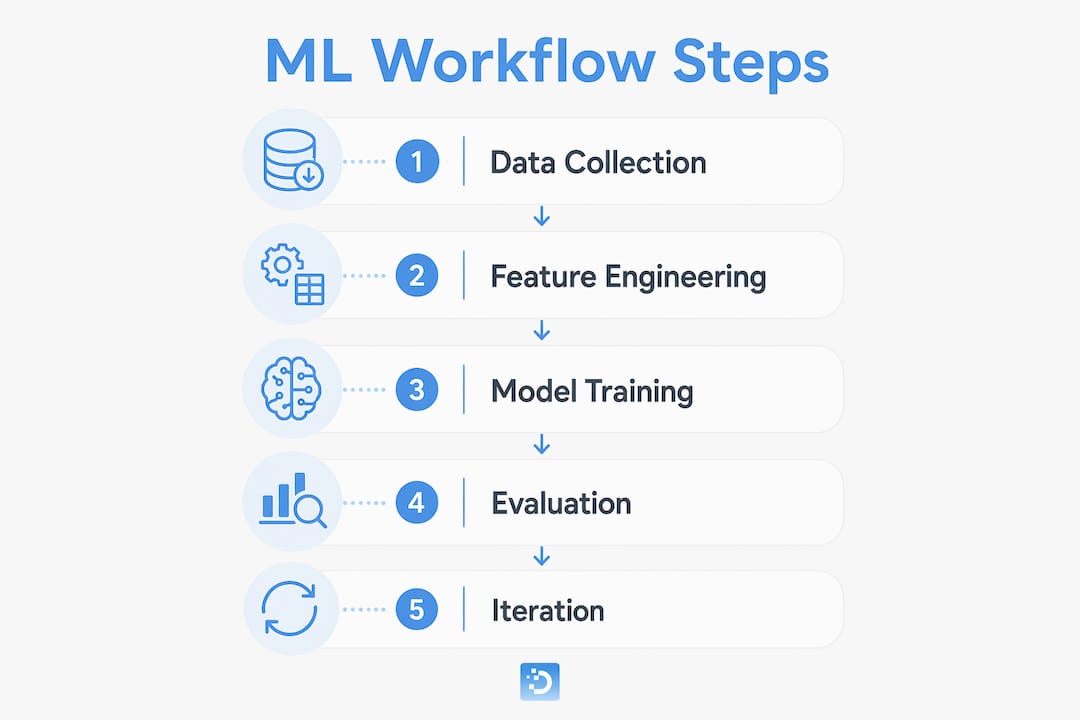
The iteration loop is where most of the value is created. You build features, train a model, examine errors, and then return to the feature set to address what the model got wrong. This cycle repeats until performance meets the acceptance threshold.
What common mistakes should practitioners avoid in feature engineering?
The most damaging mistake is flooding a model with raw or minimally processed features. Overloading models with too many raw features introduces noise and degrades accuracy. More inputs do not mean more signal. They often mean more confusion for the model.
A second common error is ignoring domain knowledge. Automated feature generation tools can surface statistical patterns, but they cannot replicate what a subject-matter expert knows about the data. A fraud analyst knows that a transaction at 3 AM in a new geography is suspicious. That knowledge produces a feature no automated tool would generate on its own. Effective feature engineering requires both automated techniques and human intuition) from domain experts.
- Relying on algorithm complexity to fix poor features wastes compute and time.
- Skipping feature selection leaves noise in the model and hurts generalization.
- Treating feature engineering as a one-time step rather than an iterative process leads to stale features that degrade over time.
- Failing to validate new features against a holdout set risks overfitting to the training distribution.
Pro Tip: After each round of feature creation, run a permutation importance check. Any feature that does not improve validation performance should be cut immediately.
Key Takeaways
Feature engineering is the highest-leverage activity in any ML project, requiring a structured workflow, four core feature types, and continuous iteration between feature creation and model evaluation.
| Point | Details |
|---|---|
| Features outrank algorithms | Simple models with strong features beat complex models on weak inputs every time. |
| Four feature types drive most gains | Recency, ratio, aggregation, and interaction features cover the majority of real-world predictive signal. |
| Workflow is iterative | Feature engineering loops back from model evaluation to feature creation throughout the project. |
| Quality beats quantity | Overloading a model with raw features degrades performance; selection is as important as creation. |
| Domain knowledge is irreplaceable | Automated tools cannot substitute for expert insight when crafting high-signal features. |
Feature engineering as art and science: my honest view
I have watched teams spend months tuning neural network architectures while their feature set remained a barely processed dump of raw database columns. The model never improved meaningfully. When they finally invested two weeks in building recency and ratio features from the same data, accuracy jumped in a way that six months of architecture changes had not produced.
Feature engineering blends automated techniques and domain expert intuition). That framing is accurate, but it undersells the craft involved. The automation part is straightforward. The intuition part requires you to understand what the data actually represents in the real world, not just what it looks like in a dataframe.
My strongest recommendation is to resist the urge to add features. Most practitioners add too many and prune too few. Advanced practitioners prioritize a limited set of high-impact features rather than large numbers of raw inputs. The discipline of cutting features is harder than creating them, and it is where most of the performance gains actually live. If you want to improve your data transformation practices, start by removing features you cannot justify, not by adding new ones.
— Oleg
How DOT Data Labs supports better feature engineering
Good feature engineering starts with good data. If your raw inputs are incomplete, inconsistently labeled, or poorly structured, no amount of transformation will produce reliable features.

DOT Data Labs delivers production-ready training datasets built for ML teams that need clean, structured, and labeled inputs from day one. The company covers automotive, healthcare, and finance use cases, with full-stack delivery from raw data sourcing through validated, model-ready output. Whether your team needs off-the-shelf datasets for rapid prototyping or a custom data pipeline that feeds your feature store continuously, DOT Data Labs handles the data supply chain so your engineers can focus on building features, not cleaning inputs.
FAQ
What is feature engineering in machine learning?
Feature engineering is the process of transforming raw data into meaningful numeric inputs that machine learning models use to make predictions. It accounts for approximately 80% of effort in real-world ML projects.
What are the most important feature engineering techniques?
Recency, ratio, aggregation, and interaction features drive the majority of successful outcomes. Encoding, scaling, bucketing, and feature selection are also core techniques in any feature engineering workflow.
Why do features matter more than algorithm choice?
Algorithms amplify the signal already present in features. A model trained on poor features will underperform regardless of its complexity, while a simple model with well-crafted features consistently delivers strong results.
How does feature engineering fit into the ML pipeline?
Feature engineering sits between data collection and model training. It integrates with ETL processes and runs as an iterative loop throughout model development, not as a single preprocessing step.
What is the biggest mistake in feature engineering?
Overloading a model with too many raw or minimally processed features is the most common error. It introduces noise, increases complexity, and degrades generalization performance on unseen data.
Recommended
- Feature Engineering Tutorial for ML Engineers: 2026 Guide | DOT Data Labs Blog
- How to create high-quality ML datasets: step-by-step guide | DOT Data Labs Blog
- What Is Data Augmentation? A Practical ML Guide | DOT Data Labs Blog
- Data transformation for AI: Clean, structure, and optimize ML datasets | DOT Data Labs Blog