
Feature Engineering Tutorial for ML Engineers: 2026 Guide

TL;DR:
- Proper feature engineering involves splitting data before transformation to prevent leakage and using pipelines to enforce correct workflow. Safe target encoding requires out-of-fold cross-validation, and in time series, shifting data prevents future data contamination. Monitoring feature drift with PSI and versioning pipelines ensures sustained model performance in production.
Feature engineering is the process of creating, transforming, and selecting input variables that directly improve machine learning model quality and performance. It sits between raw data and model training, and it determines more about final accuracy than model architecture in most real-world projects. This tutorial covers the full workflow: leakage-free pipelines with scikit-learn, safe target encoding, time series features, automated synthesis with Featuretools, and post-deployment monitoring. Tools like scikit-learn Pipelines, Featuretools, and Databricks declarative APIs each address a distinct layer of the problem.
What is a leakage-free feature engineering pipeline?
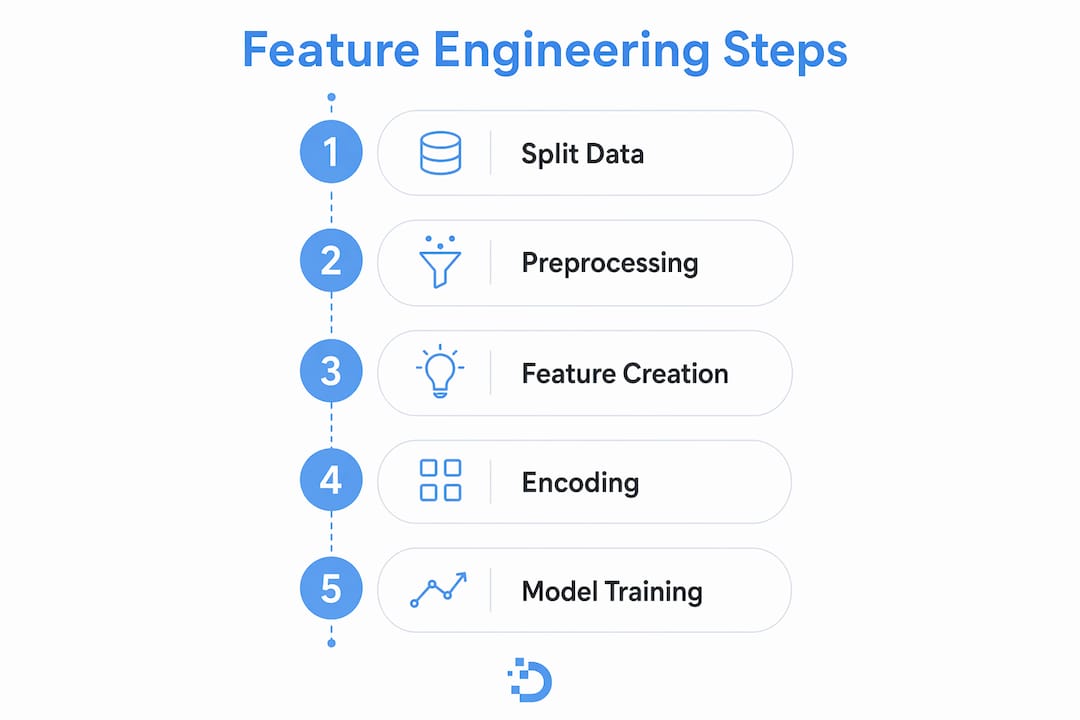
Leakage-free pipeline design is the single most important concept in any feature engineering tutorial. Most feature engineering bugs that cause unexpected model degradation trace back to fitting transformers on the wrong data split. The fix is structural, not manual.
The correct sequence is always: split first, then transform. Call train_test_split before any preprocessing step touches the data. Never compute means, standard deviations, or category encodings on the full dataset before splitting.
Scikit-learn Pipeline enforces the correct fit/transform lifecycle automatically. The Pipeline object calls fit only on training data and applies transform to validation and test sets without refitting. Calling fit_transform directly on validation data is the most common leakage mistake, and Pipeline eliminates it by design.
A production-ready pattern for mixed tabular data uses ColumnTransformer to route numeric and categorical columns through separate mini-pipelines:
- Numeric pipeline:
SimpleImputer(median strategy) followed byStandardScaler - Categorical pipeline:
SimpleImputer(most frequent strategy) followed byOneHotEncoderorOrdinalEncoder - Combined:
ColumnTransformermerges both outputs into a single feature matrix - Final step: the estimator sits at the end of the outer Pipeline
This preprocessing pipeline pattern avoids manual errors and guarantees that fitting happens only on training folds.
Pro Tip: Serialize the entire Pipeline object alongside the model artifact using joblib or pickle. Reloading the fitted Pipeline at inference time prevents training-serving skew, which is the leading cause of silent performance degradation in production.
How can you apply target encoding safely for high-cardinality features?
Target encoding replaces a categorical value with the mean of the target variable for that category. It reduces dimensionality dramatically compared to one-hot encoding, which matters when a column has hundreds or thousands of unique values. The risk is label leakage: if you compute category means on the full training set, each row’s own label contributes to its own encoding.
Safe target encoding requires out-of-fold (OOF) cross-validation. The process works as follows:
- Split training data into K folds (typically 5)
- For each fold, compute category means using only the other K-1 folds
- Encode the held-out fold using those means
- At inference time, use means computed from the full training set
Smoothing adds a second layer of protection. The smoothed estimate blends the category mean with the global mean, weighted by the number of observations in that category. Rare categories pull toward the global mean, which prevents overfitting on low-frequency values.
Target encoding leakage occurs when encoders are precomputed globally and then used inside cross-validation. The encoder must fit inside each CV fold, not before the loop starts. Libraries like Category Encoders implement OOF encoding natively when used with scikit-learn’s cross_val_score.

Pro Tip: Wrap your target encoder inside a Pipeline step and pass it to GridSearchCV. This forces the encoder to refit on each training fold automatically, with no extra code required.
What special considerations apply to time series feature engineering?
Time series feature engineering carries a leakage risk that does not exist in cross-sectional data: the future can contaminate the past if window calculations are not anchored correctly. A rolling 7-day mean that includes the current row’s value inflates offline metrics and produces a model that cannot replicate its training performance in production.
The fix is a single line: always call shift(1) before computing any rolling statistic. This shifts the series forward by one period so the window covers only past observations. Rolling features without shifting almost always cause leakage, and the error is invisible until the model is deployed.
Key practices for time series features:
- Use
TimeSeriesSplitfrom scikit-learn instead of randomKFoldto preserve temporal order in cross-validation - Compute lag features (lag 1, lag 7, lag 30) after shifting to avoid including the current target
- Track “as-of” timestamps for every feature join; even small misalignments cause hidden leakage
- Validate that timestamp alignment between feature tables and label tables is exact before training
Databricks declarative feature APIs enforce point-in-time correctness by associating each feature with an entity and a timestamp. Training sets receive only features known as of each label’s timestamp, which removes the manual burden of managing as-of joins.
Pro Tip: Build a unit test that checks your feature DataFrame for any column with a correlation above 0.95 with the future target. Run it as part of your CI pipeline before every training run.
How does automated feature synthesis work, and what are the trade-offs?
Automated feature synthesis generates new features by composing mathematical operations across tables without manual specification. Featuretools implements this through Deep Feature Synthesis (DFS), which applies aggregation primitives (sum, mean, count) and transformation primitives (log, subtract, divide) across related entity sets.
Featuretools DFS returns a feature matrix plus a list of feature definitions. The max_depth parameter controls how many primitives are composed. Depth 1 produces simple aggregations; depth 2 produces aggregations of aggregations, which can generate thousands of columns.
| Approach | Feature count | Interpretability | Leakage risk |
|---|---|---|---|
| Manual engineering | Low | High | Low (if careful) |
| DFS depth 1 | Medium | Medium | Low |
| DFS depth 2+ | Very high | Low | Medium without time index |
The trade-off is clear: higher depth produces more signal but also more noise. Pruning is mandatory. Use permutation importance or a regularized model like Lasso to rank generated features and drop those below a threshold. Keeping all DFS features without pruning produces brittle models that overfit on training data.
Automated feature generation works best as a starting point for exploration, not as a replacement for domain knowledge. DFS cannot know that “days since last purchase” matters more than “count of transactions” for churn prediction. A practitioner still needs to validate generated features against business logic.
Pro Tip: Set max_depth=1 for your first DFS run. Evaluate model performance, then increment to 2 only if depth 1 features are insufficient. This keeps the feature space manageable and the pruning step tractable.
What monitoring strategies maintain feature quality after deployment?
Feature drift is the change in the statistical distribution of input features between training time and inference time. It is the most common cause of gradual model performance decay after deployment. Catching it requires a dedicated monitoring layer separate from model accuracy tracking.
Population Stability Index (PSI) is the standard metric for measuring feature drift. A PSI below 0.1 indicates no significant shift. A PSI between 0.1 and 0.25 signals moderate drift requiring investigation. A PSI above 0.25 signals significant drift that likely requires retraining.
Monitoring workflow essentials:
- Compute PSI weekly for every feature in production
- Set automated alerts when PSI exceeds 0.1 for any high-importance feature
- Log raw feature distributions at inference time for retrospective analysis
- Separate drift detection from accuracy monitoring, since accuracy labels often arrive with a delay
Pro Tip: Track feature importance rankings across retraining runs. A feature that drops from top 5 to bottom 20 between runs signals distribution shift, even before PSI alerts trigger.
Key takeaways
Leakage-free feature engineering requires splitting data before transformations and fitting all encoders strictly inside cross-validation folds, with PSI monitoring to catch drift after deployment.
| Point | Details |
|---|---|
| Split before transforming | Always call train_test_split before any preprocessing step touches the data. |
| Use scikit-learn Pipeline | Pipeline enforces correct fit/transform lifecycle and prevents the most common leakage mistakes. |
| Apply OOF target encoding | Fit target encoders inside CV folds, not globally, to prevent label leakage on high-cardinality features. |
| Shift before rolling windows | Call shift(1) before any rolling calculation in time series to anchor features strictly to past data. |
| Monitor PSI post-deployment | A PSI above 0.25 on any key feature signals significant drift and likely requires retraining. |
What I’ve learned from production feature engineering failures
The gap between a clean tutorial and a production pipeline is wider than most teams expect. The issue I see most often is training-serving skew: the training pipeline applies a transformation that the inference service does not replicate exactly. The model trains on scaled features but scores on raw ones, or vice versa. The fix is not better documentation. It is versioning the fitted Pipeline as a single artifact alongside the model weights, then loading both together at inference time.
The second pattern I see is over-engineering. Teams spend weeks building 200 features when 15 well-chosen ones would outperform the full set. Feature importance is not just a diagnostic tool. It is a pruning tool. Run it after every training cycle and drop features that contribute less than 1% of cumulative importance.
The third lesson is about data preprocessing workflow documentation. Pipelines that are not documented at the transformation level become unmaintainable within six months. Every transformation step should have a comment explaining why it exists, not just what it does. That context is what allows a new team member to modify the pipeline without introducing a new leakage bug.
— Oleg
High-quality training data is the foundation of effective feature engineering
Feature engineering only works when the underlying data is clean, consistently labeled, and representative of production conditions. Poorly sourced or inconsistently annotated data makes even the best pipeline produce unreliable features.
DOT Data Labs supplies production-ready training datasets across industries including finance, healthcare, and automotive. The team handles sourcing, cleaning, deduplication, and labeling at scale, so your engineers spend time on feature design rather than data wrangling. DOT Data Labs also offers ongoing data pipelines that continuously deliver structured, validated data into your training infrastructure. If your feature engineering workflow is bottlenecked by data quality rather than pipeline design, that is the right place to start.
FAQ
What is feature engineering in machine learning?
Feature engineering is the process of transforming raw data into input variables that improve model performance. It includes creating new features, encoding categoricals, scaling numerics, and selecting the most predictive columns.
How do I prevent data leakage in a feature engineering pipeline?
Split your data before any transformation, then use scikit-learn Pipeline to enforce that all encoders and scalers fit only on training data. Never call fit_transform on validation or test sets.
What is target encoding and when should I use it?
Target encoding replaces a categorical value with the mean of the target for that category. Use it for high-cardinality columns where one-hot encoding would create too many dimensions, and always apply it with out-of-fold cross-validation to prevent label leakage.
What tools are best for automated feature engineering?
Featuretools is the leading open-source library for automated feature synthesis using Deep Feature Synthesis. Databricks declarative feature APIs handle time-windowed aggregations with built-in point-in-time correctness for temporal ML tasks.
How do I detect feature drift after model deployment?
Use Population Stability Index (PSI) to measure distribution shift for each feature. A PSI above 0.25 indicates significant drift and typically requires retraining the model on fresher data.