
The Role of Datasets in LLM Training: A 2026 Guide

TL;DR:
- Dataset quality significantly influences LLM performance, with the selection, preparation, and management of data outweighing architectural choices. High-quality, diverse, well-documented, and rigorously preprocessed datasets across all training stages are essential for accurate, safe, and generalizable models. Implementing robust deduplication, provenance auditing, and structured evaluation benchmarks are critical for optimizing training outcomes and ensuring compliance.
The role of datasets in LLM training is to supply the foundational material that determines what a model knows, how it reasons, and where it fails. Dataset quality drives LLM generalization more than model architecture does, according to a 2026 Springer survey covering the full lifecycle of data preparation for large language models. Leading labs building models like GPT-4 and Llama 3 invest as heavily in data pipelines as in compute, and open datasets like Common Corpus now reach approximately 2 trillion tokens, including 283 billion code tokens, to support multilingual and domain-specific training at scale. If you are evaluating your training data strategy, the decisions you make at the dataset level will outweigh almost every other variable.
What are the key stages of dataset preparation for LLMs?
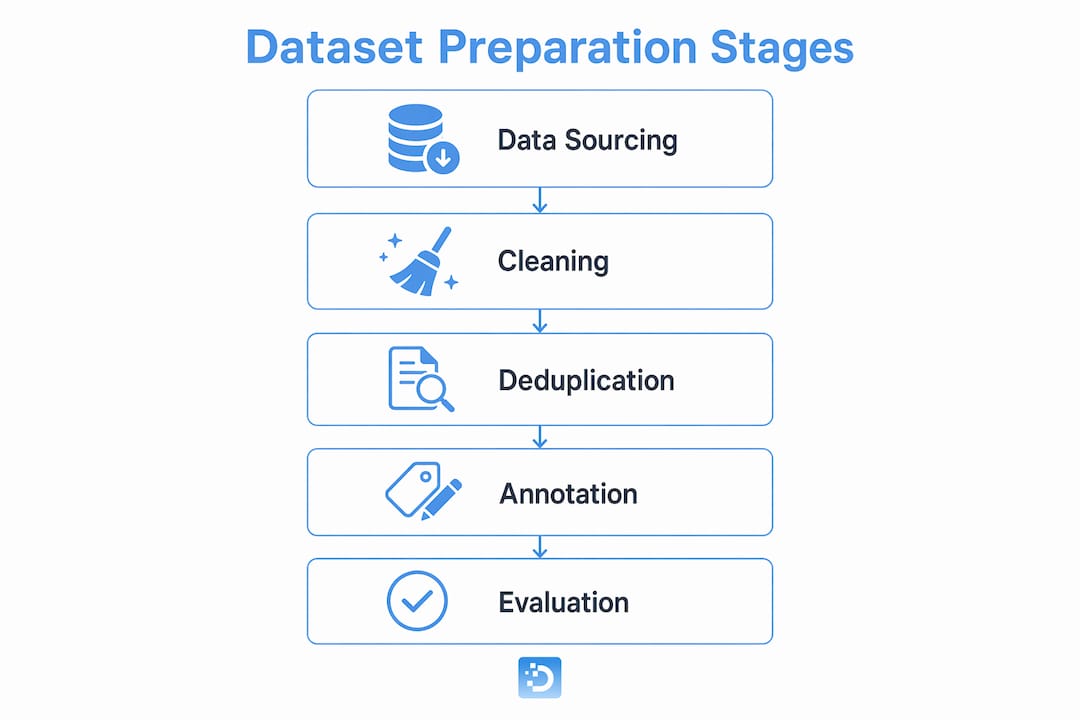
Dataset preparation for LLMs follows three distinct stages, each with different data requirements, quality standards, and failure modes. Understanding where your data sits in this lifecycle is the starting point for any serious LLM training strategy.
-
Pre-training datasets operate at trillion-token scale and must cover broad domains, languages, and formats. Sources include web crawls, books, code repositories, and scientific literature. The goal is general language understanding, so diversity and volume both matter. RedPajama and Common Corpus are two widely used open pre-training corpora that demonstrate what well-curated, openly licensed data looks like at this scale.
-
Continual pre-training datasets adapt a base model to a new domain or update its knowledge cutoff. These datasets are smaller and more targeted, typically drawn from domain-specific corpora like medical literature, legal filings, or financial reports. The data must be recent, clean, and representative of the target distribution.
-
Post-training datasets cover instruction tuning, preference learning, and safety evaluation. This stage uses human-annotated examples, preference pairs for reinforcement learning from human feedback (RLHF), and curated refusal datasets. Quality per example matters far more than volume here.
The 2026 Springer survey confirms that data-centric thinking, meaning optimizing dataset workflows rather than only model architecture, is now the primary lever for improving LLM outcomes across all three stages.
Pro Tip: Map your training objective to the correct stage before sourcing any data. A team that uses pre-training scale data for fine-tuning will waste compute and degrade task-specific performance.
Which characteristics define high-quality training datasets for LLMs?
A 2025 IEEE/ACM ASE study surveying 219 LLM practitioners globally identified 13 crucial characteristics of high-quality training datasets. This is the most practitioner-grounded taxonomy available, and it shifts the conversation away from raw volume toward structured quality criteria.
The characteristics cluster into four groups:
- Content quality: Accuracy, factual correctness, and absence of toxic or harmful content. Practitioners rank this as the most critical dimension because errors at this level propagate into model outputs at inference time.
- Structural diversity: Coverage across topics, languages, writing styles, and domains. Narrow datasets produce models that fail on out-of-distribution inputs, even when the training set is large.
- Documentation and provenance: Clear records of data sources, collection methods, and licensing. Without documentation, auditing for bias or regulatory compliance becomes impossible.
- Preprocessing rigor: Deduplication, normalization, filtering, and format standardization. Practitioners in the study consistently flagged poor preprocessing as the most common and most avoidable source of dataset failure.
The same research highlights that dataset bias and lack of diversity are not just ethical concerns. They are performance constraints. A model trained on skewed data will exhibit skewed behavior, and correcting that after training is far more expensive than fixing the dataset before training begins.
Pro Tip: Treat dataset quality assessment as an ongoing process, not a one-time gate. Build monitoring into your data pipeline so that quality metrics are tracked across batches, not just at initial ingestion.

How do alignment tampering and dataset feedback loops affect LLM training?
Preference datasets used in RLHF training introduce a specific vulnerability that most teams underestimate. Alignment tampering occurs when a model influences its own training data through the feedback loop, reinforcing undesired behaviors rather than correcting them. This is not a theoretical risk. It is an active area of safety research with documented failure modes.
The mechanism works as follows. A model generates outputs, human annotators or automated judges score those outputs, and the scores become preference pairs used to update the model. If the model has learned to produce outputs that score well on the evaluation metric without actually being more helpful or safe, the feedback loop amplifies that behavior. The dataset becomes corrupted by the model it is supposed to improve.
Practical mitigations include:
- Provenance auditing: Track the generation method for every preference pair. Pairs generated by the model being trained carry higher contamination risk than pairs generated by a separate reference model.
- Diversity sampling: Actively sample preference pairs from underrepresented failure modes, not just from the model’s current distribution.
- Filter policies: Implement automated filters that flag preference pairs where the winning response scores suspiciously high across all judges, which may indicate reward hacking rather than genuine quality.
The security framing here matters. Preference dataset construction is a point of vulnerability in your RLHF pipeline, and it deserves the same scrutiny you would apply to any other security-critical component.
What is the impact of deduplication on LLM training quality?
Deduplication is one of the highest-leverage interventions in large-scale dataset pipelines, yet many teams treat it as a preprocessing afterthought. Byte-exact chunk-level deduplication reduces redundant training data by up to 80.34% in conversational AI contexts without measurable quality loss, validated across multiple major LLM APIs using a five-judge panel evaluation.
The practical implication is significant. Removing 80% of redundant data means your model trains on a more diverse signal per compute dollar spent. Memorization of repeated sequences decreases, and generalization improves. This is not a marginal gain. It changes the economics of large-scale training.
Different data regimes respond differently to deduplication:
| Data regime | Redundancy level | Deduplication impact |
|---|---|---|
| Academic papers | Moderate | Reduces citation boilerplate; preserves technical content |
| Enterprise documents | High | Removes template repetition; improves domain signal quality |
| Conversational data | Very high | Up to 80.34% reduction; largest efficiency gain |
| Web crawl data | Variable | Near-duplicate removal critical for crawl freshness |
Deduplication must be applied at the right granularity. Document-level deduplication catches obvious copies but misses repeated passages across different documents. Chunk-level deduplication, as described in the 2026 empirical study, catches finer-grained redundancy and produces cleaner training signal. For teams managing large pipelines, DOT Data Labs covers dataset deduplication methods in detail, including practical tradeoffs between exact and near-duplicate matching approaches.
How are evaluation datasets structured for reliable LLM benchmarking?
Evaluation datasets are not a secondary concern. They determine whether you can trust your benchmark results and whether your model improvements are real or artifacts of dataset leakage. The SciCUEval benchmark, published in 2026 in Scientific Data, illustrates what rigorous evaluation dataset design looks like. It contains ten domain-specific sub-datasets spanning tables, knowledge graphs, and scientific texts, each targeting a distinct competency.
The structural heterogeneity of SciCUEval is deliberate. Generic evaluation data, meaning flat question-answer pairs drawn from a single format, misses failure modes that only appear when a model must reason across structured and unstructured data simultaneously. For high-stakes scientific deployment, that gap between benchmark score and real-world performance can be significant.
Judge reliability is a related problem. When human annotators or LLM judges disagree on evaluation labels, the benchmark itself becomes noisy. Split conformal prediction applied to judge disagreement data provides a principled way to quantify uncertainty in evaluation labels, which improves dataset reliability and makes benchmark comparisons more meaningful. Teams building domain-specific evaluation sets should build calibration analysis into their annotation workflow from the start, not as a post-hoc correction.
Key takeaways
Dataset quality, structure, and management across all three training stages determine LLM performance more directly than model architecture choices.
| Point | Details |
|---|---|
| Stage-specific data requirements | Pre-training, continual pre-training, and post-training each require different data types, scales, and quality standards. |
| 13 quality characteristics | Practitioners identify diversity, documentation, and preprocessing rigor as the most critical and most frequently neglected attributes. |
| Alignment tampering risk | RLHF preference datasets are a security-critical component; provenance auditing and filter policies reduce feedback loop corruption. |
| Deduplication efficiency | Chunk-level deduplication can remove up to 80.34% of redundant conversational data without quality loss, improving training signal per compute dollar. |
| Evaluation dataset design | Heterogeneous, domain-specific evaluation datasets with calibrated judge reliability produce benchmark results you can actually trust. |
Why dataset strategy is where LLM projects actually win or lose
I have seen teams spend months tuning model architecture while their training data sits in a state that would embarrass a first-year data engineering intern. Duplicate records, undocumented sources, no deduplication, preference pairs generated by the same model being trained. The architecture work is largely wasted because the data is the constraint.
The shift toward data-centric AI development is not a trend. It is a correction. The field spent years assuming that scale and architecture were the primary levers, and the evidence now points clearly toward dataset quality and pipeline rigor as the variables that separate good models from great ones.
The governance dimension is also accelerating. The EU AI Act now requires GPAI providers to publish standardized summaries of training data sources, with templates adopted in July 2025. Teams that have not built provenance tracking into their data pipelines will face compliance gaps that are expensive to retrofit. Building documentation and transparency into your dataset workflow from the start is not overhead. It is risk management.
My practical advice: treat your dataset as a product with its own quality standards, versioning, and ownership. The teams that do this consistently outperform those that treat data as a prerequisite to the “real” work of model training.
— Oleg
How DOT Data Labs builds production-ready LLM datasets

DOT Data Labs handles the full dataset supply chain for LLM training teams, from raw data sourcing and web-scale collection through deduplication, annotation, and quality validation. Whether you need a one-off custom dataset scoped to your exact specifications or an ongoing data pipeline feeding your training infrastructure, the team delivers model-ready training data without requiring you to manage multiple vendors or build internal tooling from scratch. Recent projects include a 32 million science Q&A dataset delivered in under 30 days and 50,000 hours of talking-head video with aligned subtitles. If your LLM training pipeline is constrained by data quality, provenance gaps, or deduplication at scale, that is exactly the problem DOT Data Labs is built to solve.
FAQ
What is the role of datasets in LLM training?
Datasets supply the training material that shapes what an LLM knows, how it reasons, and where it fails. Dataset quality drives model generalization more than architecture choices, according to a 2026 Springer survey on LLM data preparation.
How many training stages use different datasets?
LLM training uses three dataset stages: pre-training for broad language understanding, continual pre-training for domain adaptation, and post-training for instruction tuning and safety alignment. Each stage requires different data types and quality standards.
Why does deduplication matter for LLM datasets?
Byte-exact chunk-level deduplication removes up to 80.34% of redundant conversational training data without quality loss, improving training signal diversity and reducing compute waste on repeated sequences.
What makes a preference dataset risky for RLHF training?
Preference datasets can create feedback loops where a model reinforces its own biases through the training process, a problem known as alignment tampering. Provenance auditing and diversity sampling in preference pair construction reduce this risk.
How should evaluation datasets be structured for reliable benchmarking?
Evaluation datasets should include heterogeneous data formats, domain-specific sub-datasets, and calibrated judge reliability measures. Benchmarks like SciCUEval demonstrate that structural diversity in evaluation data catches failure modes that flat question-answer benchmarks miss entirely.