
Domain-specific datasets for superior LLM fine-tuning

TL;DR:
- Relevance in domain-specific datasets outperforms volume for fine-tuning AI models.
- High-quality, well-annotated data tailored to specific use cases boosts model accuracy significantly.
- Building and validating datasets with ongoing refinement creates a competitive advantage.
More data does not automatically mean better AI. Many teams spend months collecting massive general-purpose corpora, only to watch their models struggle with the precise vocabulary, edge cases, and nuanced reasoning their actual use cases demand. The real competitive advantage in 2026 comes from data relevance, not data volume. Domain-specific datasets give your model the exact signal it needs to perform at a specialist level. In this guide, you’ll learn what domain-specific datasets are, why they outperform general-purpose alternatives for LLM fine-tuning, how to build and curate them effectively, and how to navigate the real trade-offs between specialization and generalization.
Key Takeaways
| Point | Details |
|---|---|
| Define your data domain | Start by pinpointing your AI application’s use case to target the most relevant data. |
| Quality over quantity | High-quality, well-annotated samples outperform larger, less-relevant datasets. |
| Balance specialization risks | Combine general and domain data and implement validation to mitigate overfitting and poor generalization. |
| Leverage empirical benchmarks | Use published results to set performance expectations and guide dataset selection. |
What is a domain-specific dataset?
Not all data is created equal. When you feed a language model on internet-scale text scraped from everything from recipe blogs to Reddit threads, you get broad capability but shallow expertise. Domain-specific datasets flip that equation.
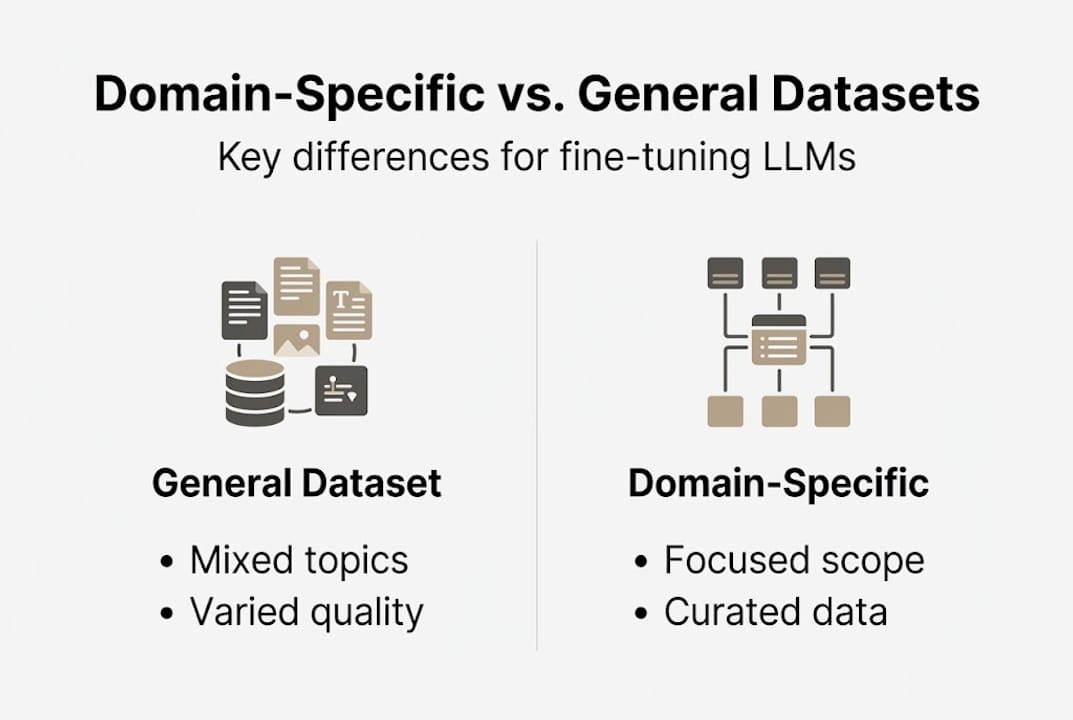
A domain-specific dataset is a curated collection of data tailored to a particular industry, field, subject, or use case, capturing specialized vocabulary, structures, contexts, and nuances that general datasets lack. Think of it as training a model on the right textbooks rather than handing it an entire library and hoping for the best.
The structural differences between domain-specific and general-purpose datasets go beyond just topic coverage. Domain-specific models focus on narrow, high-relevance content like medical records, legal documents, financial reports, or code repositories to enable precise model performance in targeted applications. General datasets handle breadth; domain datasets handle depth.
Here’s a quick comparison of what that looks like in practice:
| Feature | General-purpose dataset | Domain-specific dataset |
|---|---|---|
| Vocabulary coverage | Broad, varied | Specialized, precise |
| Training signal | Diffuse | Concentrated |
| Average task accuracy | ~78% on domain tasks | ~96% on domain tasks |
| Risk of domain mismatch | High | Low |
| Annotation depth | Minimal | Rich and structured |
Some clear examples of domain-specific datasets by industry:
- Medical: Clinical notes, radiology reports, ICD-coded diagnoses, drug interaction records
- Legal: Case law transcripts, contract clauses, regulatory filings, legal briefs
- Financial: Earnings call transcripts, SEC filings, credit risk reports, trading commentary
- Code: Function-level code with docstrings, test suites, bug reports, commit histories
“The difference between a good medical AI and a dangerous one often comes down to whether it trained on real clinical language or general text with medical terms scattered throughout.” This is why specificity matters at every level of your pipeline.
The deeper reason specificity drives performance is token efficiency. When a model’s training data already mirrors the distribution of its inference-time inputs, less of its capacity gets wasted on irrelevant pattern learning. That freed capacity gets redirected toward the nuanced reasoning and precision your use case actually requires. Building a high-quality dataset from the right domain is the foundation everything else sits on.
Why domain-specific datasets matter for LLM tuning
Fine-tuning a large language model without domain-specific data is like teaching a surgeon using only general anatomy textbooks. The foundational knowledge transfers, but the practitioner-level precision does not.
LLM fine-tuning is the process of continuing a pre-trained model’s learning on a curated, task-specific dataset to shift its behavior toward a target application. The pre-trained weights give you language understanding out of the box. Domain-specific fine-tuning data gives you the specialized performance layer on top of that foundation.
The benchmark numbers here are hard to ignore. Domain-specific fine-tuning yields 10 to 40% performance gains across multiple benchmarks: FineEdit outperformed Gemini by +11.6% BLEU on editing tasks; Llama-Fin beat general baselines by 10 to 25% on financial reasoning tasks; EnvGPT achieved 92% accuracy on the EnviroExam versus 84% for LLaMA-3.1-8B; and code-specific models consistently outperform general models on structured reasoning challenges.
Those aren’t marginal improvements. A 10 to 40% accuracy lift often means the difference between a product that users trust and one they abandon after the first week.
Here’s how to actually put domain data to work for your fine-tuning pipeline, in the order that matters:
- Define the task boundary. Know exactly what your model needs to do: classification, generation, extraction, summarization. Your dataset must mirror that task type.
- Source domain-native data first. Internal documents, proprietary records, and industry-specific corpora are always preferable to synthetic substitutes at this stage.
- Format for instruction-following. Structure your data as instruction-response pairs with consistent schemas. Consistency across samples matters more than raw count.
- Filter aggressively. Remove samples that don’t represent production-quality inputs. Garbage-in applies with devastating force at fine-tuning scale.
- Evaluate against held-out domain benchmarks. Don’t measure your model against generic benchmarks. Build or source golden datasets that reflect your actual use case to get reliable accuracy signals.
The broader implication is strategic. Organizations that invest in proprietary domain datasets create a durable moat. General-purpose fine-tuning is table stakes. The teams building systematic, well-annotated domain corpora are the ones whose models keep improving while competitors stagnate.
Building and curating a robust domain dataset
Knowing you need domain-specific data is step one. Knowing how to build it well is where most teams fall short.
The first decision is real data versus synthetic data. Real domain data, pulled from actual industry sources, always carries more authentic distributional signal. Synthetic data generated by LLMs can fill gaps and increase volume, but it tends to flatten the very edge cases and linguistic quirks that make domain data valuable. Prioritize real domain data over synthetic sources, and when you do use synthetic data, generate it from real domain seeds rather than from generic prompts.
The ideal composition for a fine-tuning dataset follows a roughly structured breakdown:
- 85% core examples: Canonical, high-quality samples that represent the typical task distribution your model will encounter in production
- 10% edge cases: Harder, less common inputs that test boundary performance and prevent brittle behavior
- 5% rejection examples: Inputs the model should refuse or flag, critical for safety-aware applications in medical, legal, or financial contexts
This distribution isn’t arbitrary. Models trained on only clean, easy examples learn confidence on easy problems but collapse on hard ones. Deliberate inclusion of edge and rejection cases trains robust behavior across the full input space.
Annotation quality is where the biggest gains and the biggest risks live. Poorly annotated data is worse than no data in some cases, because it trains confident wrong behavior. Several principles matter here:
- Use multi-annotator consensus for any subjective or ambiguous labels. Single-annotator datasets introduce individual bias at scale.
- Apply automated validators where possible. For code datasets, actually execute the code. For factual extraction tasks, cross-reference against structured knowledge bases.
- Build schema-enforced annotation guidelines that annotators follow consistently, not loosely described rubrics.
Pro Tip: The perplexity of your fine-tuning data relative to the base model is a better early predictor of supervised fine-tuning success than semantic similarity scores. If your domain data sits in a very low-perplexity range relative to the base model, it means the model already understands the surface form and just needs the task signal. High perplexity means the model is encountering genuinely novel linguistic territory, which demands larger sample counts or a different base model choice.
For dataset curation tips that go deeper on annotation workflows, and an LLM data quality checklist you can apply before any fine-tuning run, both are worth having on hand before you commit to a collection strategy.
“The single most common mistake in domain dataset construction is treating data collection as a one-time event rather than an ongoing production system. Domain language evolves. Your dataset needs to evolve with it.”
Common pitfalls to watch for include annotation drift over time, where annotators gradually shift their interpretation of guidelines without explicit retraining. Another is selection bias in collection, where easily accessible documents crowd out rare but critical edge cases. And perhaps most insidiously, there’s the problem of label noise that only becomes visible when model performance unexpectedly plateaus after reaching what looks like a good sample size.
Mitigating risks and maximizing gains: Specialization vs. generalization
Curating domain-specific datasets isn’t without challenges. The same focus that drives specialist performance can become a liability if you’re not careful.

The core trade-off is well-documented. General datasets enable broad capabilities but suffer from domain mismatch, pulling accuracy down to around 78% on specialized tasks versus 96% for specialized models. But domain-specialized models carry their own risk: overfitting to the training distribution and poor generalization when inputs drift even slightly outside the covered territory.
Here’s how the trade-offs break down in practical terms:
| Risk | Cause | Mitigation strategy |
|---|---|---|
| Overfitting | Too little variety in training data | Add structured edge cases, increase domain diversity |
| Poor generalization | Narrow distribution coverage | Hybrid training with general + domain data |
| Catastrophic forgetting | Aggressive fine-tuning on small domain sets | Use PEFT (LoRA, QLoRA) instead of full fine-tuning |
| Annotation bias | Single-source or single-annotator data | Multi-annotator consensus and cross-validation |
The most effective mitigation strategy combines parameter-efficient fine-tuning (PEFT) methods like LoRA with continued pretraining on a broader domain corpus before task-specific fine-tuning. This two-stage approach gives the model enough domain exposure to understand the language distribution without locking it into a narrow task pattern.
Cross-domain transfer is a real phenomenon worth leveraging. Code-trained data measurably improves mathematical reasoning even when no explicit math training occurs. Legal document training improves structured argumentation across domains. Building your domain corpus with awareness of these transfer effects can let you get more from less labeled data.
Pro Tip: The “production mirror test” is the gold standard for validating your domain dataset before any training run. Take 200 to 500 examples directly from your actual production input logs, hold them out completely from training, and use them as your final evaluation set. If your held-out production examples don’t match the distribution of your training data, no amount of benchmark performance will save you from real-world failure.
A practical checklist for robust dataset quality before you commit to fine-tuning:
- Annotator agreement score above 0.8 (Cohen’s kappa or equivalent)
- At least 10% edge case coverage in training split
- Held-out validation set sampled from production-mirroring inputs
- Schema consistency check across all records (zero schema violations)
- Deduplication pass to prevent memorization of repeated samples
- Perplexity comparison between domain data and base model distribution
None of these steps are optional for production-grade systems. Teams that skip validation in favor of faster iteration cycles typically discover their performance gap only after deployment, where fixing it is exponentially more expensive.
Why data quality, not just proximity, is your ultimate differentiator
Here’s the uncomfortable truth that most domain-specific dataset conversations avoid: being close to the right domain is not the same as having the right data. Many teams collect domain-proximate data and call it domain-specific. The difference between those two things is where models fail.
We’ve seen projects where the team correctly identified their domain, collected thousands of relevant documents, and still shipped a model that underperformed a general-purpose baseline. Every single time, the culprit was annotation quality, not collection coverage. The data was topically correct but structurally noisy. Labels were inconsistent. Validation sets were too clean. The model learned the surface pattern of the domain without learning its actual reasoning structure.
The role of datasets in AI model outcomes is fundamentally about signal fidelity. Multi-annotator processes, automated validators, and production-mirror testing aren’t bureaucratic overhead. They’re the mechanism by which domain proximity becomes domain signal. Invest there first. Data volume is something you can buy. Annotation quality and validation rigor are capabilities you have to build deliberately.
How Dot Data Labs accelerates your domain-specific dataset journey
Building the right domain dataset is hard enough without also engineering the collection, cleaning, schema design, and validation infrastructure from scratch.
Dot Data Labs builds large-scale, structured, machine-ready datasets designed specifically for LLM fine-tuning, RAG pipelines, and vertical AI systems. From automated multi-source collection to schema-consistent structuring and AI optimization layers, every dataset is built to be training-ready from day one. Whether you need a custom domain corpus, a production dataset structure built around your model’s input distribution, or a complete machine-ready dataset guide to accelerate your next training run, the team at Dot Data Labs can move you from data gap to production-ready pipeline faster than any in-house build.
Frequently asked questions
How do I choose the right domain for dataset collection?
Define your AI model’s target use case first, then gather data that closely matches its intended real-world application domain. The tighter the match between your training distribution and production inputs, the better your model will perform.
How many samples do I need for effective LLM fine-tuning with domain data?
500 to 10,000 high-quality instruction-response pairs are typical for parameter-efficient LLM fine-tuning. Quality and task alignment matter far more than raw sample count at this scale.
Can I combine general and domain-specific data for model improvements?
Yes. Hybrid approaches using both general and domain-specific data often mitigate overfitting risks and balance accuracy across in-domain and out-of-domain inputs. The ratio depends heavily on your specific task requirements.
What matters more: dataset size or annotation quality?
Annotation quality consistently outperforms raw dataset size as a driver of model performance. Well-labeled smaller datasets outperform large, noisily-labeled corpora across nearly every fine-tuning benchmark studied.
How do you prevent overfitting when fine-tuning with domain-specific datasets?
Use a held-out validation set that mirrors production inputs, monitor training and validation loss curves throughout fine-tuning, and apply hybrid training strategies that blend domain-specific and general data to maintain generalization across input types.