
What Is Synthetic Data? Enhance AI Model Training & Quality

TL;DR:
- Over 60% of AI training data in 2024 is synthetic, used primarily as a core modeling strategy.
- Synthetic data replicates real-world data statistics without copying, generated via GANs, VAEs, diffusion models, or LLM prompting.
- Best practices involve hybrid datasets with a 70/30 real-to-synthetic ratio, continuous validation, and targeted gap filling.
There is a persistent belief in ML circles that real-world data is always superior. More of it, the better. But that assumption is quietly being dismantled. Over 60% of AI training data in 2024 was synthetic, and the models built on it are winning benchmarks, passing audits, and shipping to production. Synthetic data is not a workaround for teams that cannot get enough real data. For many practitioners, it is the primary strategy. This guide breaks down what synthetic data actually is, how it is generated, where it performs best, and how to integrate it without compromising your model’s reliability.
Key Takeaways
| Point | Details |
|---|---|
| Synthetic data is mainstream | More than half of AI training in 2024 used synthetic data to speed and improve model development. |
| Use hybrid datasets | Combining real and synthetic data, with about 30% synthetic, delivers the best performance and avoids common pitfalls. |
| Monitor for risks | Always check for reduced diversity, bias, and utility when using synthetic data to prevent model collapse. |
| Balance privacy and fidelity | Synthetic data enables privacy compliance and rare event simulation, but requires careful evaluation for fidelity and privacy. |
Understanding synthetic data: Definition, generation, and types
Synthetic data is artificially generated data that replicates the statistical properties, structure, or both of real-world data, without directly copying it. It is not fake data in the dismissive sense. It is engineered data, built to serve a specific modeling purpose.
The generation methods vary significantly depending on your use case:
- Generative Adversarial Networks (GANs): Two neural networks compete to produce realistic data. Best for images and structured tabular outputs.
- Variational Autoencoders (VAEs): Encode data into a latent space and decode it into new samples. Strong for continuous distributions.
- Diffusion models: Iteratively add and remove noise to generate high-fidelity outputs. Increasingly dominant in image and audio generation.
- LLM-based prompting: Use large language models to generate text, instruction sets, or structured records at scale. Widely used for NLP fine-tuning.
Synthetic data comes in four primary types: tabular (structured rows and columns for classification and prediction tasks), image (generated visuals for computer vision), text (synthetic documents, conversations, or labeled corpora), and time-series (sequential data for forecasting and anomaly detection).
When evaluating synthetic datasets, three metrics matter most:
| Metric | What it measures | Why it matters |
|---|---|---|
| Utility | ML task performance on synthetic data | Confirms the data is trainable |
| Fidelity | Statistical match to real data | Ensures distributional accuracy |
| Privacy | Risk of re-identification | Required for compliance |
Tools like SDV, YData, Mostly AI, and Gretel are benchmarked on utility, fidelity, and privacy across these exact dimensions. Choosing the right tool depends on your data type, privacy requirements, and downstream task.
For teams working on AI structuring methods or building optimized datasets, understanding these generation mechanics is not optional. It directly shapes how you design your data pipelines.
When and why synthetic data is used in AI and ML training
Synthetic data solves problems that real data simply cannot address on its own. The most common scenarios fall into four categories.
Privacy and regulatory compliance. In healthcare and fintech, using real patient or transaction records for training is often illegal. Synthetic data lets you preserve privacy under GDPR and HIPAA while still building functional models. You get the statistical signal without the legal exposure.
Rare events and edge cases. Real datasets are often skewed. Fraud occurs in less than 1% of transactions. Certain disease presentations appear in fewer than 100 documented cases globally. Synthetic generation lets you manufacture these rare events at scale, giving your model enough signal to learn from them.

Dataset balancing. Imbalanced classes are one of the most common causes of poor model performance. Synthetic oversampling techniques like SMOTE or GAN-based augmentation can restore balance without distorting the real distribution.
Software and ML system testing. Synthetic data is widely used to stress-test pipelines, validate schema integrity, and simulate production conditions before deployment.
Here is how the value plays out across industries:
| Industry | Synthetic data application | Primary benefit |
|---|---|---|
| Self-driving vehicles | Simulated driving scenarios | Edge case coverage |
| Healthcare | Synthetic patient records | HIPAA compliance |
| Fintech | Synthetic fraud patterns | Rare event modeling |
| NLP/LLM | Instruction-tuning datasets | Scale and diversity |
“Synthetic data is particularly valuable when real data is scarce, sensitive, or imbalanced, making it a core tool rather than a fallback.”
Pro Tip: Before generating synthetic data, audit your real dataset for the specific gaps you need to fill. Generating broadly without a gap analysis wastes compute and risks introducing noise.
For a broader view of where this fits in the market, AI dataset trends for startups and dataset curation tips are worth reviewing before you commit to a generation strategy.
Risks and pitfalls of using synthetic data
The benefits are real, but so are the failure modes. Practitioners who treat synthetic data as a plug-and-play solution tend to run into the same set of problems.
Model collapse. This is the most serious risk. When a model is trained recursively on synthetic data generated by earlier model versions, it progressively loses diversity. Tail events disappear. The model converges on the most common patterns and forgets the rest. Recursive synthetic training causes collapse, erasing rare cases and degrading accuracy over iterations.
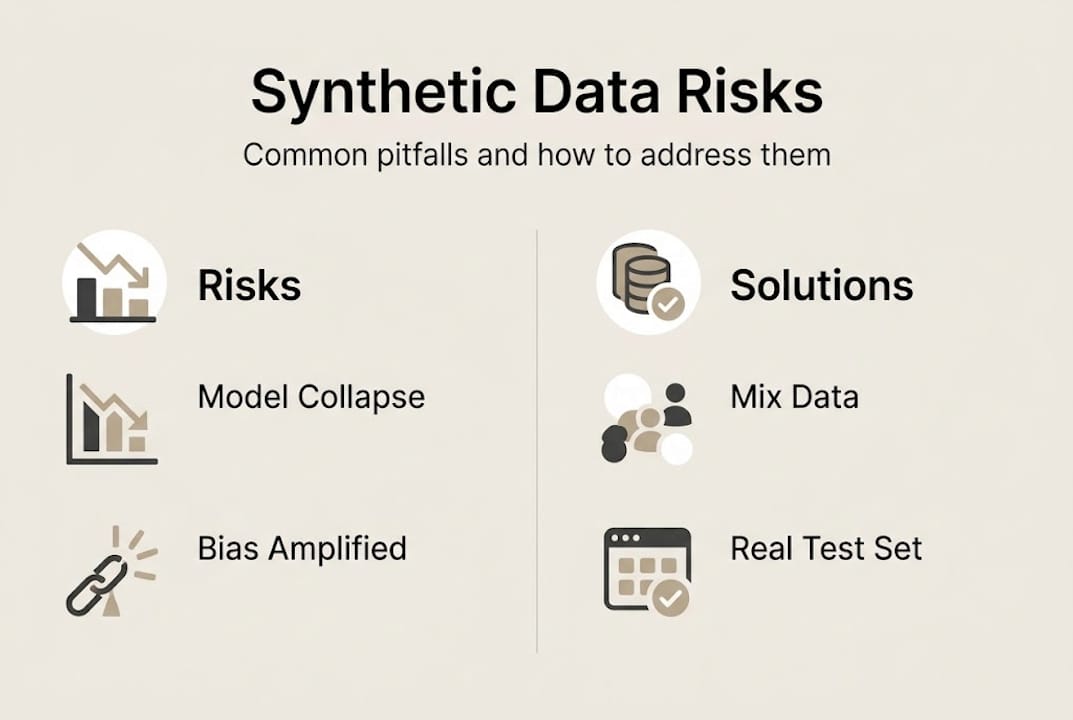
Bias amplification. Synthetic generators learn from real data. If that real data contains biases, the generator will reproduce and often amplify them. A model trained on biased synthetic data at scale can be harder to debug than one trained on biased real data, because the source of the problem is less visible.
Privacy leakage. Synthetic data is not automatically private. If the generator memorizes training examples, those examples can be reconstructed through membership inference attacks. Always run privacy audits before treating synthetic data as safe for compliance purposes.
Loss of tail coverage. Pure synthetic datasets tend to oversample the modal distribution and undersample the tails. For tasks where rare events matter most, like fraud detection or medical diagnosis, this is a critical failure.
Key risks to monitor:
- JS divergence: Measures distributional distance between real and synthetic data
- Tail coverage: Checks whether rare events are preserved in the synthetic set
- Membership inference tests: Evaluates re-identification risk
- Accuracy delta: Compares model performance trained on synthetic vs. real data
“Accumulation-based workflows, where synthetic data supplements rather than replaces real data, consistently outperform replacement-based approaches.”
Research confirms that teams using accumulate-and-subsample workflows avoid collapse, while those who replace real data with synthetic equivalents see degraded diversity and accuracy over time.
Pro Tip: Never evaluate your synthetic data in isolation. Always run a train-on-synthetic, test-on-real benchmark before integrating any synthetic set into production pipelines. This is your ground truth check.
For teams building evaluation frameworks, golden dataset reliability covers how to construct the real-world test sets you need to validate against.
Best practices: Balancing synthetic and real data for optimal results
The question is not whether to use synthetic data. It is how to use it without undermining what your model is supposed to learn.
Here is a practical workflow for getting it right:
- Start with a real-data audit. Identify gaps: class imbalance, missing edge cases, privacy constraints, and volume shortfalls. Synthetic generation should be targeted, not general.
- Apply the 70/30 rule. Hybrid datasets of 70% real and 30% synthetic consistently outperform pure synthetic or aggressively augmented sets. This ratio preserves real-world signal while adding coverage.
- Validate with train-on-synth, test-on-real tasks. This is the single most important quality check. If performance degrades on real test sets, your synthetic data is introducing noise or distributional shift.
- Monitor fidelity and diversity continuously. Do not run a one-time check. As your generator evolves or your real data changes, fidelity and diversity metrics need to be tracked over time.
- Use accumulation, not replacement. Add synthetic data to your training pool. Do not swap out real records. Rephrased synthetic mixes can speed pre-training 5 to 10 times without the collapse risk that comes from full replacement.
- Match generator scale to task complexity. Larger generators are not always better. Empirical findings suggest that approximately 8B parameter generators hit the optimal quality-to-cost ratio for most fine-tuning tasks.
Pro Tip: Use synthetic data for augmentation in your training split only. Keep your validation and test sets entirely real. This is the only way to get an honest performance signal.
For teams ready to operationalize this, AI dataset optimization and the role of datasets in success offer practical frameworks for structuring these workflows at scale.
A practitioner’s take: Rethinking synthetic data for real-world AI
The narrative around synthetic data has shifted from “can we use it” to “how much should we use.” That is progress. But a subtler misconception has taken its place: that high-fidelity synthetic data is inherently safe and reliable once it passes a utility benchmark.
It is not. Fidelity scores measure statistical similarity, not semantic correctness. A synthetic dataset can score well on JS divergence while still encoding subtle domain errors that only surface after deployment. The generator does not understand your problem. It replicates patterns.
The teams getting real value from synthetic data are not the ones with the best generators. They are the ones with the strongest validation loops. They pair domain expertise with data engineering. They treat synthetic assets as hypotheses to be tested, not facts to be trained on.
Conventional wisdom says synthetic data fixes your data problem. The more accurate framing is that synthetic data extends your real data, and only if you monitor what it is actually contributing. Understanding the dataset importance in AI goes deeper than generation. It is about what you validate, what you discard, and how you iterate.
Accelerate your AI with optimized datasets from Dot Data Labs
If you are building AI systems that depend on structured, high-quality training data, the gap between good synthetic strategy and poor execution usually comes down to dataset design. At Dot Data Labs, we build machine-ready datasets engineered for LLM fine-tuning, classification models, RAG pipelines, and vertical AI systems.

Whether you need support with production dataset structuring, want to follow an AI optimization guide built for practitioners, or are looking for high-quality datasets that are schema-consistent and training-ready, Dot Data Labs has the infrastructure to support your pipeline. Explore our resources and see how structured data production accelerates model performance from day one.
Frequently asked questions
What are the main types of synthetic data?
Synthetic data can be tabular, image, text, or time-series, each created to mimic real-world data for a specific domain and modeling task.
How much synthetic data is too much for training AI models?
Experts recommend capping synthetic data at around 30% of your training mix. Exceeding that threshold increases the risk of model collapse and loss of distributional diversity.
Can synthetic data replace real data entirely?
No. Full replacement leads to model collapse and loss of realism. Hybrid real plus synthetic datasets consistently outperform pure synthetic approaches across benchmarks.
What are the best tools for generating synthetic data?
Leading tools include SDV, YData, Mostly AI, and Gretel, with GANs, VAEs, diffusion models, and LLM-based generation leading in output quality across different data types.