
What is data normalization? Essential guide for AI teams
TL;DR:
- Data normalization plays a vital role in ensuring proper model convergence by scaling features to prevent dominance of large-scale data. Applying normalization only on training data, integrated within a pipeline, avoids leakage and improves evaluation reliability. Choosing the appropriate normalization method based on data distribution and model type can significantly enhance overall model accuracy and training speed.
When your model’s loss curve won’t converge and you can’t figure out why, the culprit is often not your architecture or your learning rate. It’s your data. Specifically, it’s unscaled features pulling gradient descent in the wrong direction. Data normalization in ML is the process of scaling numerical features to a common range or distribution so that no single feature dominates due to its scale. It sounds simple, but the implementation decisions your team makes around normalization have measurable, quantifiable effects on model accuracy and training speed.
Key Takeaways
| Point | Details |
|---|---|
| Normalization boosts model accuracy | Scaling features can improve accuracy by up to 8% and accelerate convergence. |
| Tree models can skip scaling | Tree-based algorithms like Random Forests do not require normalization. |
| Always avoid data leakage | Fit normalization parameters only on training data, never on test sets. |
| Choose techniques wisely | Pick StandardScaler, MinMaxScaler, or RobustScaler based on data distribution and outliers. |
| Normalization differs for neural nets | Deep learning models use batch or layer normalization to stabilize gradients and training. |
Defining data normalization: Scaling for machine learning
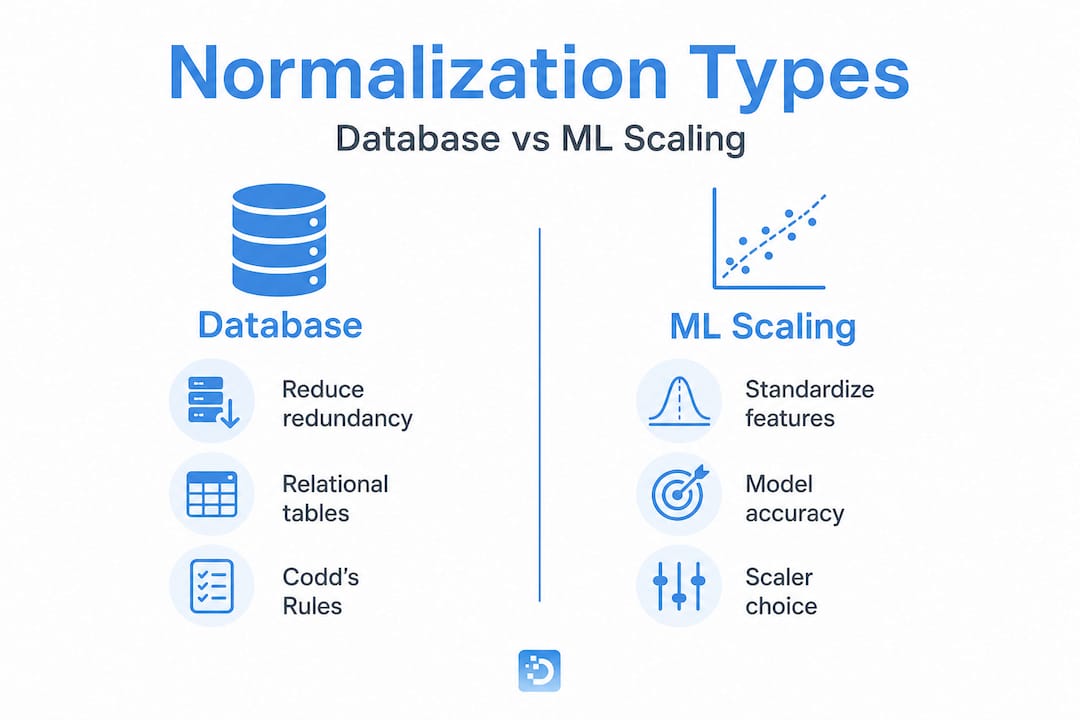
First, let’s clear up a persistent confusion. When database engineers hear “normalization,” they think of Codd’s normal forms, reducing redundancy, and restructuring relational tables. That’s a completely different discipline. Database normalization reduces data redundancy through schema design, while ML normalization scales numerical features for model training. They share a name and nothing else.
In machine learning, data normalization in ML means transforming raw feature values so they occupy a consistent numerical range or follow a consistent distribution. A dataset with income in dollars (range: 20,000 to 500,000) and age in years (range: 18 to 90) will cause serious problems for distance-based and gradient-based algorithms. The income feature will dominate simply because its numbers are larger, not because it carries more predictive signal.
Algorithms that are particularly sensitive to feature scale include:
- Gradient descent based models (neural networks, logistic regression, linear regression)
- Support vector machines (SVMs) where kernel distances drive classification boundaries
- K-nearest neighbors (KNN) where Euclidean distance determines class membership
- Principal component analysis (PCA) where variance drives component selection
Tree-based models like Random Forests and XGBoost are notably scale-invariant, which matters when you’re choosing where to invest preprocessing effort.
When you’re normalizing datasets at scale, the method you choose matters as much as the decision to normalize at all. Consider programmatic normalization as part of your preprocessing pipeline rather than a one-off manual step.
Pro Tip: Before selecting a scaling method, profile your feature distributions. Visualize histograms for every numerical column. Features with heavy outliers, bimodal distributions, or bounded ranges each call for different scaling strategies.
| Aspect | Database normalization | ML normalization |
|---|---|---|
| Goal | Reduce data redundancy | Scale features for model training |
| Applies to | Schema and table structure | Numerical feature values |
| Output | Restructured relational tables | Scaled feature arrays |
| Affects | Data storage and retrieval | Model convergence and accuracy |
How and when to apply normalization in data pipelines
Knowing that you need to normalize is one thing. Knowing exactly where and when to apply it in your pipeline is where teams consistently make mistakes that invalidate their results.

The single most common error is fitting the scaler on the full dataset before splitting into train and test sets. This leaks statistical information from the test set into the training process, producing artificially inflated evaluation metrics. Apply scaling only on training data to compute parameters, then transform test data using those same parameters. This prevents leakage and ensures your evaluation reflects real-world generalization.
Here is the correct sequence for integrating normalization into your workflow:
- Split your data first. Create your train, validation, and test splits before any scaling happens.
- Fit the scaler on training data only. Compute mean, standard deviation, min, max, or other parameters from training samples exclusively.
- Transform all splits using those fitted parameters. Apply the same fitted scaler to validation and test sets without refitting.
- Wrap everything in a pipeline object. Use scikit-learn’s Pipeline or an equivalent to bundle preprocessing and model steps together.
- Version your fitted scaler alongside your model. When you deploy the model, you must deploy the scaler too. A mismatch between training-time and inference-time scaling is a silent, hard-to-catch bug.
Refer to this data pipeline guide for broader context on structuring your AI workflows, and use a pipeline checklist when auditing existing pipelines for preprocessing gaps.
“Normalization implemented correctly inside a pipeline isn’t just a preprocessing step. It’s an integrity guarantee for every evaluation metric your team will stake decisions on.”
Teams that skip the pipeline abstraction often discover inconsistencies at inference time. The feature scaling applied during training doesn’t match what production data receives, and model performance degrades silently. Using normalization in pipelines as a formalized step eliminates this category of failure entirely.
Pro Tip: Use cross-validation inside your pipeline object, not outside it. If you apply scaling before cross-validation, you’re leaking validation fold statistics into each training fold. The pipeline ensures the scaler refits on each training fold automatically.
Normalization methods and their effects on models
Not every scaler is appropriate for every situation. Choosing the wrong one is a low-visibility mistake that quietly reduces model performance. Here’s how the major options compare:
| Scaler | Formula | Best for | Watch out for |
|---|---|---|---|
| StandardScaler | (x - mean) / std | Gaussian-distributed features, gradient models | Sensitive to outliers |
| MinMaxScaler | (x - min) / (max - min) | Bounded features, neural network inputs | Outliers distort the range |
| RobustScaler | (x - median) / IQR | Data with significant outliers | Less effective for Gaussian data |
| Normalizer | x / | x |
Empirical benchmarks show that normalization improves accuracy by 6 to 8%, reduces loss by 15 to 30%, and accelerates convergence by 30 to 50%. In one comparison on the UCI dataset, ContraNorm achieved an F1 score of 84.72% versus LayerNorm’s 83.84%. These are not trivial differences for production systems.
When to use each approach:
- StandardScaler: Default choice for linear models, logistic regression, SVMs, and neural networks when features are roughly Gaussian.
- MinMaxScaler: Use when your algorithm expects inputs in a fixed range, such as [0, 1] for certain activation functions or when the feature has a natural bounded range.
- RobustScaler: Use when your dataset has outliers that you can’t or don’t want to remove. It uses median and interquartile range (IQR) instead of mean and standard deviation.
- Normalizer: Use for sample-wise scaling where the magnitude of the feature vector needs to be standardized, common in text and document classification.
Edge cases deserve special attention. Tree-based models like Random Forests and XGBoost are invariant to monotonic feature transformations, so scaling adds zero benefit and introduces unnecessary complexity. Low-variance features should be removed before scaling, not after. And the Normalizer operates row-wise across samples, not column-wise across features, which is a fundamentally different operation that confuses many engineers working on their first text classification project.
For scaling for robust training on large datasets, use dataset structuring techniques that incorporate preprocessing validation into the build process. A normalization scaler choices review is worth doing when you’re inheriting a pipeline you didn’t build.
Normalization in deep learning: BatchNorm, LayerNorm, and more
Classical ML normalization operates on input features before they reach the model. Deep learning introduces a different category of normalization that happens inside the network, between layers. Understanding both is essential for teams building or fine-tuning neural architectures.
In neural networks, normalization layers like Batch Normalization and Layer Normalization are distinct in scope and behavior:
- Batch Normalization (BatchNorm): Normalizes activations across the batch dimension using batch statistics (mean and variance computed over the current mini-batch). It stabilizes training, allows higher learning rates, and acts as mild regularization. It performs well for convolutional networks and image models but struggles with small batch sizes.
- Layer Normalization (LayerNorm): Normalizes across the feature dimension within each individual sample. It’s independent of batch size, making it ideal for transformers, recurrent networks, and any architecture where batch statistics would be noisy or inconsistent.
- Instance Normalization: Normalizes per sample per channel, common in style transfer tasks.
- Group Normalization: A middle ground that normalizes within groups of channels, useful when batch sizes must be small due to memory constraints.
The choice of normalization layer directly affects gradient stability in deeper networks. Without internal normalization, deep networks suffer from vanishing and exploding gradients that make training impractical beyond a certain depth. BatchNorm was one of the key innovations that made training very deep networks feasible.
When transforming data for deep learning, apply input normalization at the data pipeline level and use architecture-appropriate internal normalization layers. These are complementary, not interchangeable.
Pro Tip: For transformer-based architectures, prefer LayerNorm over BatchNorm. Transformers process variable-length sequences where batch statistics are inherently unstable. LayerNorm’s per-sample behavior handles this cleanly.
Normalization is not one-size-fits-all: Our actionable take
There’s a reflex in many ML teams to normalize everything as a default step, the same way they might scale images to [0, 255]. That reflex solves real problems for gradient-based models. But it can also waste compute, introduce fragility, and occasionally harm model quality when applied without thought.
Scaling is critical for distance and gradient algorithms, but unnecessary for trees. Over-normalization is rare but possible, particularly with sparse data. Forcing sparse features through a StandardScaler can destroy the sparsity structure that makes the data efficiently processable and interpretable.
Our recommendation is to benchmark rather than default. Train a baseline without normalization. Add your chosen scaler. Compare. The difference is almost always measurable, and occasionally you’ll find that for a particular dataset and model combination, a specific scaler performs meaningfully better than the standard choice. If your features have bounded, well-behaved distributions and you’re using a tree-based model, skip normalization entirely. It won’t hurt performance, and it simplifies your pipeline.
Also assess your structuring data for models choices before deciding on a scaler. The way your raw data is structured often determines which normalization approach is even viable.
The honest truth is that normalization is powerful, but it’s also a decision that should be revisited for every new dataset and architecture. The team that benchmarks scaler choices will consistently outperform the team that picks StandardScaler by convention and moves on.
Streamline your AI workflows with expertly curated data
Getting normalization right is only one part of the equation. The upstream quality of your raw data, how it’s collected, structured, and labeled, determines how much normalization can actually help you.

At DOT Data Labs, we deliver training datasets that are already structured for model-ready use, reducing the preprocessing burden on your team. Whether you need datasets for AI prediction tasks, a detailed classification dataset guide to inform your build decisions, or fully validated machine-ready datasets delivered to your pipeline’s exact specifications, we handle the full data supply chain. From raw collection through cleaning, labeling, and final validation, we remove the vendor complexity so your team can focus on model performance, not data wrangling.
Frequently asked questions
Is data normalization always needed for machine learning models?
Normalization is crucial for models sensitive to feature scales, but tree models like Random Forests or XGBoost are generally invariant to feature scaling and can skip this step without any accuracy penalty.
How much does normalization impact neural network accuracy?
Normalization improves accuracy by 6 to 8% and accelerates convergence by 30 to 50%, according to empirical benchmarks across multiple datasets and model architectures.
Should normalization parameters be fit on the entire dataset?
Parameters should always be computed on training data alone, then applied to test sets using those same parameters to prevent data leakage and ensure your evaluation metrics are valid.
What’s the difference between database normalization and ML normalization?
Database normalization reduces data redundancy through schema design, while ML normalization scales numerical feature values for model training. They are entirely separate concepts that happen to share a name.