
Structured datasets: why quality beats volume for LLM fine-tuning

Most AI teams at startups assume the path to a better model runs through more data. Scrape more, collect more, store more. But 1,000 curated examples matched or exceeded models trained on 52,000 noisy examples in the LIMA paper, which is one of the most cited findings in recent LLM research. That single result should reframe how you think about your data strategy. For startups with limited compute, tight budgets, and domain-specific goals, the real bottleneck is not data volume. It is data quality, structure, and curation.
Key Takeaways
| Point | Details |
|---|---|
| Structure beats size | Curated structured datasets drive more reliable LLM outcomes than massive unstructured data collections. |
| Cost and accuracy gains | Structured data reduces training costs, improves accuracy, and lowers management overhead for startups. |
| Critical for production AI | Structured datasets ensure consistent outputs, compliance, and easier debugging for LLM applications in real-world use. |
| Quality-first approach | Investing in high-quality, well-annotated examples yields better results than chasing large quantities. |
What makes a dataset ‘structured’?
Before you can build better training data, you need a clear definition of what structured actually means in the context of LLM fine-tuning.
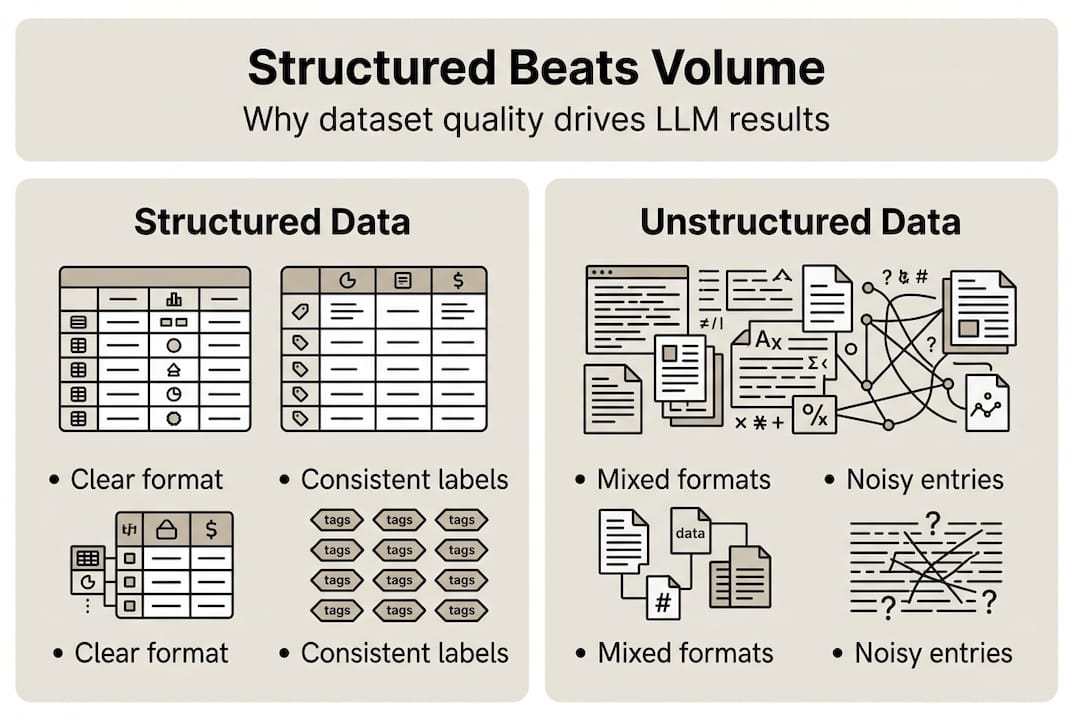
Structured vs unstructured data is not just a technical distinction. It is a practical one. Structured datasets have defined schemas, consistent field formats, and clear input-output relationships. Think JSONL files with instruction-response pairs, SQL tables with labeled columns, or human-annotated conversation pairs. Unstructured data is the opposite: raw web scrapes, free-form text dumps, PDFs without parsing, or social media exports with no labeling.
The difference matters enormously for LLM behavior. Structured datasets provide clear input-output pairs that teach LLMs specific response formats, styles, and behaviors. When your model needs to return a JSON object, follow a specific tone, or call an API function correctly, unstructured training data simply cannot teach that reliably.
Here is a quick comparison:
| Feature | Structured dataset | Unstructured dataset |
|---|---|---|
| Format | JSONL, SQL, CSV with schema | Raw text, HTML, PDFs |
| Input-output clarity | Explicit pairs | Implicit or absent |
| LLM behavior alignment | High | Low |
| Preprocessing required | Low | High |
| Fine-tuning suitability | Excellent | Poor to moderate |
For startups, high-quality datasets built with consistent schemas let you align model behavior directly to your product goals. Whether that is a customer support bot that always responds in a specific format or a document parser that extracts structured fields, the training data must reflect the exact output you want.
“Structure is not just about cleanliness. It is about teaching the model what success looks like.”
Why structured data outperforms volume: Evidence from recent LLM projects
The LIMA finding is not an outlier. It reflects a pattern that keeps showing up across LLM experiments.
The LIMA paper result showed that 1,000 carefully selected, high-quality examples performed as well as or better than 52,000 noisy examples from the Alpaca dataset. The key variable was not size. It was curation. Every example in the LIMA set was reviewed for quality, diversity, and clarity. Alpaca was generated at scale with minimal filtering.
The operational numbers back this up too. Structured data reduces preprocessing time by 60%, improves AI accuracy to 99.9%, and cuts data management costs by 30% for startups. Those are not marginal gains. For a team running on a seed-stage budget, a 60% reduction in preprocessing time is the difference between shipping in Q2 or Q4.

Low-quality datasets do not just fail to help. They actively degrade model performance. Noisy labels teach the model wrong patterns. Inconsistent formatting creates unpredictable outputs. Duplicate examples skew the model toward overrepresented behaviors. The result is a model that is harder to debug, less reliable in production, and more expensive to retrain.
Key takeaways from recent LLM training research:
- Curated datasets of 500 to 2,000 examples routinely outperform datasets 10x to 50x larger
- Dataset labeling for startups is one of the highest-leverage investments in the model pipeline
- A solid dataset cleansing process removes the noise that silently kills model accuracy
- Diversity within a small, structured dataset matters more than raw volume
Where structure matters most: Use cases for startup LLM projects
Not every LLM task is equally sensitive to data structure. But for the use cases that matter most to startups, structure is non-negotiable.
Tool and API calling is the clearest example. When your LLM needs to call a function with specific parameters, the training data must show exactly what valid function signatures look like. For consistent structured outputs like JSON, SQL, or formatted responses, structured datasets enforce reliability where prompting alone fails. You cannot prompt your way to 99% function-call accuracy in production. You need fine-tuning on structured examples.
Information extraction and classification is another high-value area. RAG pipelines depend on the model returning structured, parseable answers. If your retrieval system expects a JSON object with specific keys, your fine-tuning data must reflect that exact format. Unstructured training data produces inconsistent outputs that break downstream parsing.
Startup use cases where structure delivers the most value:
- Customer support bots that must follow escalation logic and response templates
- Document automation tools that extract fields from contracts, invoices, or reports
- Finance and legal summarization systems that require consistent output schemas
- Classification models for routing, tagging, or intent detection
- Datasets for prediction tasks where label consistency directly drives accuracy
For a deeper look at how LLMs and structured content interact across different system architectures, the patterns are consistent: structure at the data layer reduces brittleness at the output layer.
Pro Tip: If your LLM is producing inconsistent outputs in production, check your training data format before adjusting your prompt. Formatting errors in training data are often the root cause.
Best practices: Building and curating effective structured datasets
Building a structured dataset for LLM fine-tuning is not just a data engineering task. It requires editorial judgment, domain knowledge, and a clear definition of what good looks like.
1. Use JSONL as your standard format. Each line should be a self-contained JSON object with clear instruction and response fields. This format is compatible with most fine-tuning frameworks and makes quality review straightforward. JSONL with instruction-response pairs is the de facto standard for a reason: it enforces structure at the file level.
2. Filter aggressively for quality and diversity. Do not just collect examples. Review them. Remove duplicates, near-duplicates, and low-quality responses. Then check for coverage: does your dataset include edge cases, rare scenarios, and diverse phrasings? A dataset of 1,000 nearly identical examples is worse than 500 genuinely varied ones.
3. Prioritize real domain data over synthetic. Synthetic data has its place, especially for edge case coverage, but real user interactions carry authentic language patterns, domain-specific terminology, and realistic ambiguity. Real data teaches the model how your users actually communicate.
4. Write clear annotation guidelines before you start. Annotator disagreement is one of the biggest sources of label noise. Define what a good response looks like, what to do with ambiguous inputs, and how to handle edge cases like sarcasm, ambiguous requests, or potential data leakage before annotation begins.
5. Build a review step into your pipeline. Human review of a random sample before training catches systematic errors that automated checks miss. Even reviewing 5% of your dataset can surface labeling inconsistencies that would otherwise corrupt your model.
An optimized dataset workflow treats data production as a repeatable process, not a one-time task. Your AI data quality checklist should cover format validation, deduplication, coverage analysis, and annotation consistency before any data touches your training pipeline.
Pro Tip: Run a small pilot fine-tune on 200 to 300 examples before committing to a full dataset build. The model’s failure modes will tell you exactly which gaps in your data need to be filled.
Structured data = faster, cheaper, and more reliable AI for startups
The business case for structured datasets goes beyond model accuracy. It touches every part of your AI development cycle.
Structured data reduces preprocessing time by 60%, improves AI accuracy to 99.9%, and cuts data management costs by 30%. Those numbers translate directly into shorter training cycles, fewer engineering hours spent on data cleaning, and faster iteration between model versions.
For startups running parameter-efficient fine-tuning methods like LoRA, structured datasets are especially critical. LoRA on single GPUs becomes viable when your training data is clean, consistent, and compact. Noisy unstructured data forces you to train longer, on more examples, with more compute, just to achieve the same result. Structured data lets you do more with less.
Operational benefits of structured datasets for startups:
- Shorter training cycles mean faster product iteration and quicker time to market
- Consistent model outputs reduce debugging time and production incidents
- Clean, labeled data makes model behavior auditable, which matters for compliance in regulated industries
- Lower data overhead frees engineering resources for product development
- Predictable model behavior builds user trust faster than a larger but noisier model
A solid preprocessing workflow for startups is not overhead. It is a competitive advantage. Teams that invest in data structure early ship better models faster and spend less time firefighting in production. For practical guidance on integrating these practices into your stack, AI integration tips from teams that have done it at scale are worth reviewing.
Accelerate your startup’s AI with quality structured datasets
Building structured datasets in-house is possible, but it is slow, expensive, and easy to get wrong. Most startups underestimate the engineering effort required to design clean schemas, run annotation pipelines, enforce quality standards, and maintain consistency across thousands of examples.
At Dot Data Labs, we produce large-scale, machine-ready datasets built specifically for LLM fine-tuning, RAG pipelines, classification models, and vertical AI systems. Every dataset we deliver follows a production dataset structure designed for immediate use in your training pipeline, with no preprocessing backlog and no format surprises. If you want to skip the data engineering overhead and go straight to training, our machine-ready dataset guide is a good place to start understanding what purpose-built structured data actually looks like.
Frequently asked questions
How many structured examples do I need to see improvements in LLMs?
500 to 2,000 high-quality structured examples can outperform tens of thousands of unstructured ones. Focus on curation and diversity, not raw count.
Can I just prompt my LLM for structured outputs instead of fine-tuning?
Prompting helps with simple cases, but only fine-tuning with structured datasets guarantees reliable format and consistent responses at production scale.
Is synthetic data as effective as real domain data for LLM fine-tuning?
Real domain data is preferred for authentic language patterns and behavior, but synthetic data works well for filling edge case gaps when labeled carefully.
Does structuring data really reduce costs for AI startups?
Yes. Preprocessing time drops 60%, accuracy reaches 99.9%, and data management costs fall by 30% when you invest in structured datasets from the start.
Recommended
- What is dataset standardization? Optimize LLM fine-tuning
- Easylink Case Study - Dot Data Labs - High-Quality Data for Training AI Models
- AI data quality checklist for LLM fine-tuning in 2026
- Production Dataset: Why Structure Drives AI Success – Dot Data Labs – High-Quality Data for Training AI Models
- GDPR AI: Choosing an LLM Provider (Azure, OpenAI, AWS)
- Selbst-Distillation gegen „Catastrophic Forgetting“: Was SDFT für Enterprise-LLMs verändert