
Multi-source data for AI model training: real results

TL;DR:
- Effective AI data integration requires purposeful selection and schema consistency across sources.
- Adaptive fusion methods and selective source choice significantly improve model robustness and accuracy.
- Overloading pipelines with data introduces noise, complexity, and can degrade downstream performance.
Stacking more data into your training pipeline is not a strategy. It is a gamble. Teams that pour every available source into their models often end up with noisy, redundant, and structurally inconsistent datasets that hurt downstream performance rather than help it. The real edge in AI development comes from knowing how to select, fuse, and manage data across multiple sources in a way that is purposeful and schema-consistent. This article breaks down what multi-source data actually means for AI and ML practitioners, which integration methods work best, how retrieval systems like RAG exploit it, and how to handle the messy realities that come with heterogeneous source environments.
Key Takeaways
| Point | Details |
|---|---|
| Diverse data, unified value | Joining multiple data sources can unlock richer, more accurate AI models than isolated datasets. |
| Smart fusion beats bulk | Selective integration and weighted algorithms yield better results than simply aggregating all available data. |
| Conflicts need strategy | Resolving source conflicts, managing trust, and reducing redundancy are essential for production-ready AI. |
| Retrieval systems benefit | RAG and advanced retrieval models see major boosts from multi-source approaches, especially with dynamic configurations. |
What is multi-source data?
For AI and ML work, multi-source data is not just “data from different places.” Multi-source data refers to data originating from multiple heterogeneous sources, often differing in format, modality, structure, or quality, requiring integration or fusion techniques to create unified datasets for analysis or model training. That definition matters because it anchors the real problem: it is not collection that is hard, it is unification.
Common modalities you will deal with include:
- Structured sources: relational databases, CSVs, CRM exports, financial records
- Unstructured sources: raw text, PDFs, HTML, social content, call transcripts
- Sensor and IoT data: time-series streams, telemetry, geolocation signals
- Web-scale data: crawled content, API feeds, scraped knowledge bases
- Graph and knowledge sources: entity relationship data, ontologies, semantic graphs
Each modality brings its own formatting conventions, update cadences, and quality assumptions. When you mix them without deliberate integration logic, schema drift and semantic mismatch become your biggest enemies. A product review dataset and a structured inventory feed may both describe the same SKU, but aligning them requires entity resolution, field normalization, and deduplication. That work is non-trivial.
Why do AI and ML tasks demand this level of diversity? Because no single source captures the full signal. Data integration in AI research consistently shows that models trained on narrow, single-source data generalize poorly outside their original distribution. Multi-source datasets for AI training introduce the variety needed to expose a model to real-world complexity.
Multi-source data fusion breaks silos for holistic insights, but it demands careful handling of heterogeneity and conflicts to avoid degraded model performance.
The implication: fusion is not a technical afterthought. It is a core design decision that shapes your model’s ability to generalize.
Key methodologies for fusing multi-source data
Now that you know what counts as multi-source data, it is time to explore how you can actually combine and use it effectively. Key methodologies for multi-source data fusion include ETL pipelines, weighted averaging, Kalman filters, vector concatenation, deep learning architectures like Transformers with multi-scale attention, and source selection algorithms like SourceSplice or Mixture-of-Retrievers.
| Method | Pros | Cons | Best for |
|---|---|---|---|
| ETL pipelines | Scalable, auditable | Rigid schema assumptions | Structured source merging |
| Weighted averaging | Simple, interpretable | Misses non-linear interactions | Sensor fusion, scoring tasks |
| Transformer fusion | Captures complex dependencies | High compute cost | LLM pre-training, RAG |
| SourceSplice / MoR | Adaptive, source-aware | Needs source metadata | Dynamic retrieval pipelines |
| Vector concatenation | Fast, low-overhead | Can inflate dimensionality | Embedding-level fusion |
A typical multi-source fusion workflow in a real ML pipeline follows this sequence:
- Source inventory: catalog all available data origins, formats, and update frequencies
- Schema mapping: normalize field names, types, and value ranges across sources
- Entity resolution: link records referring to the same real-world entity
- Quality filtering: flag or remove low-confidence, stale, or conflicting records
- Feature integration: merge source signals into a unified, model-ready format
- Validation: run statistical checks to confirm distribution alignment before training
The dataset optimization guide covers step-by-step approaches for structuring this kind of pipeline when you are working toward production-grade AI datasets.
Pro Tip: Adaptive fusion methods outperform uniform aggregation in nearly every benchmark. If you are mixing sources with variable quality or update cadence, weight them dynamically based on recent reliability scores rather than treating all inputs as equal.
When you need to build optimized AI datasets at scale, the fusion method you choose will determine not just accuracy but also how maintainable your data pipeline stays over time.
Enhancing model training with optimal source selection
With the primary fusion methodologies understood, the real breakthrough comes from how you choose which data streams to fuse. Not all sources add equal value. Some are redundant. Others introduce distribution skew. A few actively degrade your model’s performance when included without calibration.
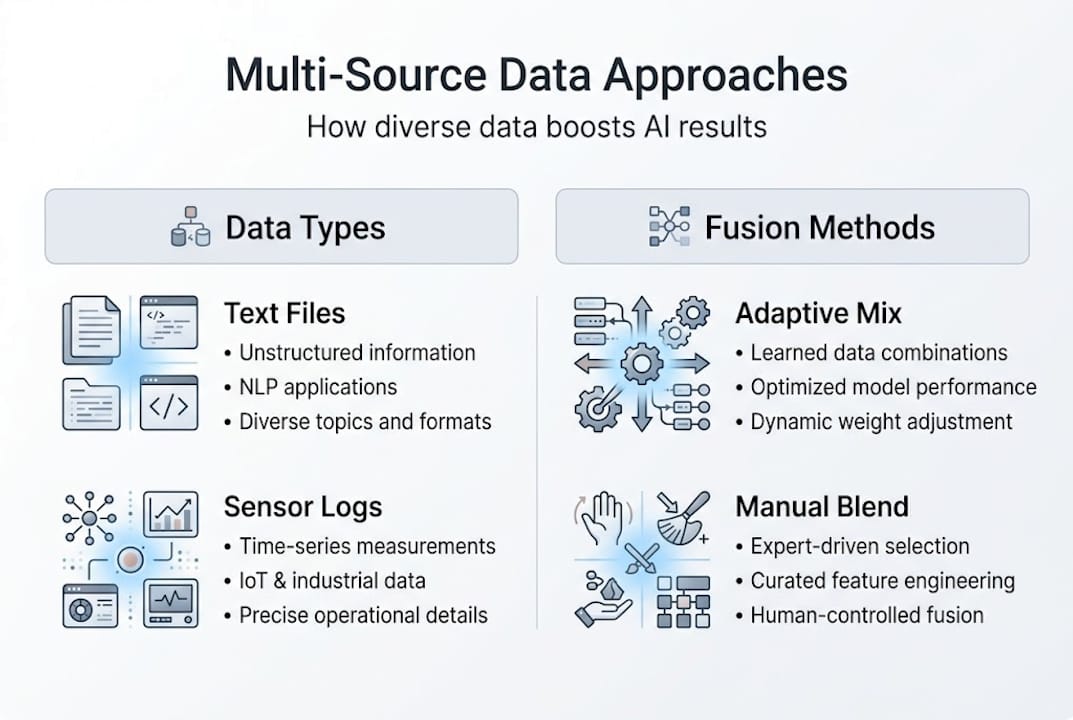
SourceGrasp and SourceSplice improve ML utility by selecting optimal source subsets, and Mixture of Data Experts frameworks optimize source mixing during pre-training. The core insight is that selection is a modeling decision, not a preprocessing chore.
| Strategy | Accuracy impact | Redundancy risk | Recommended for |
|---|---|---|---|
| All sources, no filtering | Baseline | High | Exploratory only |
| Manual curation | +5 to 10% | Medium | Small-scale projects |
| SourceSplice / SourceGrasp | +12 to 18% | Low | Production ML pipelines |
| Mixture of Data Experts | +10 to 20% | Very low | LLM pre-training |
Key benefits of smart source selection include:
- Robustness: models trained on curated, diverse subsets handle distribution shift better
- Bias mitigation: removing over-represented or systematically skewed sources reduces embedded bias
- Real-world adaptability: dynamically updating source weights keeps models relevant as conditions evolve
- Compute efficiency: training on the right data, not all data, cuts cost without sacrificing quality
The dataset curation tips available from DOT Data Labs show how this selection logic applies to practical fine-tuning workflows. And the data quality checklist helps you evaluate source utility before it enters your pipeline.
Pro Tip: Size is a vanity metric. Regularly audit each source’s marginal contribution to model performance, and retire low-utility sources the same way you would deprecate stale code.
Multi-source data in retrieval systems: RAG and beyond
Beyond pure model training, multi-source strategies are now reshaping how AI retrieves relevant information. In retrieval-augmented generation systems, multi-retriever fusion allows a single query to pull from vector databases, structured knowledge graphs, live web feeds, and domain-specific corpora simultaneously.

HM-RAG, a hierarchical multi-agent retrieval approach, coordinates multiple specialized agents to query distinct source types in parallel and then reconcile their outputs. HM-RAG improves accuracy by 12.95% on ScienceQA and CrisisMMD benchmarks compared to single-retriever baselines. That is not a marginal gain. It changes what AI systems can confidently answer.
Concrete deployment patterns include:
- Vector DB + knowledge graph: semantic similarity retrieval combined with structured entity traversal
- Web augmentation + private corpus: live search grounded by proprietary internal documentation
- Multi-modal retrieval: text, image, and tabular data retrieved and fused per query context
- Domain-specific shards: separate retrievers per vertical, routed by query classification
Production teams at Kensho have shown how multi-source RAG pipelines dramatically reduce hallucination rates in high-stakes financial and analytical tasks. LangChain’s retriever orchestration layer makes routing between source types operationally feasible at startup scale.
Building quality ML datasets that power these retrieval layers requires more than just data volume. It requires embedding-ready structuring, source tagging, and freshness metadata so your retrieval logic knows which source to trust when answers conflict.
Managing conflicts, heterogeneity, and source trust
Integral to success in multi-source strategies is how you address data messiness, contradictions, and variable quality. Edge cases in multi-source integration include data heterogeneity across modalities and temporal resolutions, conflicts between sources, redundancy, varying trust levels, temporal staleness, and context loss during chunking.
Practical steps for managing conflict and trust in your pipelines:
- Assign trust scores using metadata: publication date, source authority, update frequency, and historical accuracy all inform how much weight a source should carry
- Use voting or weighted reconciliation: when two sources contradict, majority voting or confidence-weighted averaging resolves most conflicts without manual review
- Flag staleness explicitly: attach timestamps to every record and define expiration windows per source type. A social media signal from six months ago and a regulatory filing from the same period carry very different shelf lives
- Deduplicate before fusion, not after: removing redundancy early prevents inflated confidence in repeated signals
- Run source-level validation post-integration: check that merged records still reflect the statistical properties of their origin sources
The preprocessing workflow and data curation for AI resources go deeper on each of these steps. The AI data quality checklist is worth running before any source enters a production pipeline.
The guidance on handling data conflicts in real-world RAG environments makes a strong case for treating source trust as a first-class attribute in your data schema, not something you handle reactively.
Source prioritization is not a data engineering decision. It is a modeling decision. Build trust logic into your schema from day one, and your pipeline becomes self-correcting rather than self-compounding in errors.
Why selective integration beats uniform aggregation in AI pipelines
Here is the uncomfortable reality that most data teams learn too late: adding more sources does not make your model smarter. It makes your pipeline harder to debug and your model harder to trust. Prioritizing source selection over uniform aggregation, using metadata for trust and timestamps, and applying adaptive calibration consistently outperforms the “just add more data” approach.
At DOT Data Labs, we see this pattern repeatedly. Teams come to us with bloated pipelines ingesting ten or fifteen sources. When we analyze source utility per training task, often three or four sources are doing the actual work. The rest are adding noise, inflating storage costs, and creating schema maintenance debt.
The techniques for optimal AI training that actually scale are the ones built around selective, priority-driven integration. Not volume. Not coverage breadth. Relevance, freshness, and structural consistency per use case.
Pro Tip: Treat your data source roster like a product backlog. Review it quarterly. Retire sources that no longer contribute marginal utility. Promote sources that consistently improve downstream evaluation metrics.
The teams that build reliable, production-ready AI systems are not the ones with the most data. They are the ones with the most intentional data.
Take your AI data integration to the next level
If these integration patterns resonate, DOT Data Labs builds exactly the kind of structured, schema-consistent datasets that make multi-source strategies work in practice. From source acquisition to deduplication to embedding-ready formatting, every dataset we produce is designed for AI teams who cannot afford to debug bad data mid-training.
Explore our production dataset structuring approach to see how we handle heterogeneous source environments at scale. The dataset optimization guide walks through our methodology for boosting model accuracy through smarter data decisions. If you are ready to move from data collection to data production, Dot Data Labs is built for exactly that transition.
Frequently asked questions
What is the main advantage of multi-source data in AI?
Multi-source data enables models to generalize better by training on complementary, diverse signals rather than a narrow single-source view. Fusion across sources delivers holistic insights that no individual dataset can match on its own.
How do retrieval systems like RAG leverage multi-source data?
RAG systems route queries across multiple retrievers, such as vector databases, knowledge graphs, and web feeds, to surface the most relevant answers. HM-RAG improves accuracy by 12.95% on benchmark tasks compared to single-retriever approaches.
What are common challenges with multi-source data?
The biggest friction points are schema mismatches, conflicting records, redundancy, and inconsistent source trust. Heterogeneity and temporal staleness require deliberate handling strategies, not just preprocessing scripts.
Is more data always better when using multiple sources?
No. Indiscriminate aggregation inflates noise and dilutes the signal that actually drives model performance. Targeted source selection and adaptive fusion consistently outperform volume-first strategies in production AI environments.