
Master dataset refinement for reliable AI model training

TL;DR:
- Building a better dataset involves targeted refinement beyond just increasing data volume.
- Proper refinement improves factual consistency, diversity, coverage, and safety, enhancing model performance.
- Dynamic, model-influenced refinement strategies outperform static approaches by adapting data to the model’s evolving needs.
Building a larger dataset is not the same as building a better one. Many ML teams fall into the trap of equating scale with quality, only to discover that noisy, inconsistent, or poorly labeled data actively harms model performance. Refined small datasets can outperform large, unfiltered ones when the underlying curation strategy is precise and goal-aligned. This guide walks through the core principles, leading frameworks, and practical workflows behind dataset refinement, so you can stop treating data volume as a proxy for model readiness and start building training sets that actually move your benchmarks.
Key Takeaways
| Point | Details |
|---|---|
| Refined data outperforms | Small, expertly refined datasets often deliver better AI results than large, noisy collections. |
| Framework choice matters | Selecting the right refinement tool or method is critical for aligning with your dataset’s specific challenges and goals. |
| Go dynamic, not static | Closed-loop, model-informed refinement adapts as your AI learns, outperforming one-off fixes or pure manual curation. |
| Beware common pitfalls | Edge cases like semantic drift, budget limits, and rating bias can undermine refinement if not carefully managed. |
| Empirical validation is key | Always measure how refinements impact downstream model performance—not just intermediate dataset metrics. |
What is dataset refinement? Definitions and why it matters
Dataset refinement is not simply cleaning your data. That distinction matters more than most teams realize, especially when fine-tuning LLMs or training specialized vertical models where every training example directly shapes model behavior.
Traditional data cleaning focuses on mechanical fixes: removing exact duplicates, imputing missing values, correcting obvious formatting errors, and applying rule-based filters to catch outliers. These steps are necessary but not sufficient. They operate on the surface of a dataset without accounting for the semantic quality of the content, the coverage balance across topics, or the downstream behavior of the model consuming that data.
Dataset refinement in AI/ML refers to the process of automatically or semi-automatically improving raw or low-quality datasets through targeted edits and optimizations that enhance multiple quality dimensions simultaneously. These dimensions include factual consistency, topical coverage, difficulty balance, diversity across input types, and content safety. Each dimension affects model generalization in different ways, and neglecting even one can introduce systematic blind spots in a trained model.
“Refinement is not subtraction. It is surgical restructuring with a specific outcome in mind: a dataset that makes models smarter, not just smaller.”
The shift is substantial. Dataset refinement moves beyond traditional cleaning toward LLM-powered surgical edits and dynamic adaptation that can rewrite, reframe, or restructure training examples while preserving their semantic intent. This requires a fundamentally different toolset and a fundamentally different mindset.
Here is what proper refinement actually addresses:
- Coverage gaps: Underrepresented categories that cause models to fail on rare but critical inputs
- Difficulty imbalance: Datasets skewed toward easy examples, which produce overconfident, poorly calibrated models
- Factual inconsistencies: Contradictory statements across examples that confuse gradient descent and produce hallucination-prone outputs
- Diversity deficits: Redundant phrasing or structural patterns that limit a model’s ability to generalize
- Content safety failures: Toxic, biased, or legally sensitive content that passes rule-based filters but still corrupts model behavior
Understanding these dimensions gives you a framework for prioritizing your refinement work rather than applying blanket fixes. If you want practical starting points, reviewing dataset curation tips for LLM training is a strong next step. And if you are building from scratch, understanding what high-quality AI datasets look like structurally will inform every decision you make downstream.
Core frameworks and methodologies: From RefineLab to cleanlab
With the definition and its importance established, let’s see how the top tools approach dataset refinement in practical terms.
The current landscape of dataset refinement tools spans a range of approaches, from constraint-based optimization to closed-loop model feedback systems. Knowing which tool fits your use case prevents you from over-engineering simple problems or under-investing in complex ones.
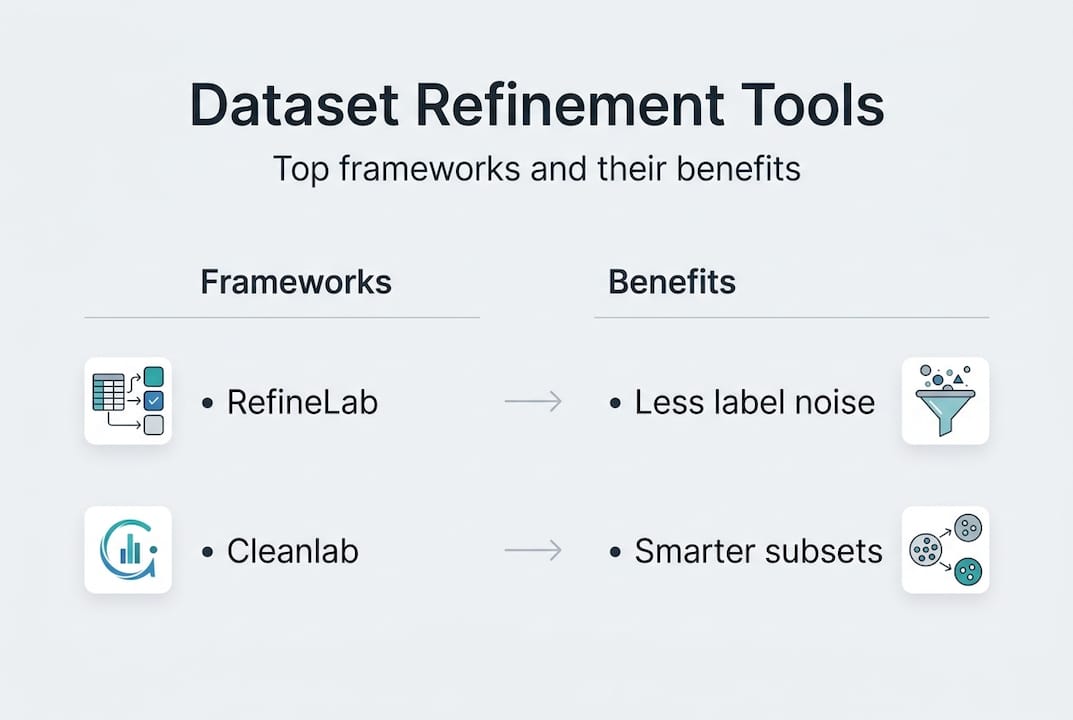
RefineLab is one of the most sophisticated LLM-driven frameworks available for structured refinement. RefineLab uses Integer Linear Programming to assign refinement operations across a dataset within token budgets, optimizing which edits produce the highest quality gains per unit of compute spent. Rather than applying uniform transformations, it selects from a menu of operations, including rewriting, augmenting, and restructuring, based on estimated quality impact. This makes it especially powerful for large-scale fine-tuning datasets where you cannot afford to reprocess every record.
Middo takes a different approach. It operates as a closed-loop, model-in-the-loop optimization system that continuously adjusts refinement strategy as the model being trained evolves. Instead of treating the dataset as a fixed artifact, Middo treats it as a dynamic input that should change as the model’s learning curve progresses. This matters because a training example that challenged the model in epoch one may be redundant by epoch five.
Cleanlab addresses the problem from a label quality angle. Cleanlab automatically detects label errors, outliers, and near-duplicate examples using model-based confidence analysis. It surfaces likely mislabeled records by comparing model predictions against ground truth annotations, flagging cases where the two diverge beyond a confidence threshold. For classification and prediction tasks, cleanlab can dramatically reduce the manual review burden while catching errors that rule-based systems miss entirely.
Generative Data Refinement (GDR) is an emerging approach that uses generative models to produce synthetic variants of existing training examples, improving both privacy protection and factual accuracy. Instead of discarding sensitive records, GDR rewrites them to preserve the signal while removing personally identifiable or legally sensitive content. For more context on where synthetic data fits in the broader pipeline, see our overview of synthetic data for AI model training.
| Framework | Primary use case | Optimization method | Best for |
|---|---|---|---|
| RefineLab | LLM fine-tuning data | ILP within token budgets | Large-scale structured datasets |
| Middo | Dynamic model training | Closed-loop feedback | Evolving LLMs and iterative training |
| Cleanlab | Label quality | Model-confidence scoring | Classification, supervised learning |
| GDR | Privacy and factuality | Generative rewriting | Sensitive or legally constrained data |
Pro Tip: Match your tool to your primary failure mode. If your dataset has label noise, cleanlab should be your first stop. If your fine-tuning data lacks diversity or has coverage gaps, RefineLab’s constraint-based selection will have a bigger impact. For full-lifecycle refinement support, the dataset cleansing process deserves a closer look.
Dynamic refinement vs. static curation: Why model evolution matters
Understanding the available frameworks makes it clear that how you refine matters, but is a one-off fix enough? Next, we explore the dynamic advantage.
Most teams treat dataset preparation as a one-time task. You clean, you format, you train. That linear model worked reasonably well for classical ML pipelines with stable feature spaces and fixed label sets. It breaks down badly for LLMs and any model that undergoes iterative fine-tuning across multiple rounds.
Static curation means applying a defined set of quality filters before training begins and leaving the dataset unchanged throughout the training process. The logic is clean and the workflow is straightforward: define your quality criteria, apply them once, and train on the filtered result. The problem is that a model’s data needs shift as it learns. What constitutes a challenging, informative training example at initialization is not the same as what the model needs after ten thousand gradient steps.
Dynamic, model-informed optimization aligns data complexity, diversity, and quality with the model’s current stage of learning, consistently outperforming static curation across benchmark evaluations. This is the core insight behind systems like Middo: the dataset and the model should co-evolve, with refinement operations guided by real-time signals from the training process itself.

The practical impact is measurable. Middo improved LLM accuracy by 7.15% on standard benchmarks without increasing dataset size. That is a meaningful gain achieved purely through smarter data selection and refinement, not through scaling. For teams operating under compute constraints, that efficiency is critical.
A high-level workflow for dynamic refinement typically looks like this:
- Initialize with a baseline refined dataset using static curation tools
- Train for a defined number of steps or epochs and capture model performance signals
- Evaluate which data subsets contributed most and least to measurable gains
- Refine dynamically by adjusting difficulty weighting, resampling underperforming categories, and pruning redundant examples
- Repeat the loop, letting model feedback drive the next refinement cycle
Static approaches fail for evolving LLMs because they assume the data requirements at training start are the same as the requirements mid-training. They are not. If you want to explore dynamic refinement approaches in more depth, there are frameworks available that automate much of this loop. Understanding dataset standardization is also essential before you enter a dynamic refinement cycle, because inconsistent schemas will corrupt the feedback signals the loop depends on.
Challenges and edge cases in dataset refinement
Equipped with the advantages of modern frameworks, let’s address the practical obstacles and subtle traps that threaten high-quality AI data.
Refinement introduces its own category of risks. Done poorly, it can cause more damage than doing nothing at all. Understanding these failure modes in advance is the difference between a successful refinement pipeline and one that confidently trains your model on higher-quality errors.
1. Semantic drift during rewriting When LLM-based rewriting tools modify training examples to improve clarity or factual accuracy, they sometimes alter the underlying meaning. This is called semantic drift, and it is one of the hardest failure modes to detect automatically. Refinement must preserve semantics and respect budget constraints to avoid introducing hallucinations or factually inconsistent rewrites into your training data.
2. LLM-based rating bias Using LLMs as quality raters is standard practice in modern refinement pipelines. But LLMs carry their own biases, stylistic preferences, and knowledge cutoffs. Ratings generated by a single LLM judge tend to favor outputs that resemble that model’s training distribution, which can narrow rather than broaden your dataset’s useful diversity.
3. Budget constraints at scale Refinement operations are not free. Rewriting, augmenting, and evaluating individual training examples consumes significant compute. At datasets of hundreds of thousands of records, unconstrained refinement becomes economically unviable. This is exactly why RefineLab’s ILP-based budget allocation is valuable: it forces prioritization and produces the highest quality improvement per token spent.
4. The labeling trap When preference datasets contain unreliable or ambiguous labels, the instinct is often to relabel them. However, flipping uncertain labels introduces its own noise. Removing unreliable data outperforms relabeling in most preference tuning scenarios, because the model learns cleaner boundaries from fewer high-confidence examples than from larger sets of ambiguous ones.
5. The myth of scale Perhaps the most persistent misconception in ML is that more data always helps. Curated subsets as small as 3.3% of a full noisy dataset have been shown to outperform training on the complete unfiltered set, directly challenging common assumptions about scaling laws.
“Scaling your dataset without refining it is like increasing print volume on a document with typos. You just get more of the problem, faster.”
Pro Tip: Do not neglect long-tail and edge-case examples. These are the records that appear rarely in your training data but represent exactly the scenarios where models fail in production. Actively curating for edge-case coverage is one of the highest-leverage refinement actions you can take. Use an AI data quality checklist to ensure you are tracking these systematically.
A practitioner’s perspective: Quality beats quantity, but context rules
The field has largely accepted that quality matters more than quantity. But that consensus sometimes collapses into a new oversimplification: that every dataset should be aggressively refined down to its best 10% and trained on that. Reality is more nuanced.
In practice, the value of refinement depends heavily on where you are in the model development cycle and what your downstream task actually requires. Early-stage models benefit from diverse, broad training signals, even if some noise is present. Over-refining at this stage can produce a dataset that is too narrow to support good generalization. Later-stage fine-tuning, where you are optimizing for precision on a specific vertical task, is where surgical refinement delivers the biggest returns.
The 20% principle holds more often than teams expect: roughly 20% of your training examples typically drive 80% of the learning signal for a given task. Identifying that 20% through dynamic feedback, difficulty scoring, or influence analysis and then investing refinement effort there, rather than uniformly across the full dataset, is a more cost-efficient and empirically grounded strategy.
Over-refinement is a real risk. When you remove too much, you trade diversity for polish and end up with a model that performs beautifully on benchmark evaluations but struggles with real-world input variation. The structured dataset guide can help you balance these tradeoffs before committing to a refinement strategy. Always evaluate downstream task performance, not just dataset quality metrics, before declaring a refinement pipeline successful.
Need high-quality, production-ready datasets? Dot Data Labs can help
If this guide has clarified the value of serious dataset refinement, the next practical question is how to actually build pipelines that produce production-grade training data at scale.
At Dot Data Labs, we design and produce structured, machine-ready datasets built specifically for LLM fine-tuning, RAG pipelines, classification models, and vertical AI applications. Our process is built around the same principles covered here: schema consistency, semantic quality, coverage balance, and format readiness. Whether you need to understand production dataset structure or want to follow a complete structured datasets guide before your next training run, we have the resources and the production capability to support your team. Explore our machine-ready dataset guide to see exactly how we structure data for real-world AI performance.
Frequently asked questions
What is the difference between dataset refinement and traditional data cleaning?
Dataset refinement uses advanced models and targeted, context-aware edits to improve semantic quality and coverage, while traditional cleaning focuses mainly on removing duplicates, fixing formatting errors, and filling missing values through rule-based methods.
How does dataset refinement impact model accuracy?
Refined datasets can significantly boost model accuracy without increasing dataset size: Middo improved benchmark accuracy by an average of 7.15% using only smarter data selection and quality-driven refinement, with no increase in training data volume.
Are larger datasets always better than smaller, refined ones?
No. Curated small subsets outperform full noisy datasets in multiple evaluations, demonstrating that targeted quality improvements consistently beat raw scale for real-world AI generalization and benchmark performance.
Which tools or frameworks are most effective for dataset refinement?
RefineLab, Middo, and cleanlab represent the leading approaches for LLM fine-tuning and general ML tasks, each addressing a different layer of refinement from constraint-based optimization to automated label error detection and closed-loop model feedback.