
Large-Scale Data Collection Guide: Steps for Model Training

TL;DR:
- Successful AI training relies on high-quality, legally compliant large-scale datasets and hybrid collection methods.
- Infrastructure, provenance, and continuous compliance are critical for scalable, legal data collection.
- Benchmark achievements include extracting billions of tokens and tens of thousands of labeled data points within weeks.
Most AI projects don’t fail because of bad model architecture. They fail because the training data was never good enough to begin with. For data scientists and ML engineers at startups, this is the core tension: you need massive, structured, legally clean datasets to build competitive models, but collecting at scale without a clear process leads to noise, compliance gaps, and wasted compute. This guide breaks down exactly how to plan, execute, and verify a large-scale data collection pipeline built for LLM fine-tuning, classification, and retrieval-augmented generation (RAG) systems.
Key Takeaways
| Point | Details |
|---|---|
| Diversify data sources | Combining web, crowdsourced, and synthetic data improves coverage and model performance. |
| Prioritize provenance | Tracking sources and licenses minimizes compliance risk and ensures dataset transparency. |
| Automate and audit | Use automated pipelines with built-in checks and regular audits to scale safely and catch errors early. |
| Follow optimization frameworks | Frameworks like LOC prevent costly over-collection and help you hit quality targets efficiently. |
Core methodologies for large-scale data collection
Every serious AI dataset starts with a collection strategy. The method you choose shapes everything downstream: quality, cost, legal exposure, and how fast you can iterate. Core methodologies for large-scale collection include web scraping, automated pipelines, APIs, crowdsourcing, and synthetic data generation. Each has a distinct role depending on your use case.
Here’s how the main approaches compare:
| Method | Best for | Scalability | Legal/ethical risk | Typical data rate |
|---|---|---|---|---|
| Web scraping (e.g., Common Crawl) | LLM pretraining, NLP corpora | Very high | High (license ambiguity) | Billions of tokens/run |
| APIs (e.g., Twitter, Reddit) | Domain-specific structured data | Medium | Low to medium | Thousands to millions/day |
| Crowdsourcing (e.g., MTurk) | Labeled datasets, RLHF | Medium | Low | Thousands/week |
| Synthetic data generation | Rare classes, edge cases | Very high | Low | Unlimited (with compute) |
| Hybrid (scrape + label + synth) | Production LLM/RAG datasets | High | Medium | Depends on pipeline |
No single method wins every scenario. Web scraping gives you volume, but raw crawled data is notoriously dirty. APIs give you cleaner, more structured records, but rate limits cap your throughput. Crowdsourcing produces high-quality labeled examples, which are gold for fine-tuning, but doesn’t scale to billions of tokens. Synthetic generation fills gaps, especially for underrepresented categories, but synthetic-only datasets risk distributional mismatch.
Here’s the process most high-output teams follow when selecting and combining methods:
- Define your data contract first. Know the schema, label types, and target domains before touching a collection tool.
- Match method to scale requirement. If you need 10B+ tokens, scraping plus deduplication is your baseline.
- Layer crowdsourcing for quality signals. Use labeled crowdsourced data to create fine-tuning sets on top of raw scraped corpora.
- Add synthetic data for coverage. Fill rare class gaps or generate instruction-tuning pairs programmatically.
- Automate normalization from day one. Explore automation strategies to reduce human bottlenecks at the normalization layer.
Startups that try to run one method exclusively almost always hit a wall. Hybrid pipelines are now the industry standard for production-grade training data.
Prepping for scale: Infrastructure, compliance, and provenance
Before you run a single scrape, your infrastructure needs to be ready to handle the load and your compliance posture needs to be locked in. Skipping this step is one of the most expensive mistakes a startup team can make.
On the infrastructure side, you’ll need distributed compute for parallel collection jobs, object storage (S3-compatible) for raw and processed data, an orchestration layer (Airflow or Prefect work well), and a metadata catalog to track dataset versions. Security is not optional. Encrypt data in transit and at rest, especially if any PII passes through your pipeline before removal.

Now, the piece that most teams underinvest in: data provenance. Provenance audits reveal that more than 70% of dataset licenses are unspecified, and more than 50% of license categories are miscategorized. Tools like Data Provenance Explorer can reduce unspecified license rates to around 30% by tracing source lineage and flagging ambiguous rights. That’s not a marginal improvement. It’s the difference between a defensible dataset and a legal liability.
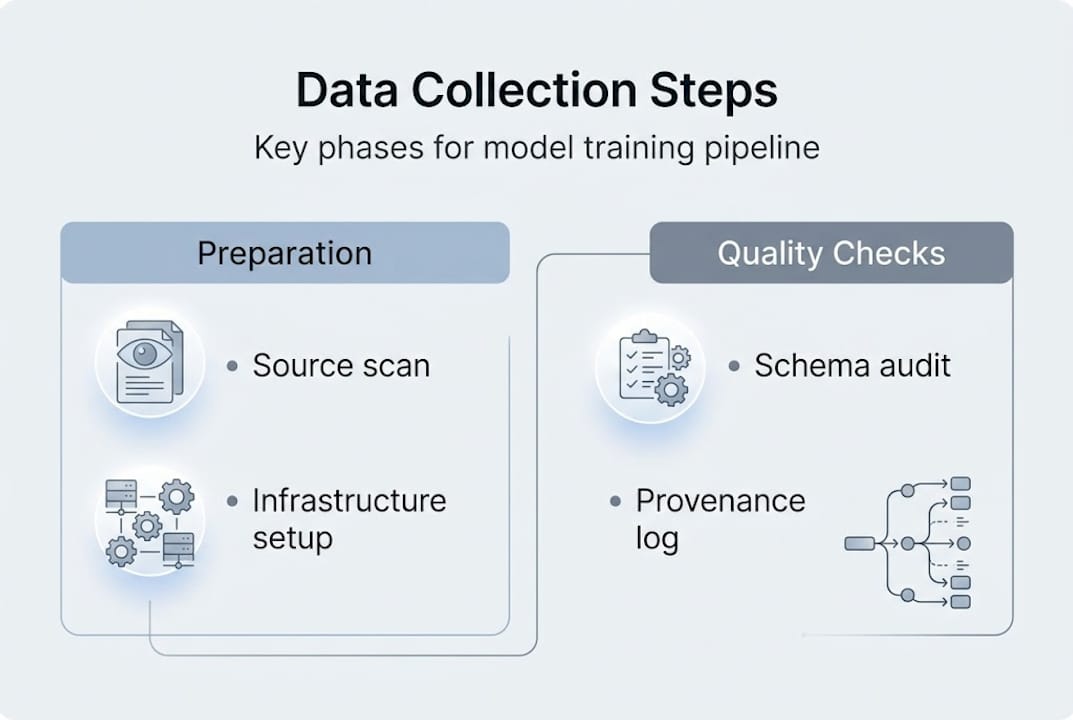
Here’s the core infrastructure and compliance checklist:
- Distributed compute cluster (CPU for scraping, GPU for embedding or labeling)
- Object storage with versioning enabled
- Pipeline orchestration with retry logic and alerting
- PII detection and scrubbing tools (e.g., Presidio, cloud-native options)
- License audit log per source domain
- Provenance metadata schema (source URL, crawl date, license type, processing steps)
- Data lineage tracking for every transformation
You also need to think about dataset quality best practices before data ever hits storage. Enforcing schema consistency at ingest prevents cascading issues later.
Pro Tip: Run a pilot provenance audit on your first 1,000 collected records before scaling. If you find more than 20% with unclear licenses, fix your source selection process before you’ve collected 100 million records and have to throw half of them out.
Step-by-step: Executing your large-scale data collection pipeline
With infrastructure and compliance in place, here’s how to run an actual production collection pipeline without losing control of quality or legality.
- Prep your source list. Validate each domain for robots.txt compliance, license clarity, and content relevance. Remove anything with ambiguous terms of service.
- Write and test automation scripts. Use headless browsers (Playwright or Puppeteer) for JavaScript-rendered pages and standard HTTP clients for static content. Test on a small sample before scaling.
- Implement rate limiting from the start. Respect crawl delays. Aggressive scraping gets you blocked and creates incomplete datasets.
- Run batch validation checkpoints. After every 10% of your target volume, validate a random sample for schema adherence, language distribution, and noise levels.
- Triage issues in real time. Build alerts for sudden drops in collection rate, which usually signal anti-bot blocks or site changes.
- Stage into storage by source and date. Partition your raw data by domain and timestamp so you can trace any issue back to its origin.
Edge cases in web data include boilerplate content, JavaScript-rendered pages that scrape poorly, PII embedded in free text, anti-bot detection, dynamic site changes, license conflicts, and severe language skew toward English and Western sources. These are not corner cases. They are the norm at scale.
For noise handling, convert raw HTML to Markdown output as a semantic cleaning step. This strips navigation, ads, and boilerplate while preserving structured content. Pair this with exact and near-dedup passes using MinHash or SimHash to eliminate redundant text before it bloats your corpus. Understanding dataset impact on AI prediction makes it clear why clean inputs at this stage compound into better model outcomes downstream.
Warning: Ignoring edge cases at collection time doesn’t just hurt model quality. It creates compounding costs. Re-cleaning a 500GB corpus post-hoc can consume more engineering hours than the original collection did. Budget for edge case handling upfront. Think carefully about how much data you need to avoid over-collecting and multiplying cleanup costs.
Pro Tip: Build a language distribution check into your batch validation step. If more than 85% of your corpus is English and your model targets multilingual use, you’ll catch the skew early and can redirect collection resources before it’s too late.
Verification and optimization: Auditing, scaling, and results measurement
Data collection without verification is just data hoarding. Once your pipeline is running, you need a systematic way to evaluate whether you’re collecting the right data at the right volume.
Start with routine audits. Every collection run should produce a provenance report: source breakdown, license status per domain, deduplication rate, and PII scan results. This isn’t bureaucracy. It’s your legal and scientific accountability layer. Use structuring datasets for efficiency principles to organize audit outputs in a queryable format so your team can act on findings quickly.
For volume calibration, the LOC framework models data collection as a cost-minimization problem using learning curves and scaling laws. It handles multiple source types, including labeled, unlabeled, real, and synthetic data, and tells you when adding more data stops improving model performance. This prevents the expensive trap of over-collecting.
Here’s a verification and scaling checklist to run after every major pipeline iteration:
- Confirm provenance metadata is complete for all new records
- Run deduplication across the full corpus (not just new additions)
- Check semantic diversity with embedding-space analysis
- Plot learning curves to detect performance plateaus
- Audit license status for any newly added source domains
- Validate label consistency for supervised subsets
- Review language and domain distribution against your model’s target use case
| Checkpoint | Tool/method | Frequency | Target threshold |
|---|---|---|---|
| Deduplication | MinHash / SimHash | Per batch | Less than 5% near-duplicates |
| License audit | Data Provenance Explorer | Per source added | 0% unresolved licenses |
| PII scan | Presidio or equivalent | Per batch | 0% residual PII |
| Learning curve | Loss vs. data volume plot | Per model eval | Plateau detection before over-collect |
| Domain diversity | Embedding cluster analysis | Monthly | Target distribution match |
Also track AI dataset trends to understand where the industry is moving so your collection strategy stays ahead of model requirements.
Benchmarks and real-world case studies
Abstract methodology is useful, but real numbers help you calibrate your own targets. Here’s what top-performing teams have actually achieved.
MPT LLM pretraining used the C4 dataset (10B+ rows) sourced from Common Crawl. That scale required massive parallel scraping infrastructure, aggressive deduplication, and careful filtering to get clean enough data for production pretraining. Lionbridge collected 28,000 annotated data points in 7 days using managed crowdsourcing pipelines. Separate startup teams have built fully compliant, domain-specific datasets in 4 months using managed scraping workflows.
| Case | Dataset size | Collection time | Compliance score | Source diversity |
|---|---|---|---|---|
| MPT LLM (C4/Common Crawl) | 10B+ rows | Weeks (infrastructure-intensive) | Medium (post-hoc filtering) | Very high (web-wide) |
| Lionbridge annotation | 28K labeled points | 7 days | High (managed) | Domain-specific |
| Startup managed scraping | Custom (millions of records) | 4 months | High (built-in audits) | Multi-domain |
The takeaway from these benchmarks is that speed and compliance are not opposites. Managed and structured pipelines consistently outperform ad hoc scraping on both dimensions. You don’t have to choose between moving fast and staying legally safe if you design the process correctly. Explore dataset impact case studies and Dot Data Labs work to see how structured production translates into model performance.
Statistic callout: Lionbridge’s 28,000 annotated points in 7 days and MPT’s 10B+ row C4 corpus are not outliers. They’re the benchmarks your pipeline should be measured against.
What most guides miss: The new risks and realities of large-scale data collection
Here’s what we see consistently: even technically sophisticated startup teams treat provenance as a one-time checkbox rather than an ongoing operational discipline. That’s a mistake that is getting more expensive by the quarter.
Legal scrutiny around training data is accelerating. Provenance tools like MIT DPI exist precisely because the status quo, where more than 70% of dataset licenses are unspecified, is no longer defensible. Leading teams now run continuous provenance audits, apply semantic cleaning with Markdown output, and deduplicate across every new batch, not just at initial collection.
The contrarian point worth making: even well-regarded benchmark datasets go stale faster than most teams expect. Source sites change terms of service, new licensing frameworks emerge, and domain distributions shift with web content trends. A dataset that was compliant and representative at collection time may be neither 12 months later.
The new bar isn’t just scale. It’s scale plus diversity plus continuous compliance. Teams that invest in a data preprocessing workflow as a persistent operational function outperform those treating it as a one-time project.
Get reliable, production-ready training data faster
Building a compliant, large-scale training dataset from scratch requires engineering hours, legal diligence, and infrastructure that most startup teams aren’t set up to run efficiently on their own.
At Dot Data Labs, we build machine-ready datasets purpose-built for LLM fine-tuning, RAG pipelines, classification models, and vertical AI systems. Our pipelines handle acquisition, entity resolution, deduplication, PII removal, and schema standardization so your team can focus on model work. If you need production dataset solutions that meet the compliance and quality bar this guide describes, or want to see how a structured collection is designed end to end, check out our machine-ready dataset guide and see exactly how we approach it.
Frequently asked questions
What are the main legal pitfalls in large-scale data collection?
The biggest risks come from using data with unspecified or miscategorized licenses. Over 70% of datasets have unspecified license terms, which can expose your team to compliance failures or IP claims if not audited before use.
How can startups reduce noise and irrelevant data when scraping?
Implement semantic cleaning by converting raw HTML to Markdown output, then run deduplication passes using MinHash or SimHash. Validate outputs at regular batch intervals to catch noise before it accumulates. Semantic cleaning and dedup are the two highest-impact quality steps for LLM-ready corpora.
What are best practices for avoiding over-collection of training data?
Apply learning curves and scaling laws to model how much data actually improves performance for your specific task. The LOC framework formalizes this as a cost-minimization problem so you stop collecting before returns diminish.
Which public benchmarks are most useful for assessing my dataset scale?
Use MPT LLM’s C4 corpus (10B+ rows from Common Crawl) as the upper reference for pretraining scale, and Lionbridge’s 28,000 annotated points in 7 days as a realistic target for supervised fine-tuning dataset production.
Recommended
- How to create high-quality ML datasets: step-by-step guide
- How to Format Training-Ready Data for AI Fine-Tuning
- Machine-Ready Dataset Guide: Build Optimized AI Training Sets – Dot Data Labs – High-Quality Data for Training AI Models
- How Much Data Does Machine Learning Need? Practical Rules - Dot Data Labs - High-Quality Data for Training AI Models