
Top 6 informdatalab.com Alternatives 2026
Sourcing high quality, compliant training data for ML projects with complex requirements causes delays and rework for engineering teams. Most data vendors lock details behind sales calls or lack full supply chain control, forcing teams to chase specs, pricing, and compliance checks from separate providers. This comparison covers key features, delivery models, and pricing fit across six informdatalab.com alternatives so engineering managers can select a vendor with fewer blind spots and less procurement risk.
DOT Data Labs
At a Glance
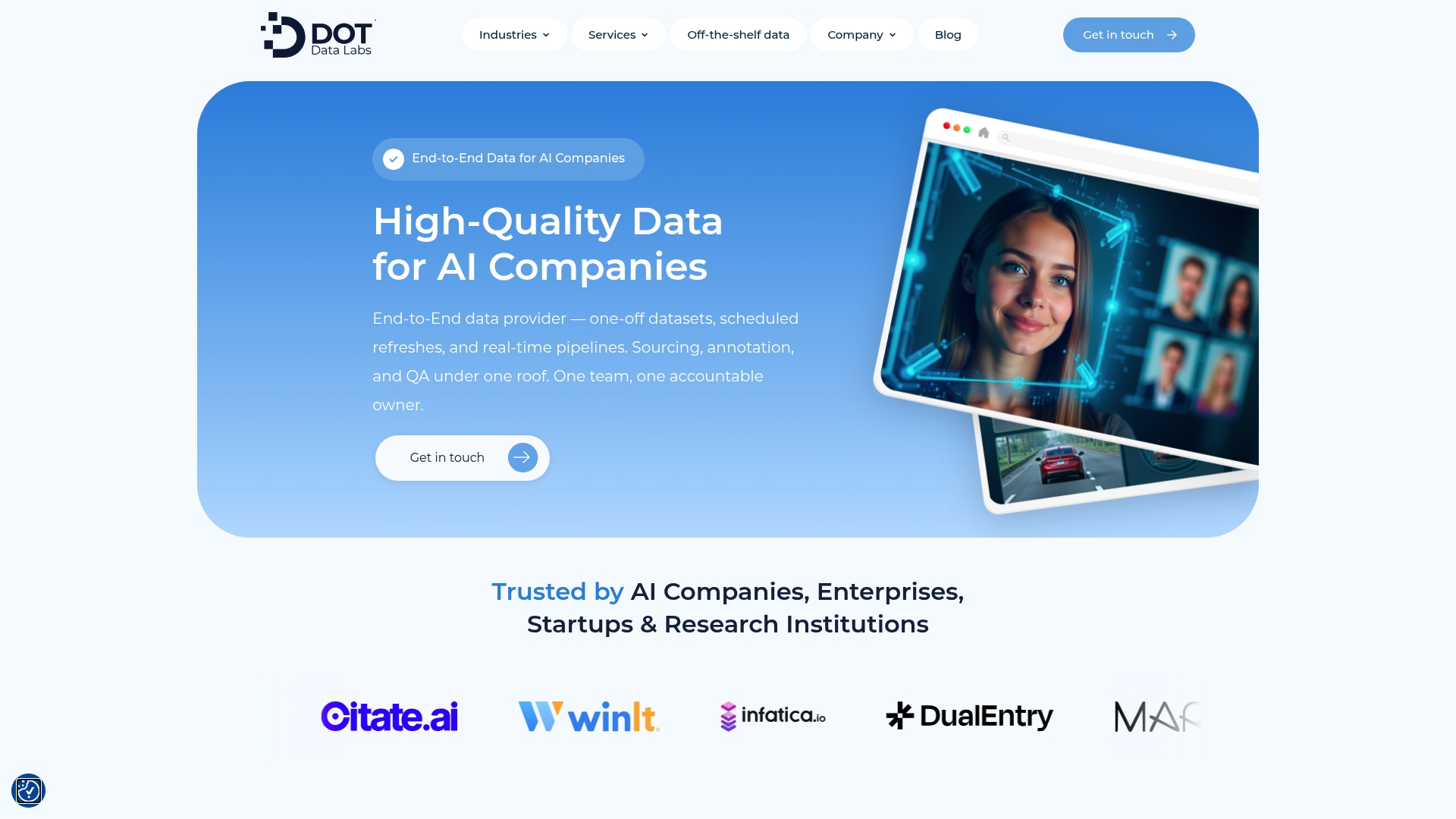
DOT Data Labs’ marketing materials state a 32 million science Q&A dataset was delivered in under 30 days. That delivery example illustrates the vendor focus on fast, large-scale scope for complex collections. The company also highlights large video and web dataset projects as representative outcomes.
Core Features
DOT Data Labs runs full data supply chains from sourcing through final delivery, combining collection, cleaning, deduplication, and human annotation into one workflow. It supports off-the-shelf datasets, one-off custom datasets, and data pipelines, including real-time ingestion and scheduled batch delivery. The vendor advertises compliance with GDPR, CCPA, and NDA protocols, and it scopes data against applicable protections before collection begins.
Key Differentiator
Combines domain-expert review with end-to-end sourcing and a compliance-first approach to improve model training data quality. Domain experts validate edge cases and specialist labels that generic crowd-sourced workflows often miss. The compliance and review layers reduce rework on regulated datasets and lower downstream validation cost.
Pros
DOT Data Labs prioritizes model lift over hours billed, which helps teams focus on metric improvements rather than annotation time. Expert reviewers in specific industries improve label relevance for regulated or technical domains. Clients receive full ownership of data and IP, with flexible deployment across cloud, on-premise, and air-gapped environments to match operational requirements.
Cons
- Pricing is project specific and may require detailed negotiation before scoping begins.
Who It’s For
Teams that need production ready training data with strict privacy controls and specialist labeling. Typical readers are ML engineering managers, heads of data, and AI research teams building models for regulated industries. Organizations that prefer vendor-owned project management and expert review will see the most value.
Unique Value Proposition
Offers turnkey delivery across immediate datasets, bespoke single projects, and continuous pipelines so your team avoids stitching multiple vendors together. That model reduces vendor coordination overhead and produces model ready outputs delivered to your chosen environment. For teams that need regulated or proprietary data, the result is fewer compliance handoffs and clearer accountability.
Real World Use Case
A healthcare AI startup contracted DOT Data Labs to source and annotate thousands of medical transcripts and imaging files. The vendor delivered validated labels and a live pipeline feeding the startup’s clinical decision support model. The engagement preserved data ownership and included workflows scoped for privacy regulations.
Pricing
Pricing is set per project with transparent scoping and a documented quote after requirements are defined. Expect a discovery and proposal phase to align dataset scope, annotation standards, and deployment environment before final pricing is issued.
Website: https://dotdatalabs.ai
Scale AI
At a Glance
Scale’s marketing materials list clients such as Meta, Cohere, Adept, Cisco, and TIME. The company focuses on supplying high quality labeled data and full delivery tools for enterprise model development. Its public positioning emphasizes safety and evaluation for high risk sectors like healthcare and government.
Core Features
Scale combines human annotation, data curation, and tooling for dataset management into a single stack. The platform includes data annotation workflows, model evaluation suites, and a generative AI environment for building custom applications. Teams can run benchmarks and red teaming alongside ongoing dataset curation to measure model behavior.
Key Differentiator
Scale centers its offering on rigorous safety testing and measurable evaluation rather than only raw label throughput. The product pairs labeling and model evaluation so teams can benchmark performance, run adversarial testing, and fold results back into data collection. That focus makes it oriented toward high stakes production systems.
Pros
Scale provides an integrated path from raw collection to validated model outputs, which reduces vendor handoffs and coordination overhead. The company has visible enterprise traction in public materials, and that visibility supports procurement and risk reviews for large buyers. Evaluation and benchmarking features help teams trace failures to specific dataset or model decisions.
Cons
- Homepage content was unavailable, so detailed feature pages and limitations are sparse.
- Pricing requires contacting sales for a demo, which slows initial cost comparisons.
- The emphasis on enterprise work suggests higher price points and less fit for individual researchers or very small teams.
When It May Not Fit
If your team requires transparent, self-serve pricing, Scale will likely slow procurement because pricing appears gated behind sales engagement. Small proof of concept projects with tight budgets will find the enterprise orientation a poor match. Teams needing simple one-off labeling without evaluation tooling may prefer lighter marketplaces or open source tooling.
Who It’s For
Large enterprise and government AI teams that must prove safety, traceability, and compliance will get the most from Scale. Organizations in healthcare, insurance, and public sector work that require evaluation labs and red teaming will find the offering aligned to their needs. Small companies and independent researchers will probably find the procurement model and pricing barriers prohibitive.
Real World Use Case
A healthcare organization uses Scale’s annotation and evaluation services to raise diagnostic model safety before deployment. Annotators label clinical imaging at scale while the evaluation suite measures false positive modes and edge case failure. The team then adjusts data collection and retrains models until benchmark results meet internal safety targets.
Pricing
Not specified. Pricing is available upon request via a demo with sales. That model means you must engage the vendor to get concrete rates and implementation estimates.
Website: https://scale.com
Label Your Data
At a Glance
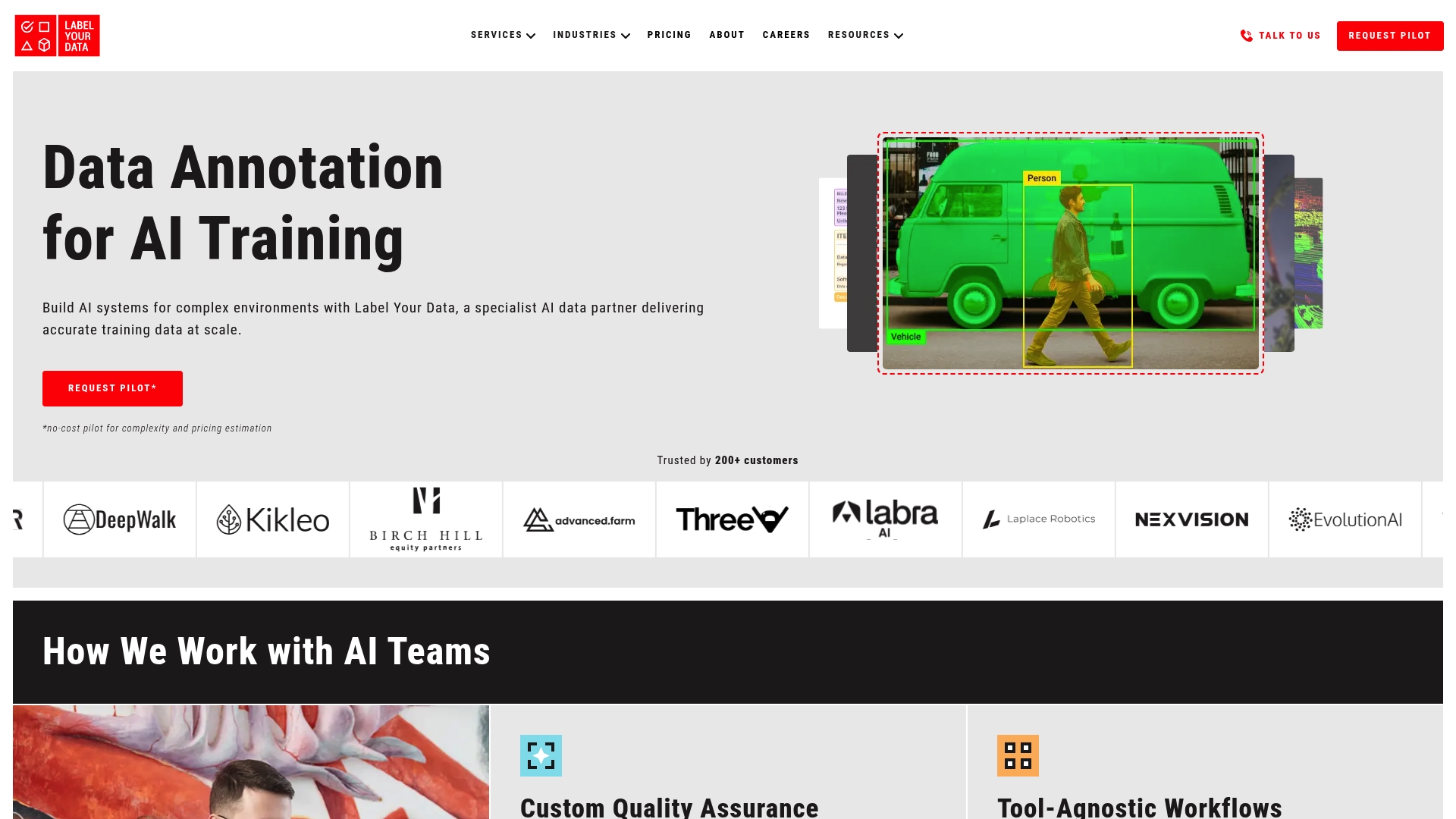
Label Your Data reports working with over 200 customers worldwide. The company advertises industry awards for service quality and reliability. Its sales materials emphasize flexible engagement models and enterprise-grade security for sensitive projects.
Core Features
Label Your Data handles annotation across images, video, 3D point cloud, text, and audio and adapts to complex project requirements. The service offers custom quality assurance workflows with specialist reviews and tool-agnostic processes that fit existing pipelines. Engagement models include hourly, per-object, and project pricing plus risk-free pilots and language training where needed.
Key Differentiator
The standout is a focus on high-quality, scalable annotation backed by tailored QA processes and strong security controls. Teams report tight feedback loops and specialist reviewers for edge cases and complex labels. That emphasis makes the offering suitable for high-stakes projects that need repeatable, auditable labels.
Pros
Clients praise the vendor for high annotation accuracy and for handling complex datasets and edge cases. Fast turnaround and responsive feedback loops reduce iteration time during model development. Flexible operations and no long-term lock-ins let teams pilot models, scale label volume, and adjust workflows without renegotiating contracts.
Cons
- Instructions can sometimes be unclear, which requires extra clarification during early project phases.
- Pricing is estimated per project and not fully transparent upfront, so budgeting may need a pilot to lock scope.
- Public details on specific automation features or technical integrations are limited, which can slow evaluation for tool-first teams.
When It May Not Fit
If your project requires fully transparent per-unit pricing without a pilot, this model could slow procurement. Teams that depend on out-of-the-box automation or tightly documented APIs may find the visible integration details insufficient. If sample data quality varies, that dependence can affect label accuracy until requirements are clarified.
Who It’s For
AI and ML development teams that need precise, scalable annotation across multiple data types will get the most value. Product teams training perception systems or NLP models benefit from specialist reviewers and custom QA. Organizations handling sensitive data will appreciate the emphasis on security and compliance.
Real World Use Case
A perception team building autonomous vehicle models used Label Your Data to annotate LiDAR point clouds, synchronized camera frames, and sensor metadata. Specialist reviewers validated occlusion and edge cases, which reduced false positives in validation. That workflow helped the team shorten the validation loop and improve model recall in rare scenarios.
Pricing
Pricing varies by annotation method, application, and object count and is estimated during scoping. The vendor states image annotation starts from $0.015 per object. Flexible options include hourly, per-object, or fixed project fees and risk-free pilots to validate scope.
Website: https://labelyourdata.com
HumanSignal Services
At a Glance
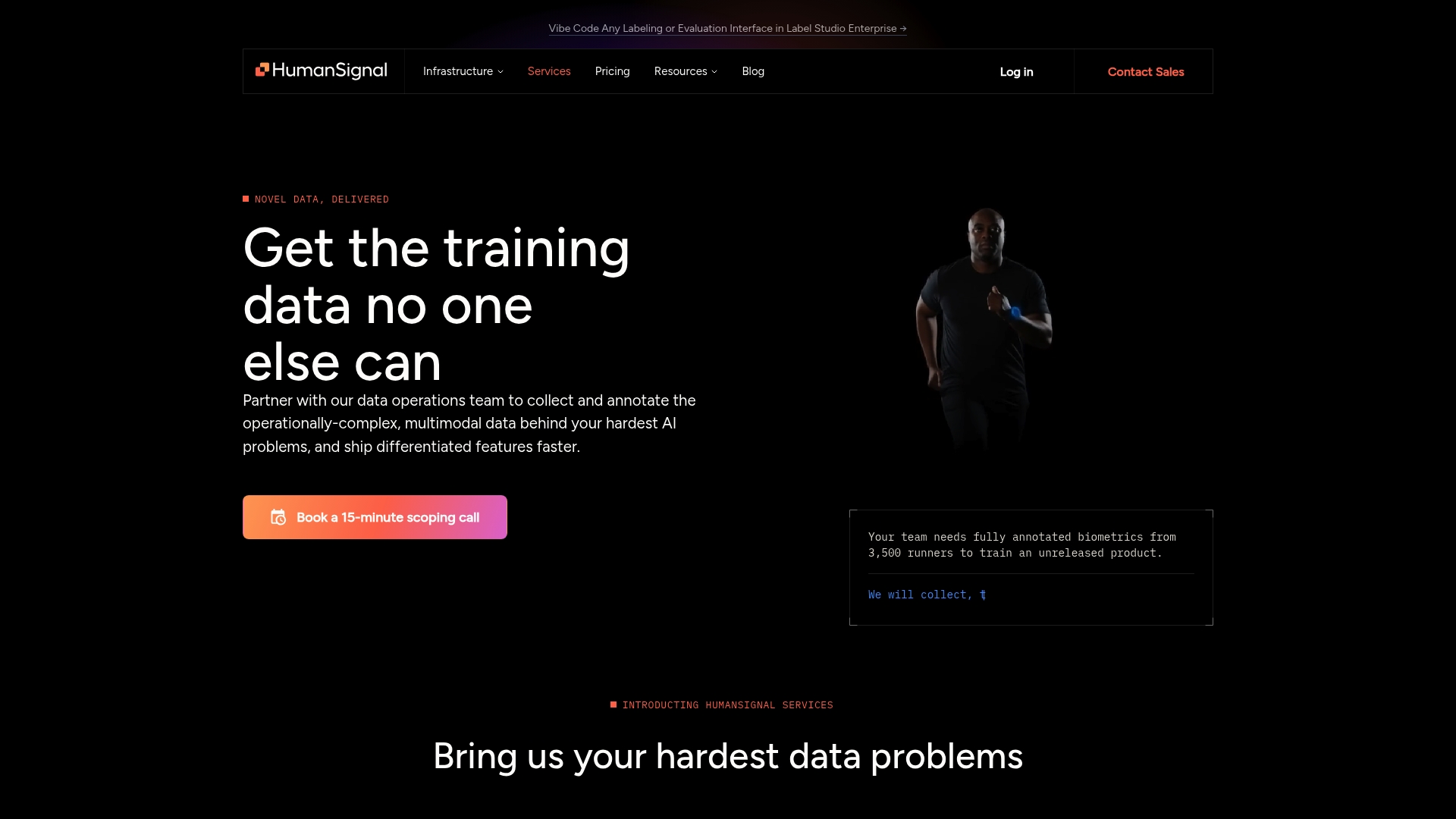
HumanSignal Services runs on-site collection and annotation for multimodal datasets, including synchronized video, audio, and biometric signals. The vendor emphasizes managed workforce operations and field logistics for projects that require physical presence or specialist skills. That model suits projects where remote crowdsourcing cannot meet quality or source-control requirements.
Core Features
HumanSignal Services delivers end to end operational data collection and annotation with on-site teams and remote contributors working under a single program. The offering includes workforce recruitment, high touch onboarding, and ongoing management tied to quality assurance and audit trails. The company states its platform is compatible with HIPAA and SOC2 standards, and it supports multilingual and multimodal collections plus custom evaluation workflows.
Key Differentiator
The one clear distinction is end to end ownership of operationally complex collections that require field teams, equipment logistics, and traceable quality controls. HumanSignal Services pairs field operations with expert annotation staff so the client keeps a single accountable vendor for collection, labeling, and evaluation. That approach reduces coordination overhead for enterprise research programs that need tight provenance and workforce governance.
Pros
HumanSignal Services shows deep operational expertise for difficult projects, from sourcing participants to managing on-site capture and annotation. The firm emphasizes quality control and traceability, which helps when audit trails and evaluation datasets must survive regulatory review. The vendor also highlights ethical sourcing policies with fair pay and consent processes, which matter for biometric and sensitive data. Global reach and multilingual capability let teams run the same protocol across regions while keeping a single vendor point of contact.
Cons
- Pricing details are not publicly specified, which makes budget forecasting harder for procurement teams.
- The company provides limited public detail about integration points with downstream ML pipelines.
- The focus on high touch, operational projects may be more than needed for small, simple labeling jobs.
When It May Not Fit
If your project is a small classification task or you only need a few thousand labeled images, this level of operational oversight may add cost and timeline. Teams that need self service URLs, simple API labeling, or a pay as you go marketplace will find the model misaligned. If rapid prototyping with minimal governance is the priority, a lighter weight vendor will usually move faster and cost less.
Who It’s For
Enterprise AI research teams and product groups that require ethically sourced, multimodal datasets with strict provenance. Ideal clients are those building models that rely on synchronized sensor streams or biometric signals and who need field collection under managed working conditions. The profile includes teams that must satisfy security and traceability requirements during model evaluation.
Real World Use Case
A medical device team needed annotated video, audio, and wearable biometric streams from thousands of runners to train motion and heart rate models. HumanSignal Services organized site captures, instrumented subjects, and delivered synchronized, labeled recordings with QA logs. The vendor also managed consent records and worker pay for every data contributor.
Pricing
Pricing is not published on the website. The vendor appears to price projects by scope, particularly for on-site logistics, workforce management, and custom evaluation workflows. Expect procurement to require an SOW and a scoped proposal rather than a public rate card.
Website: https://humansignal.com/data-services
Flipside AI
At a Glance
Public pages were not viewable on Flipside AI’s site. The site returns page not found errors for core content. The only clear detail on the site is the presence of cookie notices for analytics and experience optimization.
Core Features
The site shows restricted access and does not publish feature documentation. Cookie-based analytics and a cookie consent flow appear on public pages. No product pages, API docs, or downloadable assets were accessible at the time of review.
Key Differentiator
The single distinguishing fact is content inaccessibility. That restriction prevents readers from verifying product scope, pricing, or integrations. This makes evaluation dependent on direct contact or future site updates rather than public documentation.
Pros
Public cookie consent indicates some attention to privacy and analytics. Branding on the domain suggests the parent company is Flipside Digital Content Company, Inc. The visible elements show a live domain rather than a parked page, which means the site may be under construction or undergoing a content migration.
Cons
- Missing or broken content pages prevent understanding of actual offerings. This blocks feature comparison and procurement workflows.
- No pricing or integration details are available. Purchasing teams cannot estimate cost without vendor contact.
- Website navigation issues and page not found errors create friction for evaluators. That friction raises support and procurement overhead.
- Incomplete public information hampers technical due diligence and security review.
When It May Not Fit
If you need immediate technical specifications or sample datasets, this site is not a fit. If procurement requires published SLAs, pricing tiers, or integration lists, those items are absent. Teams that must perform vendor risk assessments will struggle without public documentation. The product may only work for people willing to contact the vendor and wait for direct answers.
Who It’s For
This listing is only useful to people doing vendor discovery who accept limited public documentation. Research teams compiling a long list of potential vendors may include Flipside AI for follow up. Procurement teams that require published details should deprioritize it until the site publishes product pages.
Real World Use Case
No verifiable use case could be extracted from the site. Without feature pages or case studies, you cannot map the offering to an ML workflow. The only realistic action is to contact Flipside Digital Content Company for clarifications and request technical material directly.
Pricing
Pricing is not listed on the public site. The product data marks pricing as not applicable and informational only. Expect to request cost details from the vendor during a sales conversation.
Website: https://flipside.ai
Accenture Edge
At a Glance
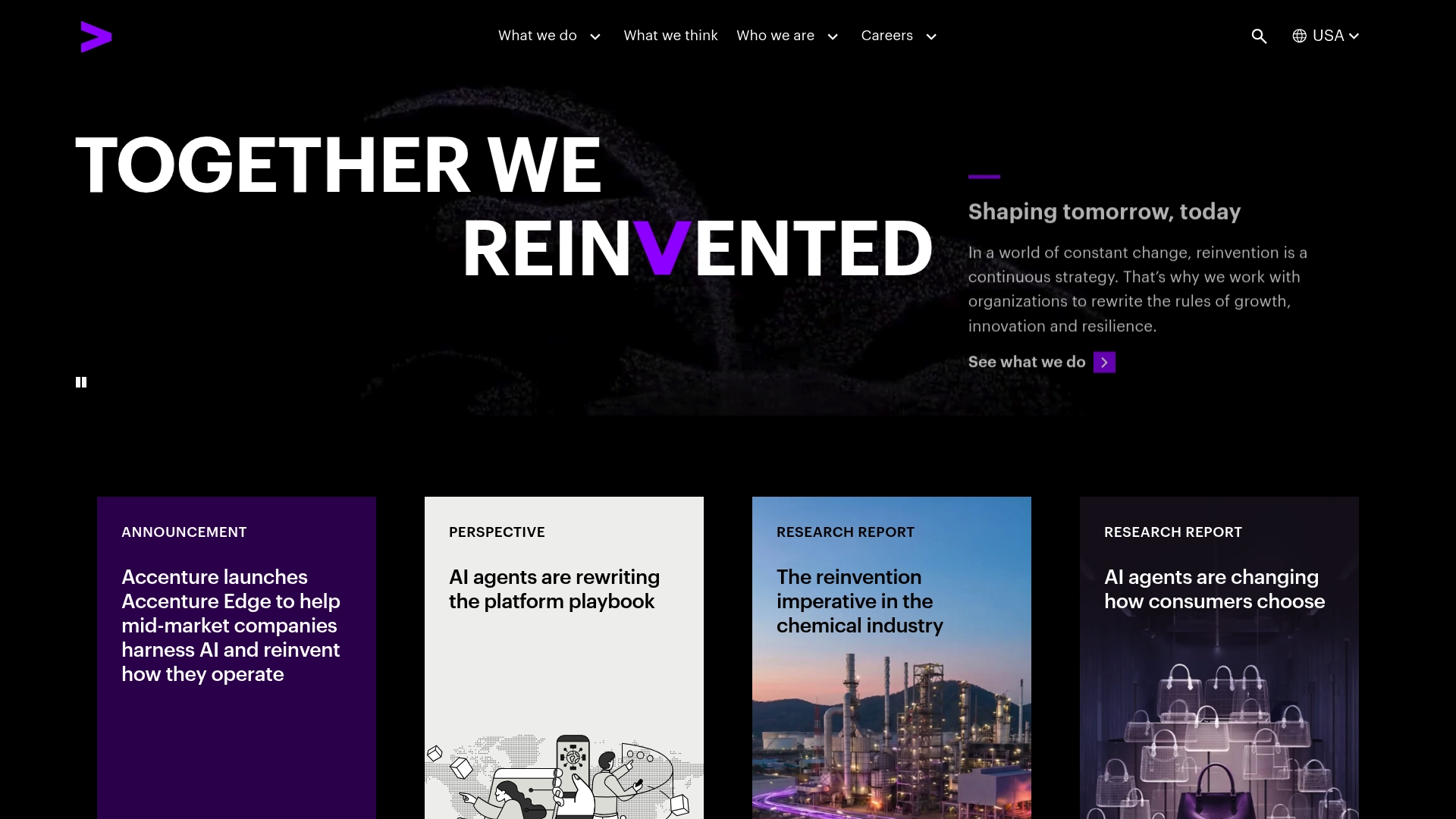
Accenture Edge targets mid market companies with prebuilt AI solutions and specialist consulting teams. The unit pairs industry research and ecosystem partnerships to accelerate technology modernization. It emphasizes agentic AI and platform innovation for sectors such as chemicals, consumer, and health.
Core Features
Accenture Edge delivers prebuilt solutions for AI and technology modernization together with consulting that scopes and implements those solutions. The offering includes industry specific research and case studies to guide strategy and change management. Ecosystem partnerships supply platform components and vendor options for faster deployments.
Key Differentiator
Accenture Edge combines prebuilt AI components with deep industry practice and a wide set of ecosystem partnerships. That combination aims to shorten time to deployment for mid market adopters. The industry focus helps tailor solutions to sector specific regulatory and operational needs.
Pros
Accenture Edge brings deep industry expertise across multiple sectors, which helps teams select models and data workflows that match domain constraints. Its research and case studies support strategic decisions and stakeholder alignment. The vendor partnerships reduce the procurement lift for integrating platform services, and the emphasis on agentic AI provides a clear direction for product teams moving from pilots to broader platform capabilities.
Cons
- Service offerings cover many areas and can lack depth on niche technologies, which may leave specialized implementation work to other vendors.
- Tailored consulting engagements can carry a high price tag, and detailed cost breakdowns are not publicly available.
- The unit focuses on mid market deals, which can leave small startups and very large enterprises without a tight fit.
When It May Not Fit
Small startups with limited budgets will find this offering misaligned with their needs. Very large enterprises seeking deep custom engineering or highly specialized research may prefer boutique consultancies. Buyers who need transparent, fixed price packages will find pricing and package details scarce.
Who It’s For
This unit fits mid sized companies that need external teams and industry playbooks to adopt AI and modernize legacy systems. Heads of data, CTOs, and transformation leads who want prebuilt components plus consulting will get the most value. It is not ideal for teams that need purely open source engineering depth or low budget pilots.
Real World Use Case
A manufacturing firm partnered with Accenture Edge to deploy AI driven supply chain optimization and digital twins. Accenture Edge combined prebuilt models, systems integration, and industry specific process design to reduce plant downtime and improve operational resilience.
Pricing
Pricing is not publicly listed and described as not applicable for informational elements. Engagements are typically quoted per project with custom scoping and commercial terms. Prospective clients must contact Accenture for tailored proposals.
Website: https://accenture.com
Comparison of alternatives
When considering alternatives for custom AI dataset sourcing, each vendor provides distinct benefits catered to specific use cases. The following highlights key tradeoffs and advantages among the available options.
Tradeoffs in Domain Specialization
DOT Data Labs incorporates domain-expert review and compliance-focused workflows. This focus benefits regulated industries where centralized accountability and precise data handling are. In contrast, Scale AI emphasizes a model evaluation and benchmarking suite integrated into its data handling platform, addressing safety and validation concerns for enterprise-scale teams. Label Your Data’s tailored quality assurance and flexible pricing models adapt to diverse project needs, proving advantageous for exploratory or evolving applications. HumanSignal Services specializes in field-level operational data collection for multimodal datasets, adding value where on-site data capture is necessary.
Prospective Operational Strategies
Due to its direct focus on compliance, DOT Data Labs caters to organizations needing centralized sourcing with specialist reviews. Scale AI’s suite is ideal for teams prioritizing model evaluation alongside data annotation workflows. Label Your Data excels in situations demanding rapid iterations and flexible scope adjustments due to its adaptive engagement models, while HumanSignal Services proves essential for projects requiring high-touch operations involving ethical data sourcing and participant consent management.
Best fit
- Teams requiring data sourcing with compliance measures and specialized domain reviews benefit from DOT Data Labs.
- Large enterprises focusing on model safety and validation tools will find Scale AI’s offerings appealing.
- Projects demanding iterative modifications and exploratory data handling prefer Label Your Data’s flexible operational models.
- Organizations addressing field-level data collection and synchronized datasets benefit from HumanSignal Services’ managed workforces and operational expertise.
Our pick
DOT Data Labs excels when regulated data projects demand strict compliance, specialized reviews, and integrated end-to-end delivery workflows. It sets itself apart as the recommended choice for aligning centralized accountability with a dataset creation process. Alternative vendors may better serve teams with specific requirements outside these parameters.
DOT Data Labs stands out by combining compliance-first approaches with expert-reviewed data sourcing, offering high-quality, production-ready training datasets.
| Product | Core Feature | Key Differentiator | Best For | Notable Limitation |
|---|---|---|---|---|
| DOT Data Labs | Full data supply chain workflows | Compliance-first approach with expert validation | Teams needing specialist labeling and regulated data | Pricing requires project-specific negotiation |
| Scale AI | Integrated annotation and evaluation | Combines labeling with model evaluation | Enterprise teams in healthcare and government | Pricing and features gated behind sales |
| Label Your Data | Scalable annotation with QA workflows | Specialist reviewers for high accuracy | ML teams handling complex datasets | Unclear pricing without a pilot |
| HumanSignal Services | On-site data collection and annotation | End-to-end field logistics and management | Enterprise teams requiring synchronized multimodal data | High operational overhead for small projects |
| Flipside AI | Limited available information | Under-construction website | Research teams exploring vendor options | Missing public documentation |
How Can You Find Reliable Alternatives to informdatalab.com for AI Training Data?
ML Engineering Managers and Heads of Data often face challenges sourcing high-quality, production-ready datasets without managing multiple vendors or building pipelines from scratch. DOT Data Labs provides full-stack solutions from raw data sourcing to validated, labeled output. Their offerings include off-the-shelf datasets, one-off custom projects, and ongoing data pipelines that meet strict privacy standards.
DOT Data Labs delivers large-scale, compliant datasets with expert annotation tailored for model lift and speed. Whether you need fast delivery or continuous data ingestion, DOT Data Labs reduces vendor overhead and simplifies management.
Take a closer look at how DOT Data Labs can handle your AI training data needs with effective sourcing, cleaning, and labeling. Visit DOT Data Labs to learn more about getting custom datasets prepared for your models and accelerate your project outcomes.
FAQ
What advantages does DOT Data Labs offer for sourcing custom training data?
DOT Data Labs provides end-to-end data supply chains that include sourcing, cleaning, deduplication, and human annotation in one workflow. This feature supports off-the-shelf datasets and custom data pipelines, ensuring compliance with GDPR, CCPA, and NDA protocols for privacy and security.
How does Scale compare to DOT Data Labs for enterprise-level custom training data services?
Scale is known for its rigorous safety testing and evaluation features that are particularly useful for high-risk sectors like healthcare and government. In contrast, DOT Data Labs focuses on delivering faster, compliance-driven datasets that prioritize model training accuracy, making it ideal for organizations needing regulated datasets within tight timelines.
What type of projects is ideal for using Label Your Data?
Label Your Data is well-suited for AI and ML development teams that need precise and scalable annotation across multiple data types. Their custom quality assurance processes enhance accuracy, making it valuable for teams looking to build perception systems or NLP models requiring meticulous labeling.
Does HumanSignal Services accommodate specialized data collection needs?
Yes, HumanSignal Services specializes in on-site collection and annotation for complex multimodal datasets that require field operations and high touch management. This level of operational oversight benefits enterprise AI research teams that need ethically sourced data under strict quality control guidelines.
What should I expect regarding project pricing with DOT Data Labs?
DOT Data Labs sets pricing per project, which involves a discovery phase to align the dataset scope, annotation standards, and deployment environment before providing a detailed quote. This approach ensures transparency and aligns costs with specific project requirements.