
Fine-tuning data: Key principles for AI optimization
TL;DR:
- Many machine learning teams focus on increasing scale, but fine-tuning with task-specific data often delivers higher leverage. Properly curated and high-quality fine-tuning datasets, even small ones, can outperform massive generic corpora by teaching models precise behaviors in specific contexts. Balancing dataset diversity, edge case coverage, and strategic preparation is critical for optimal model performance and reliability.
Most ML teams chasing better model performance immediately think about scale. More examples, bigger corpora, larger batches. But that instinct often misses the higher-leverage lever entirely. Fine-tuning data is a smaller, task-specific dataset used to adapt a pre-trained model to precise behaviors, and getting it right frequently outperforms adding millions of generic examples. This guide covers exactly what fine-tuning data is, how to prepare it properly, how much you actually need, and how to integrate it strategically with complementary approaches like RAG.
Key Takeaways
| Point | Details |
|---|---|
| Task-focused data matters | Fine-tuning data should reflect your production environment, not just generic content. |
| Diversity prevents failure | Including edge cases and rare scenarios is vital for robust model behavior. |
| Quality beats quantity | A few thousand well-selected examples can unlock superior model performance compared to larger, noisy datasets. |
| Choose strategy wisely | Fine-tune for behaviors, use RAG for up-to-date facts, and combine both approaches for optimal production results. |
What is fine-tuning data?
Fine-tuning data is not just a smaller version of your pre-training corpus. It’s a fundamentally different artifact with a different job to do. Understanding that distinction is where most teams sharpen their strategy.
A pre-training dataset is vast and general. It teaches a model the structure of language, world knowledge, and reasoning patterns across billions of tokens. Fine-tuning data, by contrast, is curated and task-specific. It teaches the model how to behave within your particular production context. According to Lenovo’s knowledge base, fine-tuning data typically consists of labeled input-output pairs or instruction-response examples scoped to a specific domain or task.
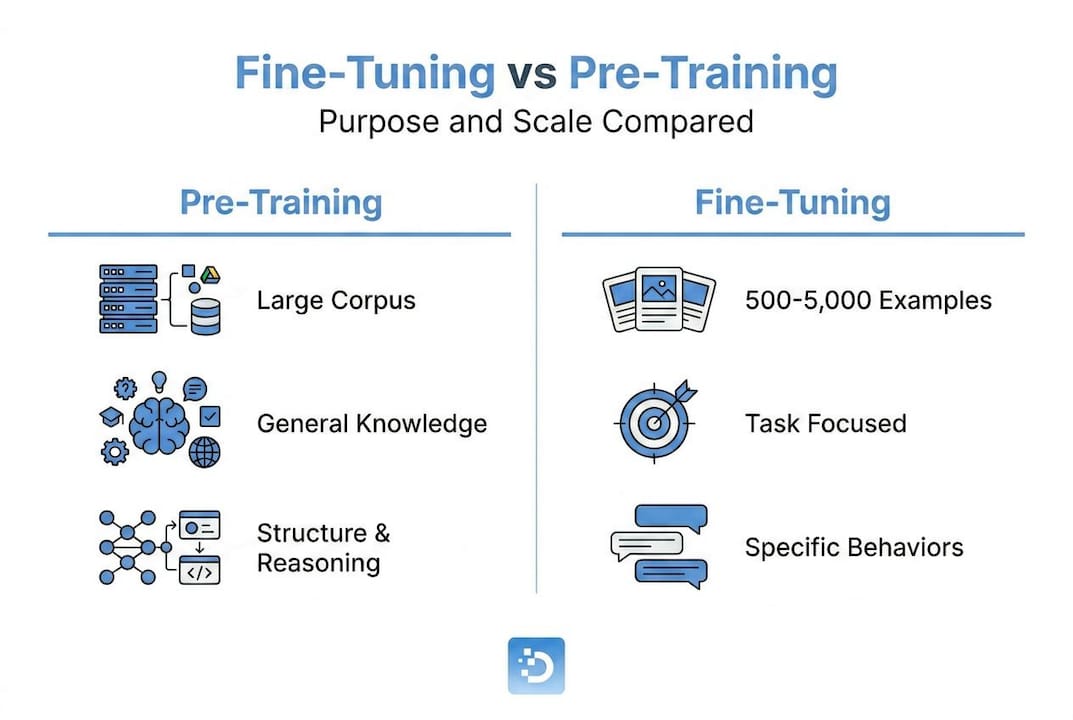
The size contrast is striking. Pre-training corpora often measure in terabytes. Fine-tuning datasets typically run between 500 and 5,000 examples. That’s not a limitation. It’s the point. Every example is doing targeted work.
| Feature | Pre-training data | Fine-tuning data |
|---|---|---|
| Size | Billions of tokens | 500 to 5,000 examples |
| Purpose | General language modeling | Task-specific adaptation |
| Format | Raw or lightly filtered text | Labeled input-output pairs |
| Freshness need | Low | High, mirrors production context |
| Replaceability | Interchangeable corpora | Must reflect your use case |
Key characteristics of effective fine-tuning data include:
- Task specificity: Every example reflects the actual inputs your model will receive in production.
- Edge case coverage: Both typical flows and rare or ambiguous inputs are represented.
- Consistent labeling: Outputs are formatted to match the exact structure your downstream system expects.
- Instruction-response structure: Clear separation of what the model is asked to do versus what it should produce.
Think of it this way: pre-training builds the foundation, and fine-tuning vs pre-training datasets differ the way a medical school education differs from a residency. One gives you general capability, the other gives you precision in a specific operating environment.
How to prepare high-quality fine-tuning data
Once you’ve identified the need for fine-tuning data, the next step is preparing it to maximize performance and compliance. Poor preparation here is the single most common reason fine-tuned models underperform expectations.
OpenAI’s fine-tuning documentation outlines a clear methodology: collect representative examples from production logs, clean for consistency, remove PII and duplicates, format into standardized templates, ensure diversity across cases, split into train/validation/test sets, and supplement gaps with human-validated synthetic data.
Here’s a practical step-by-step workflow:
- Source from production. Real interactions from your system are the most valuable raw material. They capture natural variation in how users actually phrase requests.
- Deduplicate aggressively. Near-duplicate examples inflate dataset size without adding signal. Use embedding-based similarity checks, not just exact string matching.
- Strip PII and sensitive content. This is both a compliance requirement and a quality measure. Leaked personal data degrades model behavior and introduces legal exposure.
- Standardize formatting. Use a consistent template such as JSONL with clearly defined fields for system prompt, user turn, and assistant response.
- Validate label quality. Human reviewers should check a representative sample for label accuracy. One mislabeled example per hundred can meaningfully shift behavior in small datasets.
- Split intentionally. Keep your test split completely isolated. No leakage between training and evaluation data.
When formatting fine-tuning data for instruction-tuned models, the system prompt is often undervalued. It carries significant behavioral weight. Treat it as part of the labeled data, not boilerplate.
Pro Tip: Synthetic data can fill distribution gaps effectively, but only if each synthetic example passes human review before inclusion. Automated generation without review introduces subtle label inconsistencies that compound during training.
The broader principles of high-quality ML dataset creation apply here: garbage in, garbage out holds more true for fine-tuning than for any other training stage, because there’s no large corpus to absorb noise.

Why diversity and edge cases matter for model reliability
Clean, structured data isn’t enough. To ensure your model performs reliably, you must deliberately include the unusual, not just the expected. This is where many otherwise well-built fine-tuning datasets fail.
Lenovo’s technical documentation is direct on this point: edge case coverage must include input/output boundaries, missing or conflicting information handling, refusal and fallback behaviors, and rare scenarios. Without these, generalization to production conditions breaks down unpredictably.
Coverage gaps to specifically audit for:
- Ambiguous queries: What should your model do when the user’s intent is unclear? Define the behavior and include examples of it.
- Refusal scenarios: If your model should decline certain requests, show it what that looks like, not just what compliance looks like.
- Missing values: Real inputs are often incomplete. Training only on clean, complete examples creates brittleness.
- Conflicting instructions: When system prompt and user turn imply different behaviors, the model needs to know which to follow.
“Inconsistent labels or missing edge coverage leads to poor generalization.” This isn’t abstract concern. It’s the mechanism behind most production failure modes that get escalated to the ML team.
QA-style data formats, where the model is explicitly asked a question and provides a structured answer, inject behavioral knowledge more robustly than narrative or article-style examples. The format itself reinforces the instruction-following pattern.
Follow established dataset optimization tips and classification dataset best practices to structure your coverage audits systematically. Build a coverage matrix before you start collecting, map your edge case categories in advance, and track fill rates per category as you label.
Fine-tuning vs retrieval-augmented generation (RAG): Which and when?
With a reliable, diverse dataset in hand, the next strategic question is whether fine-tuning alone is sufficient, or if RAG should play a role. These approaches are often positioned as alternatives, but they solve different problems.
Fine-tuning vs RAG is best understood as a behavioral vs knowledge distinction. Fine-tuning excels at changing how a model responds. RAG excels at updating what the model knows. Use the wrong tool and you’ll overspend on implementation while underdelivering on results.
| Dimension | Fine-tuning | RAG |
|---|---|---|
| Best for | Style, tone, output format, behavioral rules | Current facts, citations, dynamic knowledge |
| Weakness | Knowledge staleness, catastrophic forgetting | Added latency, retrieval errors, infrastructure cost |
| Update cycle | Periodic retraining needed | Real-time index updates possible |
| Implementation cost | Moderate (compute, dataset curation) | Higher (retrieval pipeline, embedding store) |
A practical decision framework:
- If your problem is behavioral, fine-tune first.
- If your problem is knowledge freshness, implement RAG.
- If your problem is both, use a hybrid: fine-tune the behavioral layer, RAG the knowledge layer, and monitor for interaction effects.
- Avoid layering both without clear ownership of each. Hybrid architectures require rigorous dataset standardization for LLM fine-tuning to maintain reproducibility.
Known risks when layering both approaches include prompt format conflicts, where RAG-injected context disrupts the instruction format the fine-tuned model expects. Test each layer independently before combining them.
How much fine-tuning data is enough? Benchmarks and evaluation
Knowing when you have “enough” data is a common question. Let’s anchor best practices with real benchmarks and evaluation criteria.
Research published on arXiv confirms that optimal dataset size for most fine-tuning tasks falls between 500 and 5,000 high-quality examples. Doubling the dataset size yields consistent but diminishing gains. Notably, a fine-tuned Llama3-70B achieves 91.9% accuracy on 20-class classification tasks. LoRA and QLoRA parameter-efficient methods deliver comparable performance with significantly reduced compute costs.
| Task type | Recommended examples | Key quality signal |
|---|---|---|
| Classification | 500 to 1,000 | Balanced class distribution |
| Instruction following | 1,000 to 3,000 | Diverse instruction phrasing |
| Domain adaptation | 2,000 to 5,000 | Representative domain vocabulary |
| Style/tone transfer | 300 to 800 | Consistent output formatting |
Evaluation metrics to track:
- Perplexity on your dataset: Data perplexity relative to the base model is a strong predictor of fine-tuning success. Low perplexity means the data is already well-represented; high perplexity means the model has more to learn.
- Downstream task accuracy: Measure directly on the production task, not just on a generic benchmark.
- Edge case pass rate: Track specifically how the model handles your pre-defined edge case categories.
- Human spot-checks: Automated metrics miss subtle behavioral regressions. Regular human review of random sample outputs is irreplaceable.
Building optimized training sets means treating evaluation as part of dataset design, not an afterthought. Your test split should be designed before you start labeling, not assembled from whatever examples are left over.
A strategic lens: Fine-tuning data as a high-leverage productivity multiplier
Here’s what years of real-world implementation teach that theory often misses: most teams are optimizing the wrong variable.
The instinct to add more data is understandable. More data feels like progress. But in fine-tuning, the highest ROI consistently comes from curation and coverage, not volume. A 400-example dataset with comprehensive edge case coverage frequently outperforms a 4,000-example dataset assembled without a coverage strategy.
The operational recommendation is clear: start with RAG for knowledge needs, then layer fine-tuning only for persistent behavioral gaps that retrieval cannot resolve. Document data provenance rigorously. Build a retraining cadence into your roadmap from day one, not as a reactive measure when performance degrades.
The teams that get the most leverage from fine-tuning treat their fine-tuning datasets as curated strategic assets, not one-time artifacts. They version their data alongside their model weights. They track which examples drove which behavioral changes. They own the data supply chain as deliberately as they own the training loop.
This is also where operational stability compounds. A well-maintained fine-tuning dataset reduces support escalations, makes model regressions easier to diagnose, and shortens retraining cycles when production conditions shift. The dataset becomes infrastructure, not just input.
Need reliable fine-tuning datasets? Accelerate with Dot Data Labs
For teams ready to apply these best practices without building the entire data pipeline internally, the right partner changes the execution timeline significantly.

DOT Data Labs specializes in AI-driven model training solutions, handling the full data supply chain from raw collection through to labeled, validated, model-ready output. Whether you need a one-off fine-tuning dataset scoped to your exact production context or an ongoing data pipeline that continuously feeds cleaned and structured examples into your training infrastructure, the team handles sourcing, cleaning, annotation, and delivery. If you need to format your fine-tuning data into production-ready JSONL or other model-specific structures, that’s included. Work with fine-tuning data experts who have delivered projects like a 32 million sample Q&A dataset in under 30 days.
Frequently asked questions
How is fine-tuning data different from pre-training data?
Fine-tuning data is small, focused, and task-specific, while pre-training data is vast and general-purpose. As defined in Lenovo’s fine-tuning documentation, fine-tuning data adapts an already-capable model rather than building foundational knowledge from scratch.
How much fine-tuning data do I need for best results?
Most tasks reach optimal performance with 500 to 5,000 examples, with consistent gains from doubling dataset size. Quality and diversity across edge cases matter far more than raw volume.
Should I use fine-tuning or RAG for updating my model’s knowledge?
Use RAG for dynamic, up-to-date knowledge retrieval, and reserve fine-tuning for persistent behavioral changes. RAG handles factual freshness better; fine-tuning handles behavioral consistency better.
Can I use synthetic data for fine-tuning?
Yes, but each synthetic example needs human validation before inclusion in your training set. Per OpenAI’s fine-tuning guidance, synthetic augmentation works well when it fills distribution gaps and passes quality review.
How do I evaluate my fine-tuned model’s performance?
Track perplexity on your dataset, downstream task accuracy, and edge case pass rates using mini-benchmarks and human spot-checks. Research shows that data perplexity relative to the base model is a strong predictor of overall fine-tuning success.