
Data validation in ML: techniques for reliable AI models

TL;DR:
- Data validation in ML focuses on ensuring dataset fitness for training, not just correctness.
- Continuous, multi-stage validation with tools like TFDV and Great Expectations helps detect drift and out-of-distribution data.
- Validations must be regularly reviewed and adapted as data sources and production environments evolve.
A model trained on corrupted data does not fail loudly. It ships, it scores, and it quietly erodes trust until someone notices the predictions make no sense. Research confirms that as little as 5% structured corruption can severely degrade model performance. Yet most ML teams still treat data validation as an afterthought, something to check off before training rather than a continuous discipline woven into every stage of the pipeline. This guide moves from the fundamentals of what data validation actually means in a machine learning context, through the edge cases that kill production models, to the tools and architectures that make validation scale.
Key Takeaways
| Point | Details |
|---|---|
| ML-specific validation | Data validation in machine learning addresses not just data quality but training-specific threats like drift and leakage. |
| Automation is key | Modern tools and CI/CD integration make robust validation scalable across pipelines. |
| Edge cases matter | Subtle issues like schema drift and category explosions can silently undermine production models. |
| Tiered strategies | Applying fast checks everywhere and deep checks on samples ensures both coverage and efficiency. |
| Cultural mindset needed | Lasting model reliability stems from ongoing vigilance, not just technical solutions. |
Defining data validation for machine learning
With validation’s stakes set, let’s pin down what the term actually means for ML teams.
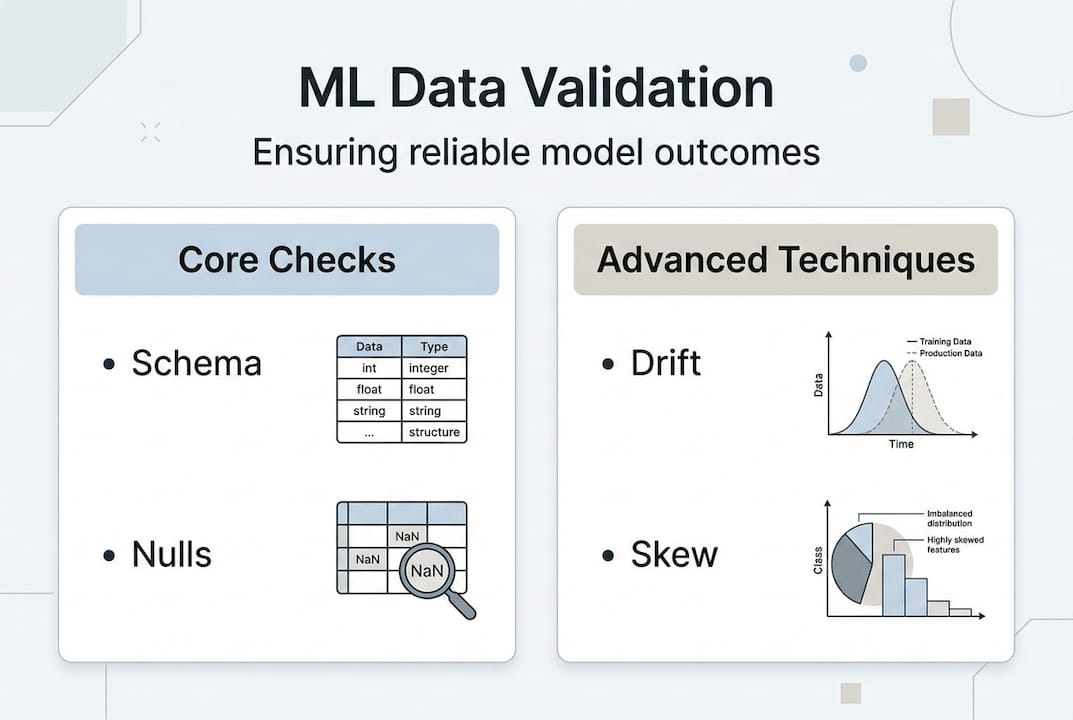
Data validation in a general software context usually means confirming that a field is present, correctly typed, and within an expected range. That is necessary, but for ML it is nowhere near sufficient. A feature can be perfectly formatted and still be catastrophically wrong for model training. A timestamp column with no nulls and valid date values can still introduce target leakage. A numeric column with values inside the expected range can still show a distribution shift that silently reduces your F1 score by 12 points.
ML-specific validation is about fitness for training, not just presence and format. It asks a different set of questions.
The types of dataset validation that matter most for model training span several dimensions:
- Shape and structure: Does the dataset match the expected number of rows, columns, and data types your training code assumes?
- Missing value patterns: Are nulls random, or are they clustered in ways that would systematically bias a model?
- Value ranges and distributions: Do numerical features fall within historically observed bounds, and do categorical features include only known categories?
- Category consistency: Has a new label appeared in a categorical column that the model has never seen?
- Duplicates: Are exact or near-duplicate rows inflating certain examples in training?
- Column relationships: Are there cross-feature constraints that, if violated, indicate upstream data corruption?
- Target leakage: Does any feature encode information that would not be available at inference time?
- Train/test distribution stability: Do training and evaluation splits share the same statistical fingerprint?
- Class balance: Is the label distribution representative, or has the balance shifted from what the model expects?
Pre-training validation covers all of these dimensions and more, including real-world availability checks that confirm each feature will actually exist when the model runs in production.
“Good data validation is not a single gate before training. It is a continuous audit that touches every stage of the ML lifecycle, from raw ingestion to live model serving.”
Two concepts deserve special attention because they are genuinely ML-specific. The first is drift detection, which compares the statistical properties of a new dataset batch against a baseline established during training. The second is target leakage, where a feature that looks predictive during training is actually a proxy for the label itself, usually because it is calculated after the event you are trying to predict. Both issues are invisible to basic schema checks and both have caused serious production failures.
Validation is also iterative. You run different checks at ingestion, at feature engineering, before a training run, and during model serving. Treating it as a single gate is one of the most common and costly misconceptions in the field.
Common pitfalls and edge cases in ML data validation
Now that definitions are clear, why do even diligent teams still get tripped up?
Simple checks catch obvious problems. They do not catch the subtle, slow-moving issues that tend to cause the most damage in production. Understanding where basic validation falls short is the first step toward building something that actually holds up.
The most frequently cited edge cases in ML validation include distribution drift and skew, schema changes introduced by upstream systems, null spikes that appear after deployment, category explosions where new values appear at low frequency, hidden outliers that pass range checks, target leakage, imbalanced classes that shift over time, and out-of-distribution data arriving at the serving endpoint. Each of these has caused real-world model failures in documented production incidents.
Consider null spikes. A feature that historically has a 2% null rate suddenly hits 18% after a backend schema change. Your schema check passes because the column still exists and the data type has not changed. But your model now receives a meaningfully different distribution of inputs, and its imputation strategy, if it has one, was calibrated for 2%, not 18%. The model scores, but it is no longer performing the task it was trained for.
Category explosions are similarly deceptive. A categorical feature like “product subcategory” might add a new value at a low frequency. A basic check confirms the column is a string and passes. But the model was trained on a fixed vocabulary. That new category gets handled by whatever the model defaults to for unseen values, which is often silent and wrong.
Here are the production-level responses that actually protect your pipeline:
- Quarantine invalid records rather than dropping them, so they can be inspected and reintroduced later.
- Block retraining when critical validation thresholds are breached. An automated retraining triggered by bad data makes the problem worse, not better.
- Alert immediately on anomalies in features with known high importance to the model. Low-importance feature drift may be acceptable. High-importance feature drift almost never is.
- Implement graceful degradation at the serving layer, so the system returns a safe fallback rather than a confidently wrong prediction.
One area where even experienced teams struggle is with the dataset cleansing process during iterative development. Cleansing rules that work for one data vintage often fail silently on a new pull, because the upstream source changed in ways that were not communicated.

Pro Tip: Always monitor for spikes in out-of-distribution (OOD) data, even in pipelines you consider stable. OOD data tends to appear gradually and then suddenly. By the time it is visible in model metrics, it has already affected multiple inference batches. Catching it at the input stage, before it reaches the model, is far cheaper than diagnosing it from degraded outputs.
Your AI data quality checklist should include explicit OOD monitoring triggers, not just schema and range checks.
How to implement ML data validation: workflow and key tools
Avoiding pitfalls means deploying robust workflows and battle-tested tools.
The modern ML stack offers genuine solutions here. The key is orchestrating validation within your CI/CD and MLOps pipelines so it runs automatically, produces structured logs, and gates training and deployment decisions without requiring manual intervention every cycle.
Two tools dominate this space. TensorFlow Data Validation (TFDV) handles statistics generation, schema inference, anomaly detection, and drift comparison between datasets. Great Expectations takes a declarative approach, letting you define expectations about schema, distributions, and null rates that are then checked against incoming data automatically.
| Feature | TFDV | Great Expectations |
|---|---|---|
| Schema inference | Automatic from data | Manual or semi-automatic |
| Drift detection | Built-in, baseline comparison | Requires custom expectations |
| Anomaly alerts | Native | Via integrations |
| Integration | TFX, Kubeflow | Any Python pipeline |
| Output format | Protocol Buffers | JSON, HTML reports |
| Best for | TensorFlow-centric MLOps | Tool-agnostic pipelines |
A practical validation workflow looks like this:
- Ingestion validation. When raw data arrives, run schema and type checks immediately. Reject or quarantine records that fail before they enter the pipeline.
- Batch and stream checks. For each batch update, compute distribution statistics and compare them against the baseline established during training. Flag deviations above your defined threshold.
- Feature store monitoring. Before writing to a feature store, validate that computed features fall within expected bounds and that cross-feature relationships hold.
- Training gate. Run a full validation suite before any training job starts. If critical checks fail, block the run and alert. Automated retraining on bad data is a silent performance killer.
- Real-time serving validation. At the inference endpoint, check that incoming requests match the expected input schema and distribution. Log OOD examples for later review.
Integrate the data preprocessing workflow tightly with these validation gates. Preprocessing steps that run before validation can mask problems that would otherwise be caught, so the order of operations matters.
The types of dataset validation you apply at each stage will differ. Ingestion favors schema and null checks. Training gates favor distributional and leakage checks. Serving favors OOD and schema checks.
Pro Tip: Use both rule-based checks and statistical methods together. Rule-based checks catch known problems fast. Statistical methods catch novel issues that no one thought to write a rule for yet. Relying on just one approach leaves a gap that real-world data will eventually find.
Tiered approaches and advanced strategies
What about when you need to scale validation or support growing pipelines?
Running full deep statistical checks on every record in every batch is computationally expensive. It also introduces latency that can conflict with real-time or near-real-time requirements. The answer is tiered validation, which matches the depth of the check to the risk and the available compute.
Tiered validation applies fast schema and null checks to the full dataset on every pass, and then runs deep drift detection and distributional comparisons on a representative sample. This preserves statistical validity while keeping the pipeline fast enough to be practical at scale.
The key architectural component is a policy engine that defines what happens when a check produces a specific result. Four actions cover most scenarios:
| Policy | Trigger | Action |
|---|---|---|
| Pass | All checks within threshold | Proceed to next stage |
| Warn | Minor deviation detected | Log alert, continue with flag |
| Block | Critical check failed | Halt pipeline, trigger alert |
| Quarantine | Specific records invalid | Isolate records, continue with clean subset |
Steps to deploying a policy-based tiered validation pipeline:
- Establish baselines. Compute distribution statistics from your training data. These become the reference for all future drift comparisons.
- Define lightweight checks. Schema validation, type checks, and null rate checks run on every record at ingestion.
- Define deep checks. Distribution comparisons, Wasserstein distance or KL divergence between current and baseline, run on stratified samples.
- Build the policy engine. Map check outcomes to pass, warn, block, or quarantine actions. Document the thresholds and review them quarterly.
- Integrate into CI/CD. Validation gates should block a training job the same way a failing unit test blocks a code deployment.
- Monitor ensemble outputs. Use multiple noise filters in combination rather than relying on a single approach, because ensemble methods consistently outperform single noise filters on realistic, noisy distributions.
Understanding what constitutes a high-quality dataset for AI training is the foundation on which your policy thresholds should be built. Thresholds calibrated against low-quality baseline data will generate false positives constantly. Calibrate against a dataset that already meets your quality bar.
Dataset structuring techniques also intersect with tiered validation at the feature store layer. A well-structured schema makes it far easier to apply fast checks at the column level and to define meaningful cross-feature constraints.
The uncomfortable truth: data validation is never “done”
Even with the most thorough architecture, a reality check is in order.
After building a tiered validation system, automating schema checks, integrating drift detection, and wiring everything into CI/CD, teams often feel they have solved the problem. They have not. They have built a system that catches the problems they currently know how to look for.
The failures we have seen most often come from areas that teams declared safe. A feature that passed every check for 18 months silently shifted because an upstream vendor changed how they computed it. A sampling strategy that was statistically sound became biased after a product change altered who generated the data. The check still passed, because the check was designed for the old world.
Validation frameworks are only as good as the assumptions baked into them. Those assumptions need to be challenged regularly, not just when something breaks. The teams that build genuinely reliable ML datasets treat every validation failure as an opportunity to ask whether the check itself is still measuring the right thing, rather than just patching the data and moving on.
Cultural commitment to validation matters more than any single tool. A team that investigates failures thoroughly and updates their policies accordingly will outperform a team with better tooling but a checklist mindset.
Pro Tip: When a validation failure surfaces, fix the data and the policy. If your check did not catch this class of problem before, it will not catch the next variant of it either.
Enhance your AI model reliability with proven data validation
Ready to apply these validation practices and boost model reliability? At DOT Data Labs, we build machine-ready datasets that are structured, schema-consistent, and optimized specifically for training, fine-tuning, and RAG pipelines. Every dataset we produce goes through rigorous structuring, deduplication, and normalization so your validation pipeline starts with a clean baseline rather than fighting upstream chaos.

Explore our production dataset structure documentation to see how we format data for real ML workflows, and check out our machine-ready dataset guide for a step-by-step breakdown of what optimized AI training data actually looks like. Your validation architecture is only as strong as the data it starts with.
Frequently asked questions
Why is data validation critical for machine learning models?
Unchecked data issues at rates as low as 5% can severely degrade model performance or cause outright failures in production, often without triggering any obvious error signals.
Which tools are best for automation in data validation?
TensorFlow Data Validation and Great Expectations are the leading tools for automating schema checks, anomaly detection, and drift tracking across ML pipelines.
How does validation differ at various ML lifecycle stages?
Validation must be applied at ingestion, batch and stream updates, feature store loads, and at the serving endpoint, as each stage surfaces different classes of data issues that earlier stages will not catch.
What is a tiered validation approach?
A tiered approach applies fast schema and null checks to all data on every pass, with deeper statistical drift checks running on representative samples, governed by a policy engine that triggers pass, warn, block, or quarantine actions based on results.
Recommended
- Dot Data Labs — High-Quality Data for Training AI Models — Providing datasets for AI training
- Dataset cleansing process to boost AI model accuracy
- Data transformation for AI: Clean, structure, and optimize ML datasets
- 6 Essential Types of Dataset Validation for ML Success – Dot Data Labs – High-Quality Data for Training AI Models