
Classification datasets: A complete guide for AI teams

TL;DR:
- Model quality depends on data structure, precision, and balance, not just quantity.
- Proper dataset creation involves careful labeling, balancing, and validation techniques.
- Recognizing and addressing biases and annotation inconsistencies are crucial for robust production models.
More data doesn’t automatically mean better models. This is one of the most persistent misconceptions in machine learning, and it costs teams months of wasted compute and disappointing model performance. What actually drives model quality is the structure, balance, and labeling precision of your training data. For AI startups building vertical applications, a poorly assembled classification dataset can silently corrupt everything downstream, from evaluation metrics to real-world predictions. This guide walks through what classification datasets are, how to build and evaluate them properly, and what advanced considerations separate production-grade datasets from ones that only work in notebooks.
Key Takeaways
| Point | Details |
|---|---|
| Definition and value | A classification dataset organizes features and labeled outputs to power supervised ML models. |
| Preparation essentials | Robust data curation, cleaning, and split strategies are crucial for reliable model outcomes. |
| Handling imbalance | Advanced resampling and bias-mitigation techniques directly impact accuracy and fairness. |
| Effective evaluation | Benchmarking and continuous optimization are key to high-performing AI in production. |
What is a classification dataset?
The role of datasets in supervised learning is foundational. Without properly structured data, even the most sophisticated model architecture falls flat.
As GeeksforGeeks defines it, a classification dataset is “a collection of labeled data used to train and evaluate machine learning models for classification tasks, where the goal is to predict categorical labels from input features.” In plain terms: each example in your dataset has input features and a target label that tells the model what category that example belongs to.
Classic examples include:
- Image datasets where each photo is labeled “cat” or “dog”
- Email datasets where each message is labeled “spam” or “not spam”
- Medical records labeled by diagnosis category
- Customer records labeled by churn status
Classification problems come in three main types. Binary classification assigns one of two labels. Multiclass classification assigns one label from three or more categories. Multilabel classification allows each example to carry multiple labels simultaneously, such as a news article tagged as both “politics” and “economy.”
The CSV dataset structure used in tabular classification typically looks like this:
| Feature 1 | Feature 2 | Feature 3 | Label |
|---|---|---|---|
| 34 | High | 0.87 | Churn |
| 22 | Low | 0.12 | Retain |
| 51 | Medium | 0.63 | Churn |
Pros of classification datasets:
- Clear evaluation metrics (accuracy, F1, AUC)
- Well-understood model architectures
- Broad tooling and framework support
Cons of classification datasets:
- Vulnerable to label noise and annotation inconsistency
- Class imbalance is common in real-world data
- Boundary cases are often underrepresented
“The quality of your label definitions determines the ceiling of your model’s performance. No amount of data volume compensates for vague or inconsistent labeling.” This is a principle every ML team learns the hard way.
A solid dataset labeling guide is essential reading before you start any annotation work.
How are classification datasets built and prepared?
Building a classification dataset is not just about gathering raw data and slapping labels on it. The pipeline matters enormously. GeeksforGeeks outlines the core preparation methodologies as: data collection, feature extraction, splitting into train/validation/test sets, handling missing values, scaling, and ensuring no data leakage between splits.
Here is a practical step-by-step sequence most ML teams should follow:
- Define your label schema. Ambiguous label definitions are the number one source of annotation errors. Write explicit guidelines with edge case examples before collection begins.
- Source and collect raw data. Identify where your examples will come from: web scraping, APIs, internal databases, or third-party providers. Volume matters, but coverage matters more.
- Clean and deduplicate. Duplicate examples inflate apparent dataset size and skew model evaluation. Remove near-duplicates, not just exact matches.
- Engineer and select features. Raw data rarely maps cleanly to useful features. Normalize numerical values, encode categoricals, and drop features with near-zero variance.
- Annotate with quality controls. Use multiple annotators for subjective labels and measure inter-annotator agreement. Disagreements reveal ambiguous cases that need clearer guidelines.
- Split strategically. Use stratified splits to preserve class distribution across train, validation, and test sets. This is especially critical for imbalanced datasets.
- Validate for leakage. Check that no information from the test set bleeds into training features. Leakage produces optimistic metrics that collapse in production.
The details of ML dataset creation steps and formatting training data are worth reviewing before you finalize your pipeline design.
Understanding data volume in ML is also critical. More examples help, but only when they add coverage of underrepresented scenarios, not just redundant copies of common cases.

Pro Tip: For datasets under 10,000 examples, always use stratified k-fold cross-validation instead of a single train/test split. A single split on small data introduces high variance in your evaluation metrics and can mislead model selection decisions entirely.
Addressing imbalance and bias in your classification dataset
Class imbalance is the rule, not the exception, in real-world classification problems. Fraud detection datasets might have 1 positive example for every 500 negatives. Medical diagnosis datasets often skew heavily toward healthy cases. When your model trains on this kind of data without correction, it learns to predict the majority class and still achieves deceptively high accuracy.
Resampling for imbalanced datasets is one of the most studied interventions in applied ML. Benchmarks consistently show that resampling improves F1, G-mean, and AUC scores across classification tasks. The main approaches are:
| Method | Mechanism | Best for | Tradeoff |
|---|---|---|---|
| SMOTE | Synthesizes minority class examples | Tabular data | Can introduce noise |
| Undersampling | Removes majority class examples | Large datasets | Loses information |
| Cost-sensitive learning | Penalizes majority class errors | Any dataset | Requires tuning |
| Ensemble methods | Balances during model training | Complex tasks | Higher compute cost |
Beyond imbalance, dataset bias in benchmarks is a deeper problem. Datasets encode the assumptions of whoever collected and labeled them. Even widely used benchmarks like MNIST contain label errors that persist undetected. Larger datasets help reduce the impact of individual errors, but they do not eliminate systematic annotation bias.
Practical pitfalls to watch for:
- Spectral imbalance: Rare but important classes are underrepresented even when overall counts look acceptable
- Annotation bias: Labelers apply different standards across demographic groups or edge cases
- Overfitting to majority patterns: Models learn shortcuts tied to majority class features rather than true discriminative signals
Dataset curation tips and high-quality dataset practices cover additional strategies for catching these issues before they reach production.
Pro Tip: Deliberately sample hard examples near the decision boundary of a preliminary model. These ambiguous cases are where your model will fail most often in production, and training on them explicitly improves generalization more than adding more easy examples.
How to evaluate, benchmark, and optimize classification datasets
Balanced and unbiased datasets are only half the journey. You also need rigorous evaluation to know whether your dataset is actually producing a capable model.
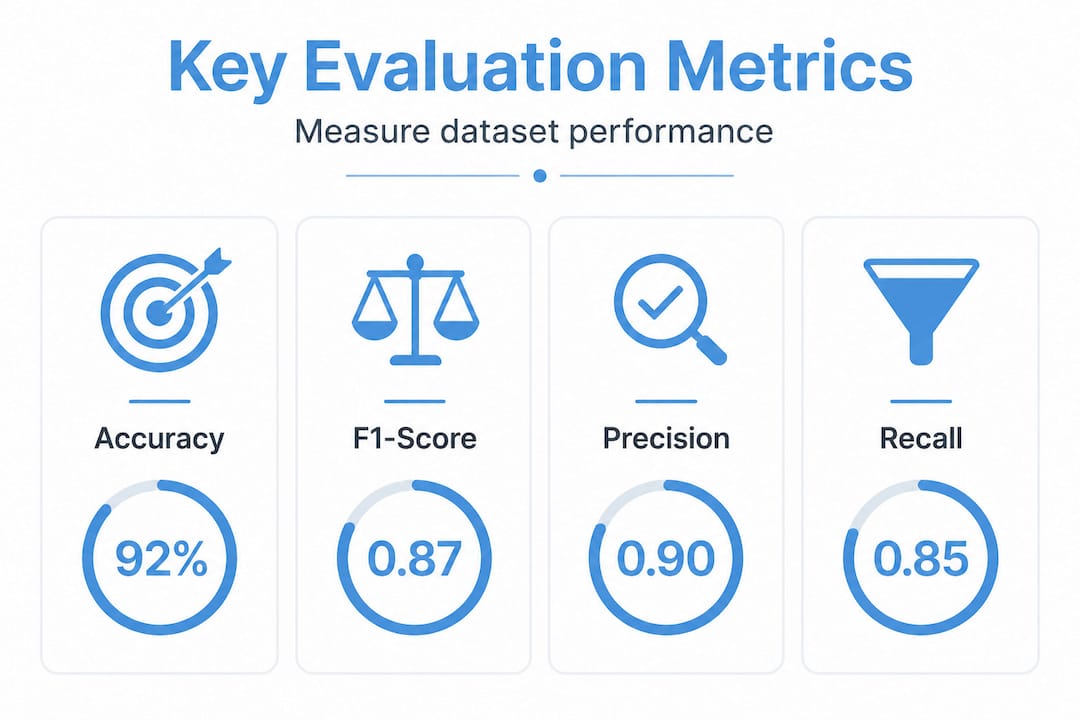
Accuracy is the most commonly reported metric, but it is the least informative for imbalanced datasets. Use F1-score when false negatives and false positives carry different costs. Use AUC-ROC when you need threshold-independent evaluation. G-mean is useful when both classes need to perform well simultaneously.
Dataset bias research confirms that overparameterization aids robustness only with proper balancing. Throwing a larger model at a poorly balanced dataset does not fix the underlying data problem. It often makes it worse by amplifying majority class patterns.
For model selection, classification benchmarks consistently favor Gradient Boosting over deep learning for tabular classification tasks. For images and text, transfer learning from large pretrained models like those trained on ImageNet outperforms training from scratch in most scenarios.
Iterative dataset optimization steps:
- Run ablation studies by removing feature groups and measuring performance impact
- Use error analysis on validation failures to identify systematic gaps in coverage
- Compare against open benchmark datasets to calibrate your dataset’s difficulty level
- Version your dataset explicitly so you can trace performance changes to specific data updates
The research dataset compilation and optimal structuring techniques guides provide additional frameworks for benchmarking your datasets against production requirements.
What most guides miss: The hidden costs of classification dataset shortcuts
Most dataset guides stop at best practices. They tell you to balance your classes, split carefully, and validate your labels. What they rarely address is what happens when these shortcuts compound quietly over time in a production system.
Label inconsistency is the silent killer. When annotation guidelines are vague or evolve without versioning, your dataset accumulates contradictory examples. The model learns noise as signal. You see this as a gradual, unexplained drift in production accuracy that is nearly impossible to debug without dataset-level auditing.
Hidden leakage is another common trap. It does not always look like a timestamp column bleeding into your features. Sometimes it is a surrogate ID field, a processing artifact, or a metadata field that correlates with the label for non-causal reasons. These produce benchmark scores that look excellent and production results that are embarrassing.
For vertical AI applications specifically, edge case coverage is often the difference between a product that works and one that fails your most important users. A fraud detection model trained on historical fraud patterns will miss novel fraud schemes. A medical classifier trained on one hospital’s patient population will underperform at another. Documenting your dataset’s coverage assumptions explicitly, not just its class distribution, is essential discipline.
AI dataset curation tips address some of these issues, but the real solution is building internal checklists for dataset versioning, labeling quality audits, and scenario coverage reviews. Treat your dataset as a living artifact with its own changelog, not a static file you hand off and forget.
Build and optimize your AI datasets with Dot Data Labs
If the challenges covered in this guide sound familiar, you are not alone. Most ML teams hit the same walls around labeling consistency, imbalance handling, and production-grade validation.

DOT Data Labs specializes in building production-ready datasets for AI startups and ML teams that need structured, validated classification data without managing a fragmented vendor chain. From raw data collection through annotation, quality validation, and delivery in model-ready formats, we handle the full pipeline. Whether you need a one-off custom classification dataset or an ongoing data pipeline, our optimized AI training sets are scoped to your exact specifications. Explore what Dot Data Labs can build for your team.
Frequently asked questions
What are typical examples of classification datasets?
Common examples include labeled image sets for cat vs dog detection, customer churn status, and sentiment classifications in text reviews. As defined in dataset for classification, these datasets pair input features with categorical target labels for supervised model training.
How do you split a classification dataset?
Most teams split datasets into training, validation, and test sets at an 80/10/10 or 70/15/15 ratio. Standard preparation methodologies recommend stratified splits to preserve class distribution across all three subsets.
What’s the best way to handle class imbalance?
Resampling methods like SMOTE or cost-sensitive learning often boost model performance when classes are imbalanced. Benchmarks show that these approaches consistently improve F1, G-mean, and AUC scores compared to training on raw imbalanced data.
How do you choose between Gradient Boosting and deep learning for classification?
Gradient Boosting generally excels on tabular data, while deep learning or transfer learning works better for images and text. Classification benchmarks consistently support this distinction across standard evaluation tasks.
Recommended
- Best practices for classification datasets: build better AI models
- Master the role of datasets in prediction for AI
- The true role of datasets in AI model success
- Machine-Ready Dataset Guide: Build Optimized AI Training Sets – Dot Data Labs – High-Quality Data for Training AI Models
- Machine learning models explained: 2026 guide for pros
- What Is AI Development? Meaning, Process & Benefits