
How to annotate datasets: a step-by-step guide for reliable AI

TL;DR:
- High-quality annotations are crucial as noise can reduce model accuracy by up to 35 percent.
- Clear guidelines, proper tools, role definitions, and ongoing QA ensure consistent, reliable datasets.
- Start with pilot batches, iterative improvements, and hybrid annotation methods to optimize speed and accuracy.
Poor annotation is a silent model killer. Research shows that annotation noise cuts model accuracy by up to 35% mAP, and that ceiling on performance is almost impossible to fix by tweaking architecture or training longer. For AI product managers and data scientists at startups, where every experiment cycle counts, annotation quality is the single most controllable lever you have. This guide walks through every stage of the annotation process: from pre-work and guideline creation through production workflows and QA. Follow it and you will build a repeatable system that produces reliable, training-ready data without wasting your team’s time or budget.
Key Takeaways
| Point | Details |
|---|---|
| Start with strong preparation | Define goals, tools, and guidelines before any data labeling begins. |
| Build clear annotation rules | Establish detailed, example-driven guidelines so all annotators are aligned. |
| Pilot, then scale up | Iterate on small batches and optimize the annotation process before large-scale efforts. |
| Verify and refine quality | Regularly measure and improve annotation accuracy using robust QA metrics. |
| Balance manual and automated | Combine expert and automated methods for efficient, high-quality dataset annotation at scale. |
What you need before you start annotating datasets
Skipping preparation is the fastest way to end up with a dataset you cannot use. Before a single label touches your data, you need clarity on what you are building, who is doing the work, and how success will be measured.
Define your task objective and success criteria first. What exactly will the model predict or classify? A named entity recognition task for medical text is fundamentally different from bounding box labeling for defect detection. Write down the expected model output, the minimum acceptable label quality score, and the downstream use case. This single document will save hours of rework later.
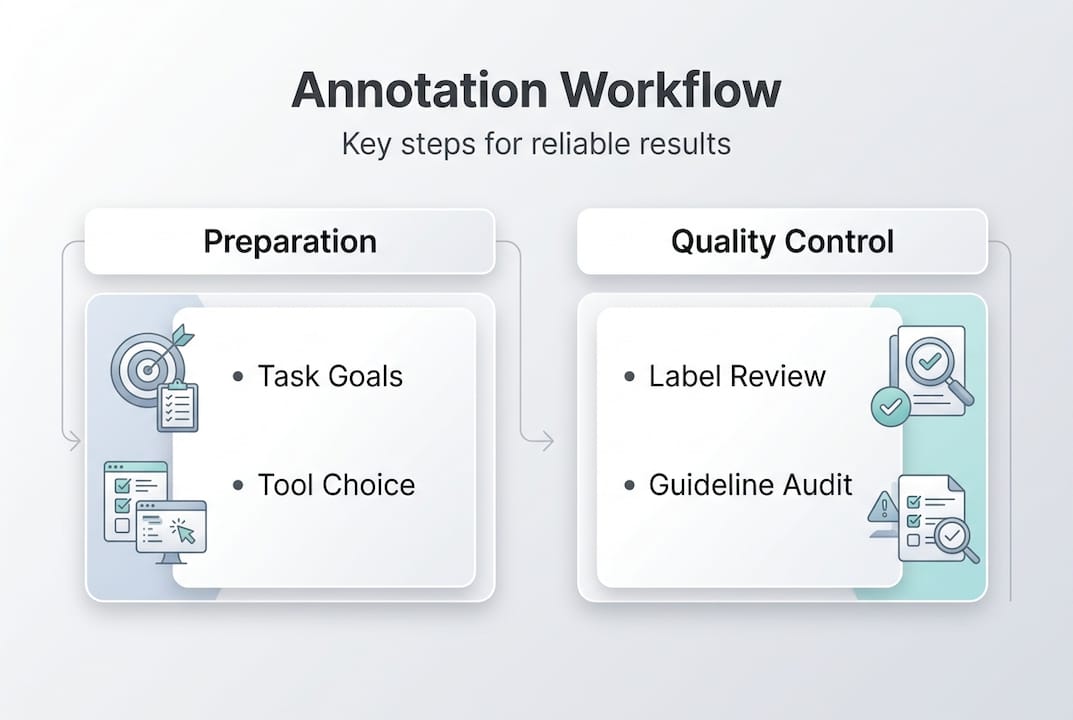
Inventory your raw data and select annotation tools. Audit what data you actually have: volume, format, and any existing partial labels. Then choose tooling that fits the task.
| Tool | Best for | Format support | Team features |
|---|---|---|---|
| Label Studio | Multi-modal tasks, flexibility | JSON, CSV, XML | Role-based access, review queues |
| Prodigy | NLP, active learning loops | JSON lines | Scriptable, fast iteration |
| Scale AI | High-volume, outsourced labeling | Custom | Managed workforce |
| CVAT | Computer vision, video | PASCAL VOC, COCO | Collaborative, open source |
| Labelbox | Enterprise pipelines | JSON, CSV | Analytics, model-assisted labeling |
Tool selection is not cosmetic. The wrong tool slows annotators down and introduces formatting errors that break your ingestion pipeline. If your output needs to be schema-consistent JSON for a RAG pipeline, verify the tool exports clean, nested JSON and not a flat CSV that you have to reparse.
Establish team roles before labeling begins. Every annotation project needs at least three distinct roles. Annotators apply labels. Reviewers validate a sample of that work. A curator owns the guideline document and resolves edge cases. In a small startup, one person may wear multiple hats, but the responsibilities must be clearly assigned. Ambiguous ownership is where consistency collapses.
Your team should also understand AI dataset trends shaping what kinds of structured data formats production models actually expect. This context helps annotators understand why precision matters, not just what to click.
Document your output format and label taxonomy early. Decide on your schema before annotation starts. Will you export JSON with nested entity spans? Will bounding boxes use COCO format or YOLO format? What are the exact class names? Consistent naming prevents silent taxonomy drift, where annotators use slightly different terms for the same class and you only catch it during model evaluation.
As a practical rule: detailed annotation guidelines should include class definitions, visual examples, edge case rules, and quality criteria to ensure consistency from day one. Write these before the first batch, not after.
- Define the annotation objective in one clear sentence
- List all class labels with exact naming conventions
- Specify output format and schema
- Assign annotator, reviewer, and curator roles
- Set minimum quality thresholds before starting pilot batches
How to develop robust annotation guidelines
Guidelines are your annotation system’s source of truth. A weak guideline document produces inconsistent labels even with experienced annotators. A strong one lets a new team member reach acceptable quality within hours.

Write class definitions that leave no room for interpretation. Each class label needs a formal description, at least two positive examples, and at least one negative example (what the class is NOT). For text classification, this might mean showing a sentence that is clearly sentiment negative, one that is borderline, and one that looks negative but is actually neutral sarcasm. For image tasks, visual examples are mandatory.
Anticipate edge cases and document them explicitly. Every dataset has ambiguous instances. The question is whether your guidelines handle them before your annotators encounter them cold. Run a small internal review of 50 to 100 raw samples before writing guidelines. This surfaces the actual hard cases: truncated entities, overlapping bounding boxes, low-quality images, ambiguous intent. Document each with a clear ruling and a rationale.
For example, if you are annotating product descriptions for an e-commerce classification model, what happens when a product spans two categories? Guidelines must answer: pick the primary category based on the first noun phrase, or flag for human review. Leaving it to annotator judgment means you get different answers from different people, which directly degrades label consistency.
Set pass/fail criteria for label quality. Annotators need to know what “good enough” looks like. Specify acceptable overlap thresholds for bounding boxes, permitted span boundary variance for text, and what triggers a rejection versus a correction. This removes the subjectivity that causes reviewer disagreements and makes QA faster and more objective.
Dataset curation tips and proper structuring of AI datasets are foundational to making these guidelines durable. Annotation guidelines do not live in isolation from schema design.
Sync with stakeholders before the pilot batch. Share the draft guideline with model engineers, domain experts, and any business stakeholders who will use model outputs. Catch misalignments early. A researcher who planned to use the model for clinical triage may have very different precision expectations than your guidelines currently reflect.
Pro Tip: Treat your annotation guidelines as a living document. After every pilot batch, schedule a 30-minute retrospective to identify recurring annotator mistakes and update the guidelines accordingly. Teams that iterate guidelines in the first two weeks of a project consistently produce more consistent datasets than those that lock guidelines early.
Run iterative improvements after every pilot. No guideline survives first contact with real data unchanged. Build in a formal revision cycle after pilot batches so the document reflects the actual distribution of your data, not just what you expected to see.
Step-by-step annotation workflow for startups
With solid guidelines in place, you can move into production annotation. The order of these steps matters. Jumping straight to full-scale labeling without a pilot is one of the most common and costly mistakes.
- Select a pilot batch of 100 to 200 samples. Choose samples that represent the real distribution of your data, including hard cases. Annotate them with your full team, then review all labels together as a group.
- Measure initial inter-annotator agreement. Before scaling, calculate agreement scores across annotators on the pilot batch. Low agreement signals a guideline problem, not an annotator problem.
- Revise guidelines based on pilot findings. Update edge case rules, add examples for problem classes, and clarify any pass/fail criteria that produced inconsistent results.
- Assign annotation tasks in structured batches. Break your full dataset into batches of 500 to 1,000 samples. Smaller batches let reviewers catch systematic errors before they propagate across the entire dataset.
- Route each batch through a review queue. Reviewers should sample at least 15 to 20% of each batch and flag errors for correction. Errors above a threshold trigger a full batch re-review.
- Log corrections and update guidelines continuously. Every correction is a signal. If reviewers are consistently fixing the same class of error, the guideline needs updating, not just the labels.
- Integrate active learning for smarter sampling. Use model predictions on unlabeled data to surface the samples your model is least confident about. Annotating those first accelerates learning more than random sampling.
| Approach | Best use case | Speed | Accuracy | Cost |
|---|---|---|---|---|
| Manual | High-stakes, nuanced tasks | Slow | High | High |
| Automated (rule-based) | Structured, repetitive patterns | Fast | Medium | Low |
| Weak supervision (Snorkel) | Large volume, noisy acceptable | Very fast | Lower | Very low |
| Hybrid (manual + automated) | Most production datasets | Medium | High | Medium |
Hybrid approaches, where weak supervision tools like Snorkel or synthetic data complement human annotation, consistently outperform purely manual or purely automated pipelines on production datasets. This is especially relevant when you are working at scale and cannot afford to hand-label every instance.
Keeping up with AI dataset trends for startups will help you decide which hybrid techniques make the most sense for your vertical.
Pro Tip: For binary classification tasks, keep labels simple: positive or negative, relevant or not relevant. Cognitive load compounds annotator fatigue. Every additional class you add beyond what the model strictly needs increases error rates measurably. Start binary, expand later.
How to ensure annotation quality: verification and best practices
Annotation without verification is not a dataset. It is noise at scale. QA is not a final checkpoint. It runs in parallel with annotation from day one.
Use inter-annotator agreement (IAA) metrics as your primary quality signal. The most widely used metrics are:
- Krippendorff’s Alpha: Works across any measurement scale. Target above 0.8 for high-confidence datasets.
- Cohen’s Kappa: Best for pairwise comparisons between two annotators.
- Intersection over Union (IoU): Standard for spatial annotation tasks like object detection. A minimum IoU of 0.5 is common, but 0.75 is better for medical imaging.
- Fleiss’s Kappa: Extends Cohen’s Kappa to three or more annotators simultaneously.
Inter-annotator agreement metrics, including Krippendorff’s Alpha above 0.8, Cohen’s Kappa, IoU for spatial tasks, and multi-stage review protocols, form the backbone of any serious annotation QA process.
Run spot checks and consensus reviews throughout the project, not just at the end. Sample 10 to 15% of completed annotations per batch. Have a second reviewer reclassify those samples independently and compare. Disagreements reveal systematic bias in a specific annotator or a specific class.
Annotation QA is not a final gate. It is a continuous feedback loop. The moment you treat it as a one-time check, error rates start to silently climb.
Deploy multi-stage review for high-stakes datasets. Stage one: annotators label. Stage two: reviewers validate a sample. Stage three: a domain expert audits the edge cases flagged by reviewers. This catches systemic errors that a single review layer misses.
Learn more about dataset labeling basics, dataset validation methods, and creating high-quality ML datasets to build out a complete validation strategy beyond annotation alone.
Refine guidelines whenever error trends appear. If the same class consistently generates disagreements across multiple batches, the guideline is insufficient. Update it, recheck recent batches for that class, and push a correction cycle before continuing forward.
- Set IAA thresholds before annotation starts, not after
- Sample review at least 15% per batch consistently
- Track error rates by class, not just overall
- Assign a guideline owner who responds to error trends within 24 hours
- Never mark a dataset complete without a final validation pass against schema
Why startups should obsess over annotation and data quality
Here is the uncomfortable reality most teams avoid confronting: model architecture is not your competitive advantage. Your data is. We have seen teams spend months tuning transformer architectures on the same dataset while competitors with simpler models trained on cleaner data consistently outperform them in production.
Data quality over architecture is the lesson embedded in the development of the top-performing LLMs, where curation discipline drives benchmark results far more than model size alone.
Startups have a structural disadvantage in compute and scale. But annotation discipline is equalizer territory. A 50,000-sample dataset with 95% label consistency will outperform a 200,000-sample dataset with 80% consistency on most classification and extraction tasks. More data does not fix noise. It amplifies it.
The iterative model matters too. One well-run annotation cycle with tight QA produces compounding returns: cleaner labels inform better models, better models produce better active learning signals, and those signals target the most valuable unlabeled samples next. Shortcuts break that loop. Small lapses in consistency compound into major reliability failures that are expensive to diagnose and even more expensive to fix at the model level.
Getting your attribute labeling strategies right from the start is part of this discipline. Annotation is not just about speed. It is about building a data flywheel that actually accelerates over time.
Accelerate dataset annotation with Dot Data Labs
Annotation done right is resource-intensive. Most startup teams are balancing model development, infrastructure, and product delivery at the same time. That is where the right dataset partner changes the equation.
At Dot Data Labs, we produce large-scale, structured, machine-ready datasets built specifically for LLM fine-tuning, RAG pipelines, classification models, and vertical AI systems. Our datasets arrive schema-consistent, labeled where required, and formatted for direct ingestion, so your team can focus on model development rather than data wrangling. Explore our production dataset structure documentation or read the machine-ready dataset guide to see exactly how we optimize datasets for training-ready use at scale.
Frequently asked questions
What annotation tools are best for startups?
Popular annotation tools for startups include Label Studio, Prodigy, and Scale AI, each offering workflow customization, team management features, and support for multiple data formats and modalities.
How do you handle ambiguous annotation cases?
Write explicit edge case rules into your annotation guidelines before labeling begins, and update those rules as new ambiguous cases surface throughout the project to keep consistency across the full team.
How can startups scale their annotation efforts efficiently?
Use hybrid methods that combine manual review for accuracy-critical tasks with automated and weak supervision approaches for high-volume, lower-stakes labeling to balance speed and quality.
What minimum quality targets are ideal for inter-annotator agreement?
Aim for Krippendorff’s Alpha above 0.8, which signals strong label consistency, and supplement with Cohen’s Kappa or IoU depending on whether your task is categorical or spatial.
When should you update annotation guidelines during a project?
Update your annotation guidelines after every pilot batch and whenever QA reviews reveal a consistent error pattern tied to a specific class or ambiguous case category.